Document search for consultants: find that old client deck fast
Free to try (1 folder, 200 files) · US$14.99 to keep · Mac & Windows
You know the deck exists. You built it two engagements ago — the one with the clean market-sizing slide and the maturity model your client loved. But it lives somewhere across thousands of files: a folder named after a client code, a proposal draft, an email attachment you saved and forgot. You can picture the content. You cannot remember the filename.
This is the daily reality of consulting work, and it is exactly what filename-based search fails at. This article looks at how document search for consultants should actually work: searching by meaning across your entire archive, fast, and without sending a single confidential file to the cloud.
Why finding old work is a consulting problem, not a filing problem
Every consultant accumulates an archive: proposals, pitch decks, workshop outputs, benchmarking research, financial models, interview notes. Over a few years that becomes thousands of files spread across client folders, a Downloads directory, a synced drive, and the occasional scanned handout.
The usual advice is to organize better — cleaner folders, stricter naming conventions. That helps at the margin, but it does not solve the core issue. When you go looking for something, you rarely remember the name you gave it. You remember the substance:
- the slide that framed operating model options as a 2x2
- the proposal where we scoped a supply-chain diagnostic for a mid-market retailer
- the research summary on switching costs in B2B SaaS
None of those descriptions match a filename. So keyword and folder search send you clicking through directories, opening files to check, and eventually rebuilding something you already made. The problem is not your filing. It is that your tools search labels, not meaning.
Keyword search vs. searching by meaning
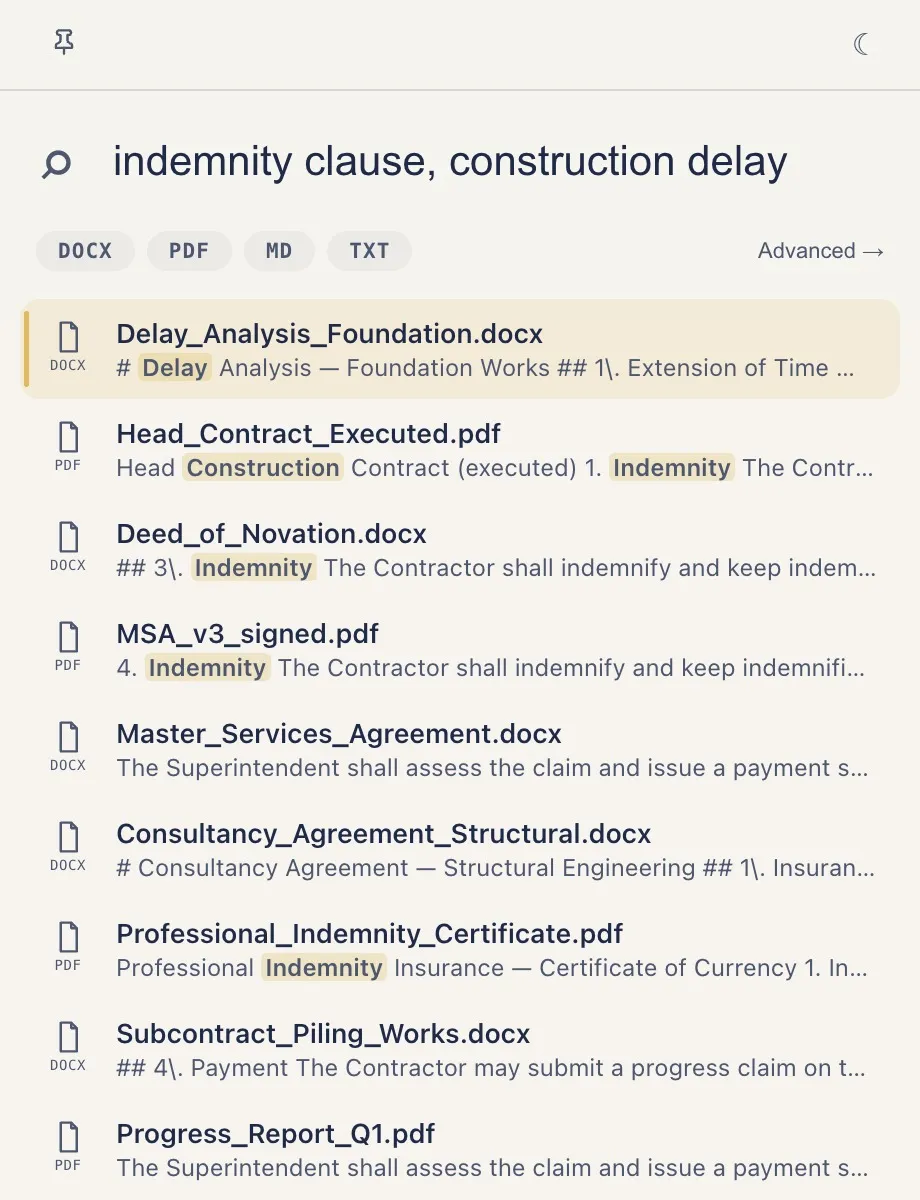
Standard desktop search matches the exact words in your query against the exact words in a file's name or text. If you search "customer churn," a document that only ever says "client attrition" or "logo loss" will not surface — even though it is precisely what you wanted.
Semantic search works differently. It represents the meaning of your query and compares it to the meaning of your documents, so related concepts match even when the words differ. Type what you remember in plain language and the relevant file comes back near the top.
We cover the mechanics in more detail in semantic search vs keyword search for documents, but the practical upshot for consultants is simple: you can describe the deck you're thinking of the way you'd describe it to a colleague, and let the search do the reconciling. It is closer to searching documents by meaning, not filename — which is how your memory actually stores your past work.
The confidentiality catch with cloud search tools
Plenty of tools promise smarter search, but most achieve it by uploading your files to a server to be indexed and processed. For a consultant, that is often a non-starter.
Your archive contains client-confidential material: NDA-covered strategy work, financials, internal org details, unpublished research. Many engagement contracts explicitly restrict where that data can be stored and prohibit sending it to third-party services. Even where it is technically allowed, uploading a client's confidential deck to an AI service to make it searchable is a risk most independent and firm-based consultants would rather not take on.
The safe answer is a tool that never moves your files at all. Everything — indexing, understanding, and search — should happen on your own machine. That is the difference between convenient and defensible when a client asks where their data lives.
How Fossick fits a consulting workflow
Fossick is a desktop app for Windows and Mac that searches your local documents by meaning, entirely offline. You point it at the folders where your work lives, it builds an index on your own device, and then you search in plain language.
A few things make it a natural fit for consulting archives:
- It searches by meaning. Describe the deck, proposal, or research note you half-remember, and Fossick surfaces the closest matches even if your exact words never appear in the file.
- It reads scanned material. Handouts, signed SOWs, and printed research you scanned are covered — Fossick runs OCR on scanned PDFs and images on-device, so the text inside them becomes searchable too.
- It handles the formats you actually use. PDFs, Word documents, plain text, and more, across as many client folders as you have.
One important boundary: Fossick is search, not chat. It does not summarize documents, answer questions, or generate anything. There is no large language model writing responses. It finds the right file and takes you to it — then you do the thinking. For confidential work, that narrower scope is a feature: nothing is being paraphrased or interpreted by an AI you can't audit.
Offline as the trust proof
The clearest way to verify a search tool never uploads your files is to unplug the internet and watch it keep working. With Fossick, indexing and search run fully on-device, so it does exactly that — Wi-Fi off, and your entire archive is still searchable.
That design is the whole point of offline document search: your documents never leave your machine, so there is no server holding your clients' data, no account tied to their files, and nothing to breach. The only time Fossick touches the internet is for licensing and billing — never for your documents.
This matters practically as well as legally. Consultants work on planes, in client offices behind restrictive firewalls, and in hotel rooms with unreliable connections. A tool that depends on the cloud fails exactly when you need to pull up a reference in front of a client. An offline tool does not.
Getting started without disrupting your files
Adopting a new search tool should not mean reorganizing years of work. Fossick reads your existing folder structure as-is — you keep your files where they are and simply let the app index them.
A sensible first run:
- Point Fossick at your main client-work folder and let it build the index. Larger archives take longer the first time, then stay current.
- Run a few searches the way you'd describe past work to a colleague — "pricing strategy deck for a subscription business," not a guessed filename.
- Add your Downloads folder and any scanned-document directory, since that's where stray-but-valuable files tend to accumulate.
Fossick is a one-time US$14.99 purchase with a 14-day money-back guarantee, so you can test it against your own archive before deciding anything. If it earns a place in your workflow, the pricing page confirms the one-time US$14.99 price, which includes the full app. You can download it here to see how it handles your real files.
Frequently asked questions
Does Fossick upload my client documents to search them?
No. Indexing, embedding, and search all run locally on your own computer. Your documents are never uploaded to any server. You can disconnect from the internet entirely and Fossick still works — that offline behavior is the proof that your files stay on your machine.
Can Fossick find text inside scanned PDFs and images?
Yes. Fossick runs OCR on scanned PDFs and image files like PNG and JPG automatically, on-device, so the text inside them becomes searchable. That covers scanned handouts, signed SOWs, and printed research you saved as images.
Is Fossick an AI chatbot that answers questions about my documents?
No. Fossick is search, not chat. It finds and takes you to the right file based on meaning, but it does not summarize, answer questions, or generate text. There is no large language model involved in searching your files — you do the reading and the analysis.
How is this different from the search built into Windows or my cloud drive?
Built-in search mostly matches filenames and exact keywords, so it misses documents when you can't remember the name or used different wording. Fossick searches by meaning, so you can describe the content you recall and still find the file. For more, see our Windows search alternative and local alternative to Google Drive search articles.
What does Fossick cost for an individual consultant?
It is a one-time US$14.99 purchase with a 14-day money-back guarantee, so you can test it against your own archive first. If you keep it, there is a single one-time purchase of US$14.99, which includes the full app and all future updates. Details are on the pricing page.