Full-text search vs semantic search for a document folder
Free to try (1 folder, 200 files) · US$14.99 to keep · Mac & Windows
You know the document exists. You just can't find it. You type the phrase you're sure was in it, and your search tool returns nothing — or ten wrong files. The problem usually isn't your memory. It's that most desktop tools do full-text search, and full-text search only finds the exact words you type.
This article breaks down full-text search vs semantic search for an ordinary folder of PDFs and Word docs: how each one actually works, where full-text is faster and better, and why semantic search catches the things full-text quietly skips.
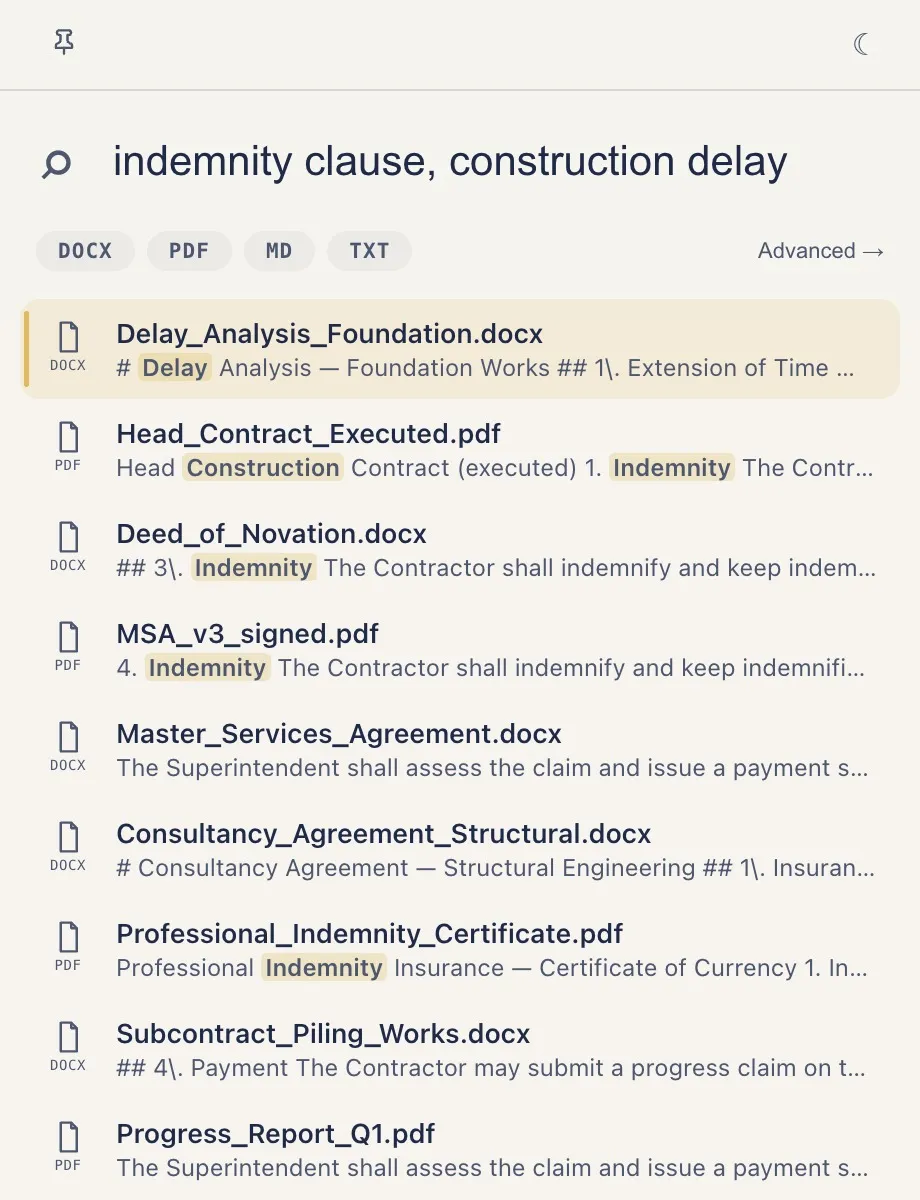
What full-text search actually does
Full-text search builds an inverted index: a map from every word in your documents to the files that contain it. When you type a query, it looks up those exact tokens and ranks results by how often and where they appear.
This is the model behind most desktop search, including the search box in Windows Explorer, grep, and classic tools like Copernic. It's fast, predictable, and precise. If a file literally contains the string you typed, full-text will find it.
The limitation is baked into the design: it matches strings, not ideas. Some common failure modes:
- You search termination clause but the contract says notice of cancellation.
- You search layoffs but the memo says workforce reduction.
- You misremember one word in a three-word phrase and get zero hits.
- The document is a scanned PDF with no text layer, so there's nothing to index at all.
Stemming and synonym lists patch a few of these, but they're brittle. You still have to guess the author's vocabulary.
What semantic search does differently
Semantic search doesn't index words — it indexes meaning. Each chunk of text is converted into a numeric vector (an embedding) that captures its conceptual content. Your query becomes a vector too, and the tool returns the passages whose vectors sit closest to it.
The practical result: you can describe what a document was about and get it back, even if you don't share a single word with the text. Search the agreement about ending the vendor relationship early and a semantic engine can surface a contract whose actual heading is Early Termination for Convenience — no keyword overlap required.
This is why semantic search shines when memory is fuzzy. You remember the topic, the situation, roughly what was said. You don't remember the exact phrasing the writer used two years ago. We cover the intuition in more depth in semantic search vs keyword search for documents.
One clarification for technical readers: semantic search is retrieval, not generation. It finds and ranks your real files. It does not write summaries or answer questions — there's no language model composing prose in the middle.
When full-text wins
Semantic search is not a universal upgrade. Full-text is genuinely better when you already know the exact string you're looking for:
- Identifiers and codes. Invoice
INV-20293, case number, part number, a specific error string. You want that literal token, ranked by exact match. - Rare proper nouns. A surname or product name that appears in only a handful of files.
- Boolean precision. "This word AND that word, but NOT the third" is a keyword operation.
- Verbatim quotes. When you need the one file containing an exact sentence.
In these cases, meaning is a distraction — you don't want conceptually similar results, you want the string. A good tool keeps literal matching available so you're not forced to choose the wrong mode for the job.
When semantic search wins
Semantic search earns its place the moment your recall gets vague. The typical scenarios:
- You remember the idea, not the words. The report that argued we should delay the launch — you never used the word "delay" in the query and it still lands.
- Vocabulary drifts across authors. Different consultants, engineers, or lawyers describe the same concept differently. Meaning-based matching bridges that gap.
- Cross-topic connections. Passages about the same underlying issue cluster together even when the terminology diverges.
- You're searching thousands of files and can't remember which one, let alone what it was called. See how to find a document you can't remember the name of.
This is the everyday knowledge-worker case. Most of the time you don't recall an exact string — you recall what the thing was about, and full-text penalises you for that.
You shouldn't have to pick one
Framed as a contest, "full-text search vs semantic search" is misleading. They solve different problems, and a mature tool offers both: literal matching when you know the exact term, meaning-based matching when you don't. The reader shouldn't have to think about which index is running — just type and get the right file.
That's the design behind Fossick, a desktop app that searches your local documents by meaning, entirely offline. It builds a semantic index of your folder so you can search by what a document was about, while still handling the exact-string cases you'd expect from ordinary search. You can see the broader approach on the Fossick homepage.
Because the goal is finding your files, Fossick is search, not chat. There is no generative AI answering questions and no chatbot inventing text — it points you to the real documents and lets you open them.
Where the files live matters as much as the algorithm
For professionals with confidential material — lawyers, accountants, consultants, engineers — the search method is only half the decision. The other half is where the indexing happens.
Many cloud search products send your documents to a server to embed and index them. That's a hard sell when the folder holds client files, case records, or unreleased engineering specs. Semantic search does not require the cloud; the embeddings can be computed on your own machine.
Fossick does exactly that. Indexing, embedding, and search all run on-device. Documents are never uploaded — the app works with the Wi-Fi unplugged, which is the simplest way to prove nothing is leaving your computer. Only licensing checks ever touch the internet. It also runs OCR on scanned PDFs and images locally, so those previously unsearchable files finally join the index; there's more in how to search scanned PDFs and images locally with OCR.
Fossick runs on Windows and Mac. You can download it and try it on your own folder, and the pricing page lists the one-time US$14.99 price.
Frequently asked questions
Is semantic search always better than full-text search?
No. Full-text search is better when you know the exact string you want — an invoice number, a citation, a specific error code. Semantic search is better when you remember what a document was about but not the precise words it used. The ideal tool supports both so you can match the mode to the task.
Does semantic search need an internet connection or the cloud?
Not inherently. The embeddings that power semantic search can be computed locally on your own machine. Fossick does exactly this — indexing, embedding, and search all run on-device, and your documents are never uploaded, so it works even with Wi-Fi disabled.
Does semantic search use AI to answer my questions?
Fossick's semantic search is retrieval, not generation. It finds and ranks the real files that match the meaning of your query and opens the ones you choose. There is no chatbot writing summaries or answers — it points you to your own documents rather than composing new text.
Can semantic search find text inside scanned PDFs and images?
Only if the text is extracted first. Fossick runs OCR on scanned PDFs and image files (like PNG and JPG) automatically and on-device, then indexes that recognised text so it becomes searchable by meaning alongside your regular documents.
Do I have to choose between finding files by keyword and by meaning?
You shouldn't have to. Keyword matching is best for exact strings and meaning-based matching is best for fuzzy recall, and both are useful on the same folder. Fossick is built around semantic search while still letting you fall back to literal matching when you need precision.