Is It Safe to Search Your Documents With AI? On-Device vs Cloud
Free to try (1 folder, 200 files) · US$14.99 to keep · Mac & Windows
If you handle confidential files — client matters, contracts, financials, research — the question isn't whether AI search is useful. It clearly is. The question is whether it's safe: what actually happens to your documents when a tool searches them by meaning.
The honest answer is it depends entirely on where the work happens. Most "AI search" tools send your files to a server. Some don't. This article breaks down the real risk — upload versus on-device — so you can get intelligent, meaning-based search without your documents ever leaving your machine.
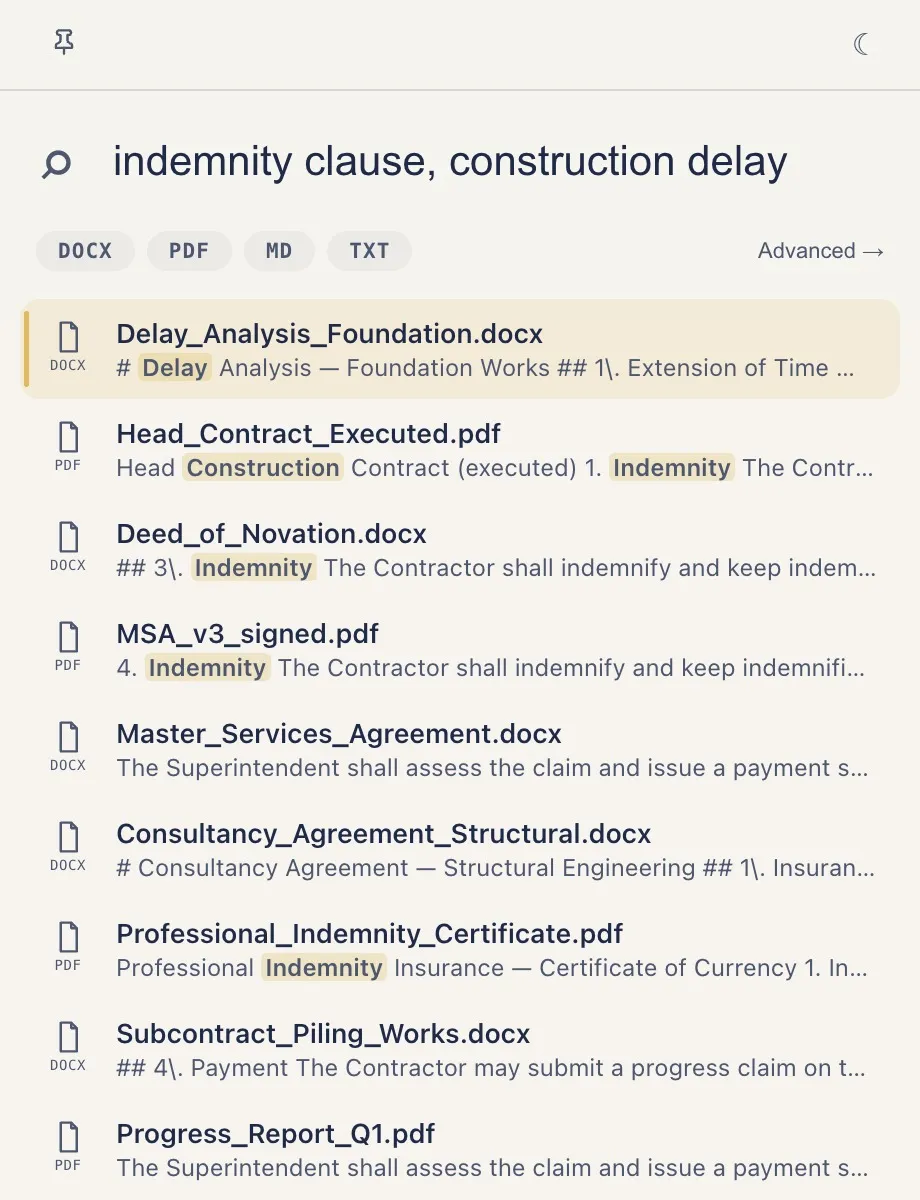
What people actually mean by "AI search"
When someone says they want to search documents with AI, they usually mean semantic search: type what you remember about a file — a concept, a phrase, the gist — and get the right document back, even if you can't recall the filename or the exact words inside it.
That's a genuine step up from old keyword search, which only matches literal strings. If you search "termination clause" but the document says "grounds for ending the agreement," keyword search misses it. Meaning-based search doesn't. (We cover this distinction in depth in semantic search vs keyword search.)
Crucially, search is not the same as chat. A chatbot generates new text — a summary, an answer, a draft. Semantic search just finds and ranks your existing files. That difference matters a lot for safety, because generating answers usually requires sending your content somewhere it can be processed by a large model.
Where the real risk lives: upload vs on-device
The safety of searching documents with AI comes down to one architectural choice.
Cloud tools upload your files
Most web-based AI search and chat tools require your documents to leave your device. That typically means:
- Your files travel across the internet to a third-party server.
- Copies are stored — sometimes temporarily, sometimes indefinitely — outside your control.
- Content may be logged, cached, or used to improve models, depending on the terms.
- You're now trusting the vendor's security, breach history, and jurisdiction with privileged material.
For a lawyer, accountant, or consultant, that's not a hypothetical. Uploading a client file to an outside service can create confidentiality, privilege, and regulatory exposure before you've searched a single word.
On-device tools keep files put
On-device (offline) search does the same meaning-based matching, but the processing happens on your own computer. Indexing, the embedding step that captures meaning, and the search itself all run locally. Nothing is uploaded. The safest document is the one that never left the building.
How on-device semantic search works without the cloud
It's reasonable to assume that "smart" search needs a server. It doesn't anymore. Modern embedding models are small enough to run on ordinary laptops.
Here's the flow, all on your machine:
- The app reads your documents and converts each passage into a mathematical representation of its meaning (an embedding).
- Those embeddings are stored in a local index on your disk.
- When you search, your query is turned into the same kind of representation and matched against the index.
- You get ranked results pointing to your own files.
No step requires the internet. This is exactly how offline document search is designed to work — the intelligence is in the model on your device, not in a distant server.
How to verify a tool is actually private
Vendors say "secure" and "private" freely. Treat those words as claims to test, not facts. A few concrete checks:
- Pull the network cable. If the search still indexes and returns results with Wi-Fi off, files aren't being uploaded. This is the single clearest proof.
- Read what touches the internet. A trustworthy offline tool is explicit that only licensing or billing contacts a server — never your documents.
- Confirm it's search, not chat. If the tool generates answers or summaries, ask where that generation happens. Answer-generation usually implies a model that needs your content.
- Check where the index lives. It should be a local file on your own disk, not a synced cloud store.
If a product can't survive the offline test, your documents are leaving your device — regardless of the marketing. For a deeper walkthrough aimed at sensitive files, see private document search.
Getting AI-quality results without sending files anywhere
This is where an offline-first tool fits. Fossick is a desktop app for Windows and Mac that searches your local documents by meaning, entirely offline. You type what you remember; it finds the file — without uploading anything.
What it is:
- On-device semantic search. Indexing, embedding, and search all run locally. Documents are never uploaded, and it works with the Wi-Fi unplugged.
- Broad format support. PDFs, Word documents, text, and more. It runs OCR on scanned PDFs and images automatically, on-device, so even scans become searchable.
- Built for confidential work. It's used the way lawyers search case files by meaning without exposing privileged material.
What it is not, so there's no confusion:
- It is search, not chat. There is no chatbot, no generative AI, and no cloud account for your files. It finds your documents; it does not summarise or answer questions about them.
That narrower scope is a feature, not a limitation. Because there's no answer-generation, there's no reason for your content to leave the device at all. You can download it and confirm the offline behavior yourself.
So — is it safe to search documents with AI?
Yes, if the AI runs where your files already are.
The danger was never the intelligence. It was the upload. Meaning-based search is now safe to use on confidential documents precisely because it no longer has to depend on the cloud. Choose an on-device tool, verify it with the network unplugged, and confirm it's doing search rather than generating answers.
Fossick is a one-time US$14.99 purchase with a 14-day money-back guarantee, so you can test the offline claim on your own machine before deciding — see pricing for the details; it is one payment, with no subscription. The right test isn't reading a privacy policy; it's watching real, meaning-based search work with the internet turned off.
Frequently asked questions
Does searching documents with AI mean my files get uploaded?
With most cloud-based AI tools, yes — your documents are sent to a third-party server to be processed. But on-device tools do the same meaning-based search locally, so nothing is uploaded. The determining factor is the architecture, not the word "AI."
Is on-device AI search as good as cloud search?
For finding your own files by meaning, yes. The embedding models that power semantic search now run well on ordinary laptops, so you get intelligent, concept-based results without a server. The main thing you give up is answer-generation, which is a separate feature (chat) rather than search.
How can I prove a search tool isn't sending my documents anywhere?
Disconnect from the internet and try to index and search. If it works fully offline, your files aren't being uploaded. A trustworthy offline tool will also state plainly that only licensing or billing ever touches the network — never your documents.
Is Fossick a chatbot that answers questions about my documents?
No. Fossick is search, not chat. It has no generative AI and does not summarise or answer questions — it finds and ranks your existing files by meaning. That deliberate scope is why your content never needs to leave your device.
Can it search scanned PDFs and images too?
Yes. Fossick runs OCR on scanned PDFs and images (PNG, JPG, and similar) automatically and on-device, so text trapped in scans becomes searchable by meaning. Like everything else, that processing happens locally with no upload.