Offline Search for Engineers' Technical Documentation
Free to try (1 folder, 200 files) · US$14.99 to keep · Mac & Windows
Engineering knowledge lives in files: datasheets, revision-controlled specs, IEC and ISO standards, test reports, and thick PDFs full of tables. The problem is rarely that the document is missing. It is that you cannot remember the filename, the part number, or which folder you filed it in three projects ago.
This article is about offline search for engineers — how to find technical documents by what they mean rather than by exact keywords, on a machine that can stay air-gapped. No cloud accounts, no uploads, no data leaving your workstation.
Why keyword search fails on technical documents
Traditional desktop and file-manager search matches strings. That works when you remember the exact wording, but engineering documents are the worst case for it:
- The same component is called a buck converter, a step-down regulator, and DC-DC across three vendors' datasheets.
- Standards are cited by number in one file and by title in another.
- The paragraph you need uses thermal derating while your memory says temperature limit.
Keyword tools also miss anything locked inside a scanned drawing or a photographed nameplate. If the text is not selectable, a string search sees nothing.
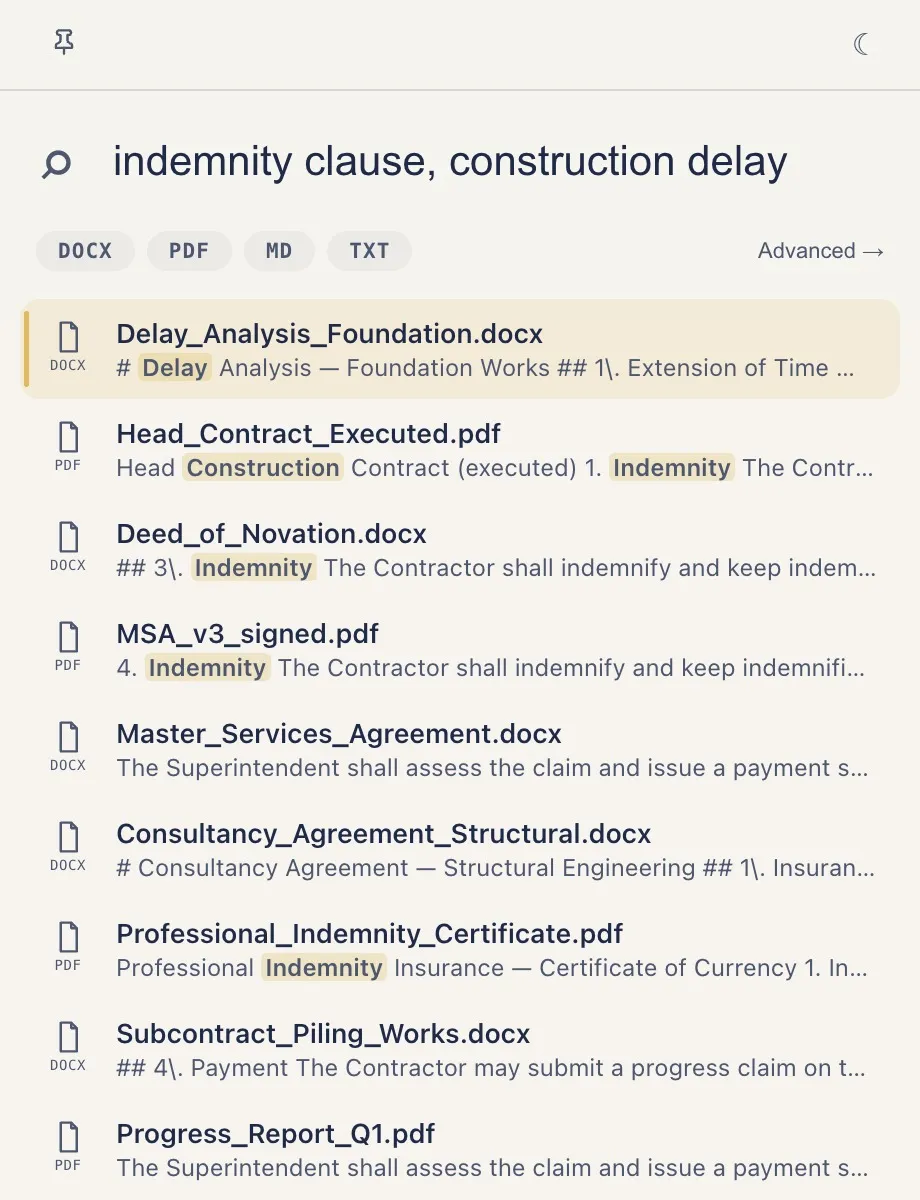
Semantic search takes a different approach: it represents the meaning of your query and each passage, then ranks documents by conceptual similarity. You type what you remember — "regulator that overheated above 60 degrees in the bench report" — and the relevant file surfaces even if none of those exact words appear. We cover the mechanics in semantic search vs keyword search for documents.
What "offline" really has to mean for engineering files
Engineering documentation is often under NDA, export-controlled, or tied to unreleased products. For a lot of teams, the search tool has to satisfy a simple test: it must keep working with the network cable unplugged, and nothing may be transmitted.
Many "AI search" products fail that test quietly. They index locally but send your query — and sometimes document snippets — to a server for embedding or answering. On an air-gapped or restricted machine, that is either a policy violation or a feature that simply does not function.
True offline search means three things happen on your own hardware:
- Indexing — reading and parsing your files.
- Embedding — turning text into the vectors that power meaning-based matching.
- Querying — running your search against that local index.
When all three are local, you can verify it yourself: disconnect from the network and confirm search still works. That is the core design of offline document search done properly.
Searching datasheets, standards, and reports by meaning
A working engineer's archive is heterogeneous. A single project might mix vendor PDFs, Word specs, exported test logs, and scanned approvals. Meaning-based search is useful precisely because it spans that variety without you maintaining tags or a naming convention.
Typical queries that keyword tools struggle with but semantic search handles well:
- "the connector with the locking latch rated for 500 mating cycles"
- "vibration test that failed at the second resonance"
- "the standard that defines the creepage distance for that voltage class"
- "supplier quote where the lead time jumped to 26 weeks"
You are describing the idea of the document. The tool ranks candidates and shows you the passages that match, so you can jump straight to the relevant page instead of reopening a dozen PDFs.
This is also how you recover work when your memory of the filename is gone entirely — the situation described in how to find a document you can't remember the name of.
Scanned drawings and photos: on-device OCR
A large share of engineering documentation is not born-digital. Legacy drawings, marked-up redlines, signed approvals, equipment nameplates, and site photos are images. Their text is invisible to ordinary search.
Optical character recognition (OCR) converts those images into searchable text. The important detail for confidential work is where the OCR runs. Cloud OCR uploads the image — a non-starter for controlled documents. On-device OCR keeps the file on your machine.
Fossick, a desktop app that searches your local documents by meaning, entirely offline, runs OCR automatically on scanned PDFs and image files (PNG, JPG, and similar) as it indexes. That means a photographed rating plate or a scanned test certificate becomes findable alongside your native PDFs and Word specs, without a separate step. There is more detail in how to search scanned PDFs and images locally with OCR.
Search, not chat — and why that matters for engineers
There is a lot of pressure right now to bolt a chatbot onto every tool. For technical documentation, a generative answer is often the wrong thing. If a model paraphrases a torque spec or a tolerance and gets a digit wrong, that error can propagate into real hardware.
Fossick is deliberately search, not chat. It does not summarise, it does not answer questions, and it contains no generative AI. It finds and ranks your documents and shows you the actual passages, so you read the authoritative source and decide. The engineering judgment stays with the engineer.
That also keeps the trust model simple. Because there is no model generating text about your files and no cloud service processing them, the only thing that ever touches the internet is licensing. Your datasheets, specs, and reports stay on disk. You can read more about that stance in private document search.
Fitting it into an engineering workflow
Getting started is intentionally low-friction:
- Point the app at the folders where your documentation lives — project directories, a standards library, vendor datasheet archives.
- Let it index and embed locally. OCR runs automatically on anything scanned.
- Search in plain language and open the matching passage.
Because the index is local, it also works on a laptop in the field, on a machine inside a restricted network, or on a fully air-gapped workstation. You can install it from the download page and confirm the offline behaviour yourself by cutting the network.
Fossick is a one-time US$14.99 purchase and includes the full application and all updates — details are on the pricing page. The point of offline search for engineers is not to replace your judgment; it is to put the right document in front of you in seconds so you can get on with the actual work.
Frequently asked questions
Does Fossick work on an air-gapped machine?
Yes. Indexing, embedding, and search all run on your device, so the app functions with the network disconnected. You can verify this by unplugging Wi-Fi or Ethernet and confirming that search still returns results. Only licensing checks ever use the internet.
Can it search scanned datasheets and drawings?
Yes. Fossick runs OCR automatically on scanned PDFs and image files such as PNG and JPG during indexing, all on-device. That makes text inside scanned drawings, nameplates, and certificates searchable alongside your native PDFs and Word documents.
Is this an AI assistant that answers engineering questions?
No. Fossick is semantic search, not chat. It has no generative AI and does not summarise, paraphrase, or answer questions. It finds and ranks your own documents and shows you the matching passages, so you always read the authoritative source yourself.
What file types can engineers search?
It handles PDFs, Word documents, plain text, and more, plus scanned PDFs and images via automatic OCR. That covers most of a typical engineering archive: vendor datasheets, specification documents, standards, test reports, and photographed or scanned records.
How is meaning-based search different from my file manager's search?
File-manager search matches exact strings in filenames or text, so it misses synonyms, alternate part names, and anything inside a scanned image. Semantic search ranks documents by conceptual similarity, so you can describe what you remember and still find the file even if the exact words differ.