How Accountants Can Search Client Records Privately
Free to try (1 folder, 200 files) · US$14.99 to keep · Mac & Windows
Every accounting practice sits on a mountain of documents: bank statements, prior-year returns, trial balances, receipts, engagement letters, and workpapers going back years. When a client calls with a question, the answer is almost always somewhere in that pile. The problem is finding it fast without exposing confidential data.
Traditional file search fails accountants twice. It only matches exact filenames and keywords, so it misses documents when you can't recall how a file was named. And most "smart" search tools want to upload your files to the cloud — a non-starter when you hold client financial records. This article covers how document search for accountants can work by meaning instead of filename, while every file stays on your own machine.
Why filename search fails at tax time
Accountants rarely remember what a file was called. You remember the substance: "the client who restructured as an S-corp last spring," "the property sale with the deferred gain," or "the invoice that flagged the sales-tax question."
But most search tools only match the exact letters in a filename or, at best, exact words inside the text. Search for "vehicle depreciation" and you'll miss a workpaper that says "Section 179 auto write-off." The document is right there — the words just don't line up.
This is the core weakness of keyword matching. If you'd like the longer explanation, we cover it in semantic search vs keyword search for documents. The short version: keyword search asks "which files contain these exact letters?" Semantic search asks "which files are about this?"
Search by meaning, not exact terms
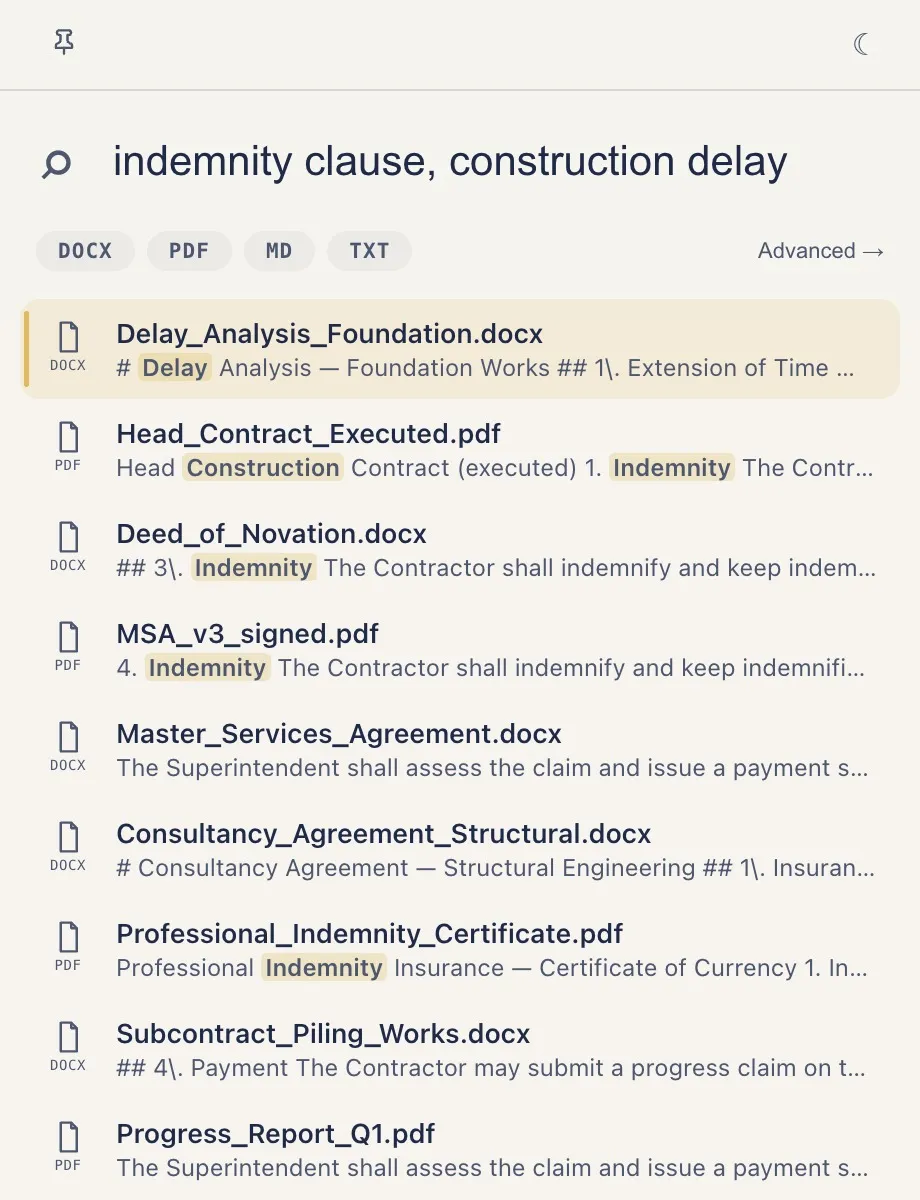
Semantic search reads the meaning of your query and the meaning of your documents, then matches them even when the vocabulary differs. You type what you remember in plain language and get the right file back.
For an accounting practice, that changes day-to-day retrieval:
- Type "client asked about home office deduction" and find the email note or memo, even if the file says "business-use-of-home worksheet."
- Type "prior year loss carryforward" and surface the return schedule that never used those exact words.
- Type "bank reconciliation discrepancy Q3" and find the workpaper regardless of how you filed it.
You're describing the concept, not guessing the filename. For a deeper look at this approach, see how to find a document you can't remember the name of.
Why client data has to stay on your machine
Accountants hold some of the most sensitive data a person owns: Social Security numbers, income, account balances, business financials. Professional standards and privacy laws expect you to protect it, and clients assume you will.
That is exactly where cloud-based search and AI tools become a liability. Many of them work by uploading your documents to a remote server to index them. For confidential financial records, that upload is the risk — regardless of the vendor's promises.
The reliable way to avoid that risk is simple: don't send the files anywhere. Search that runs entirely on-device keeps every statement and return on your own hard drive. We explain the general principle in private document search: find files without a data risk.
If a search tool needs an internet connection to read your files, your client data is leaving the building. The safest tool is one that works with the Wi-Fi unplugged.
Where Fossick fits
Fossick is a desktop app for Windows and Mac that searches your local documents by meaning, entirely offline. Indexing, the semantic model, and every search run on your own computer. Your files are never uploaded — you can literally disconnect from the network and it still works. Only licensing and billing ever touch the internet.
A few points that matter for an accounting practice:
- It handles the formats you actually use — PDFs, Word documents, plain text, and more.
- It runs OCR automatically on scanned PDFs and image files, so a photographed receipt or an imaged bank statement becomes searchable by its content. More on that in searching scanned PDFs and images locally with OCR.
- It searches across thousands of files at once, so a whole client folder or an entire archive year is one query away.
It is worth being clear about what Fossick is not. It is search, not chat. There is no chatbot, no generative AI, and it does not summarise returns or answer tax questions. It finds the right document and puts it in front of you — the analysis stays with you, the professional.
A practical way to organise the search
You don't need to reorganise your file system to benefit. Point the app at your existing client folders and let it index them in place.
A workflow that works well for practices:
- Index by engagement or year. Keep your current folder structure; Fossick reads it as-is.
- Search in the client's language. When someone calls, type what they said, not what you filed it under.
- Rely on OCR for the paper trail. Scanned receipts, mailed statements, and imaged K-1s all become findable by content.
- Re-index periodically. As new documents land during busy season, keep the index current so nothing goes missing.
Because everything is local, there is no per-file upload wait and no account for your documents to live behind. The index sits on your machine alongside the files it describes.
Trying it in your practice
The honest way to evaluate any tool that touches client data is to test it on your own files, offline. Download it, unplug the network, point it at a folder of prior-year workpapers, and search the way you'd describe a document to a colleague.
Fossick is a one-time download with no cloud account for your files. It is a one-time US$14.99 purchase with a 14-day money-back guarantee, and the price is a single payment — no subscription, and it includes the full app.
If you're weighing it against other desktop tools, our comparison pieces on a Copernic desktop search alternative and a Windows search alternative that actually finds docs may help frame the decision.
Frequently asked questions
Is document search for accountants safe for confidential client records?
It is safe when the search runs entirely on your own device and never uploads your files. Fossick indexes and searches locally, so client financial records stay on your machine — you can confirm this by disconnecting from the internet and searching anyway. Only licensing checks use the network, never your documents.
Can it search scanned bank statements and receipts?
Yes. Fossick runs OCR automatically on scanned PDFs and image files such as PNG and JPG, on-device. That turns a photographed receipt or a mailed, imaged statement into searchable content, so you can find it by what it says rather than by its filename.
Does it answer tax questions or summarise returns?
No. Fossick is search, not chat. It has no generative AI and does not summarise documents or answer questions — it finds the right file and shows it to you. The professional judgment and analysis stay entirely with you.
Will it work with my existing client folder structure?
Yes. You point it at your current folders and it indexes them in place, without reorganising anything. You can index by client, engagement, or year and search across thousands of files at once.
How much does Fossick cost?
It is a one-time US$14.99 purchase with a 14-day money-back guarantee. After that, pricing is a straightforward one-time purchase of US$14.99 that includes the full app and all future updates. You can review the current details on the pricing page.