A Copernic Desktop Search Alternative That Searches by Meaning
Short answer: A good Copernic Desktop Search alternative is a local desktop search tool that finds documents by meaning rather than exact keywords, runs entirely on your computer, and reads scanned PDFs. Fossick fits that brief: it indexes PDFs, Office files, email files and images offline on Windows and Mac, and returns results for what you describe.
Free to try (1 folder, 200 files) · US$14.99 to keep · Mac & Windows
Copernic Desktop Search earned its place with power users by doing one thing well: indexing a Windows PC so keywords, phrases and Boolean queries return matching files quickly. If you rely on it, you already understand why local indexing beats hunting through folders.
The gap shows up when you cannot remember the exact words. You know the memo was about late delivery penalties, but the document actually says liquidated damages. A keyword index will not bridge that gap. This article explains what changes when you move from keyword desktop search to semantic search, what to look for in a Copernic Desktop Search alternative, where keyword tools still win, and how to switch without losing your workflow.
Why Copernic users look for an alternative
Most people searching for a Copernic Desktop Search alternative are not unhappy with indexing itself; they want results that match intent, a Mac option, or a simpler setup.
The common reasons power users give:
- Vocabulary mismatch. Keyword search only finds a document if you type a word that appears in it. Colleagues, clients and your past self rarely use the same terms consistently.
- Scanned documents. Signed contracts, receipts and faxed letters are often image-only PDFs. Without OCR, they are invisible to a text index.
- Cross-platform work. Copernic has traditionally been a Windows tool. If you split time between a Windows workstation and a MacBook, you want one approach on both.
- Privacy scrutiny. Anyone handling client or patient files increasingly needs to confirm that search does not send content to a server.
None of this makes keyword indexing wrong. Desktop search tools have always worked by building a local index of files; the question is what that index lets you ask.
Keyword search vs semantic search: what changes in practice
Keyword search finds documents containing your terms; semantic search finds documents whose content is similar in meaning to your query.
A classic full-text index, like the one described in the SQLite FTS5 documentation, stores which terms appear in which documents and matches queries against those terms. It is fast and precise, but literal. Search for employee leaving early and you will miss a policy titled Resignation and notice periods.
Semantic search converts passages of text into numerical vectors, called embeddings, so that passages with similar meaning sit close together. The technique behind this is described in the Sentence-BERT paper (Reimers & Gurevych, 2019). At search time, your query is embedded the same way and compared against every passage, so employee leaving early lands near notice periods even with no shared words.
In practice this means:
- You can type a description of what you remember rather than guessing exact phrasing.
- Results are ranked by relevance to the idea, not by keyword counts.
- Exact identifiers still need an exact-match tool, because meaning-based ranking is not designed for strings like
INV-20931.
For a deeper comparison, see semantic search vs keyword search for documents.
What to look for in a Copernic Desktop Search alternative
The right replacement keeps what you value in Copernic, local indexing and speed, and adds meaning-based results without adding a cloud dependency.
Use this checklist when evaluating options:
- On-device processing. Text extraction, indexing and search should all happen on your machine. A reliable test: disconnect Wi-Fi and search.
- Meaning-based ranking. Try a query using words that do not appear in the target document.
- OCR built in. Scanned PDFs and screenshots should become searchable without a separate step.
- Broad file support. PDF, Word, Excel, PowerPoint, email files and plain text at minimum.
- Incremental updates. Only new or changed files should be re-processed.
- Clear scope. Know whether the tool is search or a chatbot that generates answers; they carry different risks.
| Option | Matches by | Runs offline | OCR on scans | Platforms |
|---|---|---|---|---|
| Copernic-style keyword indexer | Exact words, Boolean | Yes | Varies by edition | Windows |
| Windows Search / Spotlight | Filenames, words | Yes | Limited | Windows / Mac |
| Cloud drive search | Words, some AI | No | Varies | Browser |
| Fossick | Meaning | Yes | Yes, on-device | Windows and Mac |
If you are comparing several tools, the dtSearch alternative and X1 Search alternative guides cover similar ground.
How Fossick works as a private, meaning-based option
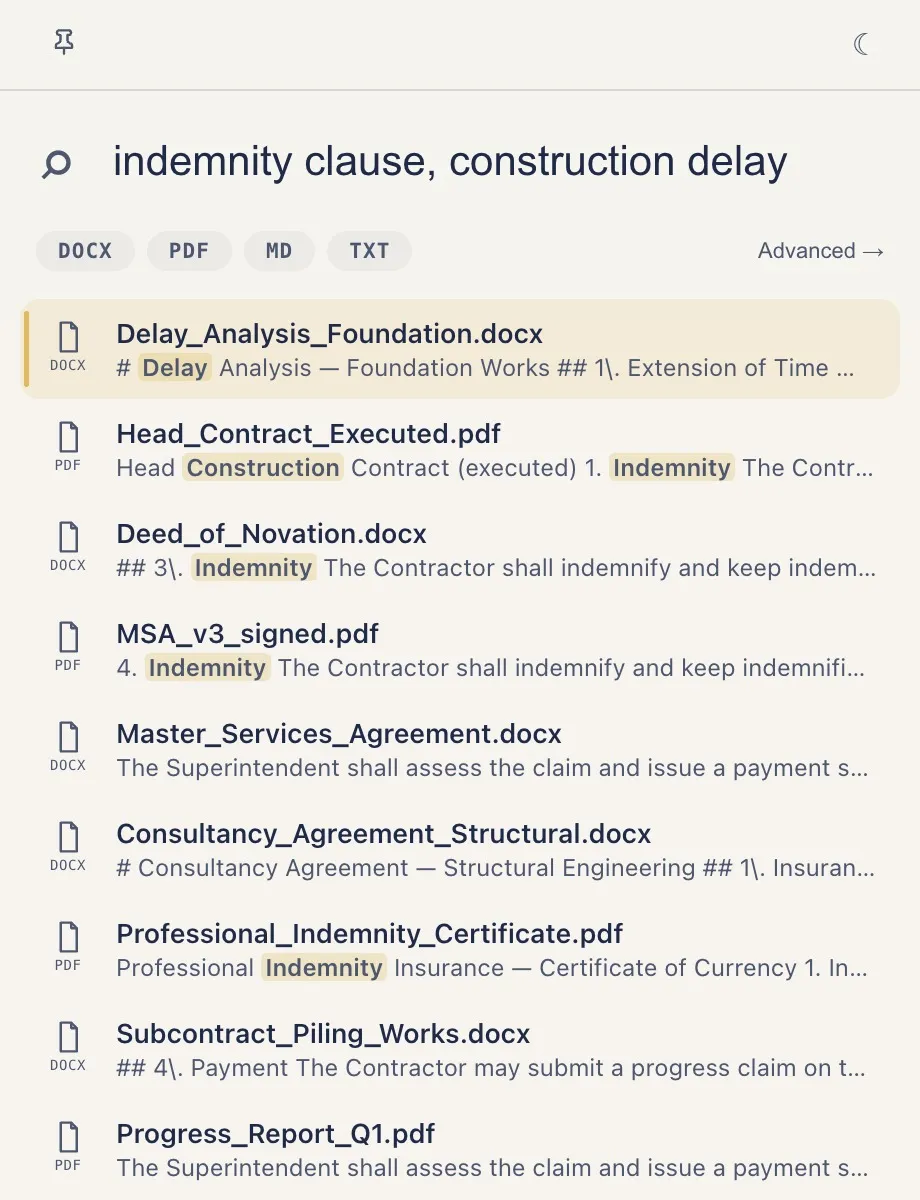
Fossick is a desktop app for Windows and Mac that searches your local documents by meaning, entirely offline.
You point it at a folder. It extracts text, runs OCR on scanned PDFs and images, and creates embeddings using the all-MiniLM-L6-v2 sentence-embedding model (384 dimensions, quantized, about 22 MB) running locally. Documents are never uploaded, and it works with Wi-Fi off; only licensing touches the internet.
Supported file types include PDF, Word (.docx, .doc), Excel (.xlsx), PowerPoint (.pptx), OpenDocument text (.odt), plain text, Markdown, CSV, HTML, email files (.eml, .msg), and images (PNG, JPG).
Measured performance
On an Apple M1 MacBook with 8 GB RAM, measured on 2026-09-21 using the engine CLI with a 52-document mixed folder (Word, PDF including scanned pages, Excel, CSV, Markdown; 700 KB):
- First-time indexing took about 81 seconds, including model load and OCR.
- Re-checking the unchanged folder took about 7 seconds, because re-indexing is incremental.
- Each semantic search took about 15-20 ms median (10 queries, 3 runs).
- The index used about 1.9 MB on disk.
What it is not
Fossick is search, not chat. There is no chatbot, no generative AI and no summaries. It shows you which documents match and lets you open them; reading and judging them stays with you. For professionals weighing AI tools against confidentiality duties, that narrower scope is the point. More on that in on-device AI search, explained.
Where keyword tools like Copernic still win
Keyword and Boolean desktop search remains the better tool for exact strings, precise operators and live mailbox indexing.
Be honest about the trade-offs before switching:
- Exact identifiers. Invoice numbers, matter numbers, part codes and quoted phrases are best found with exact matching.
- Boolean logic. If your workflow depends on
AND,NOT, proximity or wildcard operators, a keyword indexer gives you that control. - Live email. Fossick reads saved email files (.eml, .msg). If you need to search a live Outlook mailbox as mail arrives, a dedicated email indexer may suit you better.
- Built-in tools for single files. Inside one open document, Word's own Find is usually quickest; see how to search a Word document.
Many power users run both: a keyword tool for known strings, and semantic search for the times they remember the idea but not the wording, such as finding a document you can't remember the name of.
How to switch from Copernic without losing your workflow
Switch gradually: test semantic search on one real folder, compare results against your keyword tool, then expand.
- Pick a representative folder. Choose one with mixed file types and some scanned PDFs, such as a client matter or project archive.
- Write down five real searches. Use things you have genuinely struggled to find, phrased the way you remember them.
- Run them in both tools. Note where keyword search returns nothing or too much, and where semantic search surfaces the right file.
- Test offline. Turn off Wi-Fi and repeat a search to confirm nothing depends on a connection.
- Decide the split. Keep your keyword tool for identifiers if it still earns its place; use semantic search for everything you describe in words.
Fossick's free trial covers exactly this test: 1 folder, up to 200 files, no sign-up or card. If it fits, a single one-time purchase of US$14.99 unlocks every folder and file with all future updates and a 14-day money-back guarantee; details are on the pricing page. You can download it for Windows or Mac and run the comparison on your own files.
Frequently asked questions
Is there a free Copernic Desktop Search alternative?
Windows Search and Spotlight on Mac are built in and free, though they match words and filenames rather than meaning. Fossick is a paid one-time purchase, but it is free to try with 1 folder, up to 200 files, and no sign-up or card, which is enough to compare it against your current tool.
Does Fossick work on Mac as well as Windows?
Yes. Fossick is a desktop app for both Windows and Mac, and indexing, OCR and search run locally on either platform. That makes it an option for people who used Copernic on Windows but now also work on a Mac.
Can Fossick search my email like Copernic?
Fossick searches saved email files in .eml and .msg format by meaning, alongside your other documents. It does not connect to a live mailbox, so if you need to search Outlook as new mail arrives, a dedicated email indexer may be a better fit for that part of your workflow.
Does semantic desktop search upload my files?
Not with Fossick. Text extraction, OCR, embedding and search all run on your device, documents are never uploaded, and it works with Wi-Fi turned off. Only licensing touches the internet.
Should I replace Copernic entirely or use both?
It depends on how you search. If you rely on Boolean operators or exact identifiers, keeping a keyword tool makes sense. Semantic search covers the searches where you remember the idea but not the exact words, so many power users run both side by side.