How to Search Inside PDF Files Privately and Offline
Free to try (1 folder, 200 files) · US$14.99 to keep · Mac & Windows
When you need to search a PDF, the built-in reader's find box only matches the exact word on the page you have open. That falls apart the moment you have hundreds or thousands of PDFs and can only remember the idea — not the filename, not the precise phrase.
This guide shows how to search across an entire PDF collection by meaning and by keyword, without uploading a single file. Everything happens on your own machine, which matters when those PDFs are contracts, medical records, financial statements, or engineering specs.
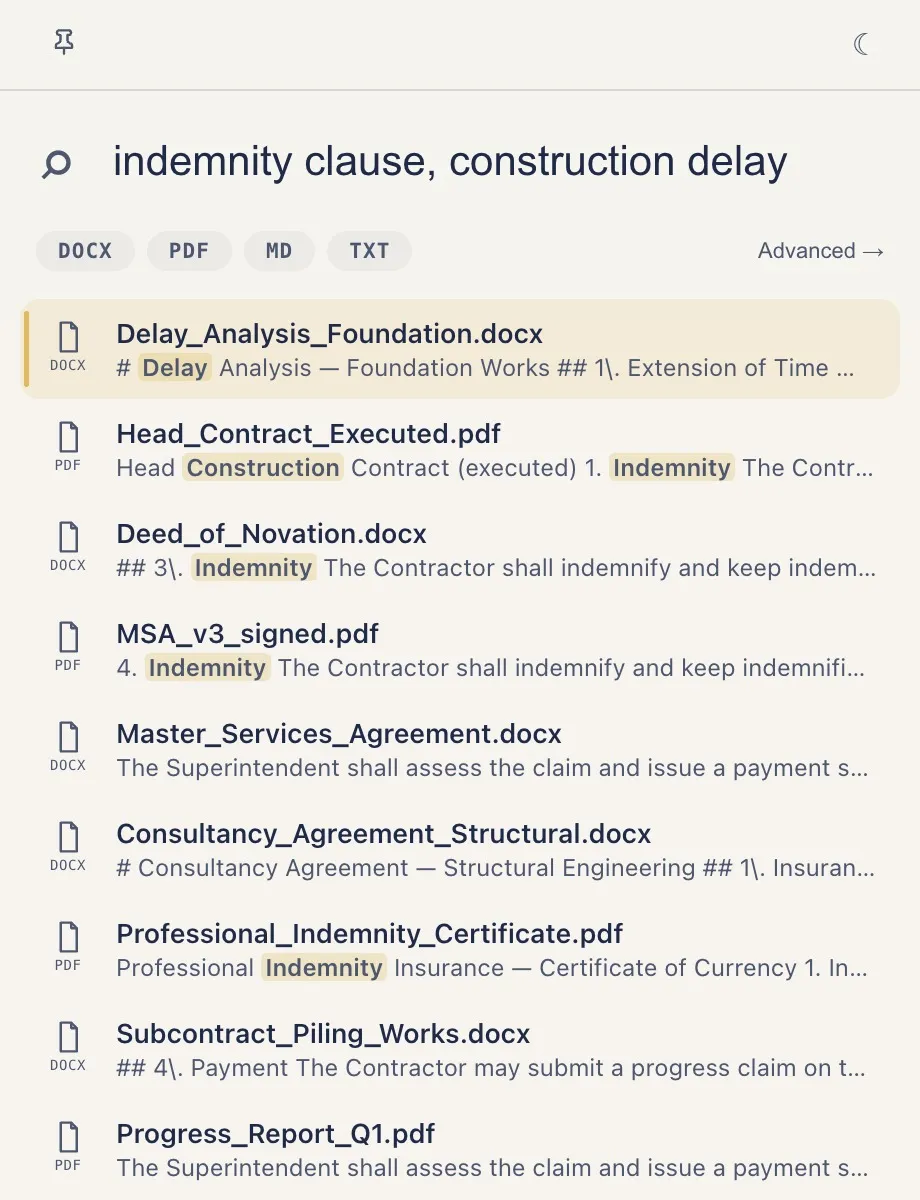
Why the PDF find box fails at scale
Every PDF reader has a search function, and for a single document it works fine. The trouble starts when your knowledge lives across many files.
- It only searches one file at a time. You cannot ask "which of my 2,000 PDFs mentions this?" without opening each one.
- It matches exact strings. Search for termination clause and you miss a document that says ending the agreement.
- It ignores scanned pages. A PDF that is really a photo of a page contains no selectable text, so the find box returns nothing.
These limits are why people resort to opening file after file, or dumping everything into a cloud tool that indexes their documents on someone else's servers. Neither is acceptable when the PDFs are confidential.
Keyword search vs. searching by meaning
There are two useful ways to search a PDF, and you want both.
Keyword (full-text) search finds exact words and phrases. It is precise when you know the term — an invoice number, a defined term, a person's name.
Semantic search finds documents by meaning. You describe what you remember in plain language — the report about supplier delays last winter — and it surfaces the right file even if those exact words never appear. This is the difference between remembering a filename and remembering an idea.
We cover the trade-offs in detail in semantic search vs keyword search for documents and full-text search vs semantic search for a folder. The short version: keyword search is great when you know the words, semantic search rescues you when you don't.
Scanned PDFs and the OCR problem
A large share of real-world PDFs are scans — signed contracts, receipts, older records, faxed pages. To your computer these are images, not text, so no search tool can read them until the text is extracted.
That extraction is called OCR (optical character recognition). It converts the picture of the words into actual, searchable text. The catch: many OCR services run in the cloud, meaning your document leaves your machine.
The better approach is OCR that runs on your device. It reads scanned pages locally, adds them to your searchable index, and never transmits the file. If your collection includes scans, see how to search scanned PDFs and images locally with OCR for a deeper look.
Why searching PDFs offline matters
For most professionals, the contents of their PDFs are the entire point of confidentiality. A lawyer's case files, an accountant's client records, a consultant's client decks — none of these should be copied to a third-party server just to make them findable.
Cloud search tools index your documents by uploading them. Even reputable ones create a copy you no longer fully control, and that can conflict with client agreements, NDAs, or regulatory duties.
Offline search removes the question entirely. If indexing and search run on your own computer, there is no upload to audit, no server to trust, no data-residency worry. The proof is simple: it works with the Wi-Fi unplugged. We explore this further in private document search and do you have to upload files to search them with AI? No.
How to search your PDFs by meaning with Fossick
Fossick is a desktop app for Windows and Mac that searches your local documents by meaning, entirely offline. It reads your PDFs — including scanned ones, via on-device OCR — builds a private index on your own machine, and lets you search by description or exact keyword. Nothing is uploaded.
A typical setup looks like this:
- Install and point it at your folders. Choose where your PDFs live — a local drive, an external disk, or a synced folder.
- Let it index on-device. Fossick extracts text, runs OCR on scans automatically, and builds the search index locally. The files never leave your computer.
- Search the way you remember. Type a keyword when you know the term, or describe the document in plain language when you don't.
- Open the result. Fossick points you to the actual file so you can read it in your normal viewer.
A few things Fossick is deliberately not. It is search, not chat — there is no chatbot, no generative AI, and it never writes summaries or answers questions for you. It finds the real document and gets out of your way. If you want that distinction spelled out, on-device AI search, explained covers it.
Who this helps most
Anyone with a large, confidential PDF collection benefits, but a few groups feel it immediately:
- Lawyers searching case files and contracts by concept — see how lawyers search case files by meaning, offline.
- Accountants locating records and statements without exposing client data — see document search for accountants.
- Engineers finding specs across huge documentation sets — see offline search for engineers.
- Researchers tracking down papers by idea rather than title — see document search for researchers.
If your PDFs live on Windows specifically, how to search inside PDFs on Windows walks through both text and scanned cases.
Fossick is a one-time US$14.99 purchase with a 14-day money-back guarantee, and you can download it here. When you're ready, the pricing page lists the one-time US$14.99 price — it includes the full app and all updates.
Frequently asked questions
How do I search across many PDF files at once?
A standard PDF viewer only searches one open file, so you need a desktop search tool that indexes an entire folder. Point it at the folders holding your PDFs, let it build a local index, then search all of them in one query. Fossick does this on-device, so no files are uploaded. See how to search across thousands of files at once for more.
Can I search a scanned PDF that has no selectable text?
Yes, but only after OCR extracts the text from the scanned image. Look for a tool that runs OCR automatically and on your own machine, so scanned pages become searchable without leaving your computer. Fossick applies on-device OCR during indexing, so scans are searchable just like normal PDFs.
Do I have to upload my PDFs to the cloud to search them?
No. Offline tools index and search entirely on your device, so your PDFs never leave your computer. This is the safest option for confidential documents because there is no server copy to trust or audit. Fossick is fully offline — it works with the Wi-Fi unplugged.
What is the difference between keyword and semantic PDF search?
Keyword search matches exact words and phrases, which is ideal when you know the precise term. Semantic search finds a PDF by its meaning, so a plain-language description of what you remember is enough. Having both means you can find a document whether or not you recall the exact wording.
Is Fossick a chatbot that answers questions about my PDFs?
No. Fossick is search, not chat — it has no generative AI and does not summarise or answer questions. It finds the actual PDF that matches your query and lets you open it in your usual reader, keeping you in control of the source document.