On-Device AI Search, Explained (No Cloud, No Chatbot)
Free to try (1 folder, 200 files) · US$14.99 to keep · Mac & Windows
You have heard "AI search" pitched a hundred ways, and most of them involve shipping your documents to someone else's servers. On-device AI search is the quieter alternative: the same meaning-based matching, but every step runs on your own computer, and nothing ever leaves it.
This article explains what on-device AI search actually is, how local embeddings let a program understand what you meant instead of just what you typed, and why "search" and "chatbot" are two very different things. If you handle confidential files for a living, the distinction matters.
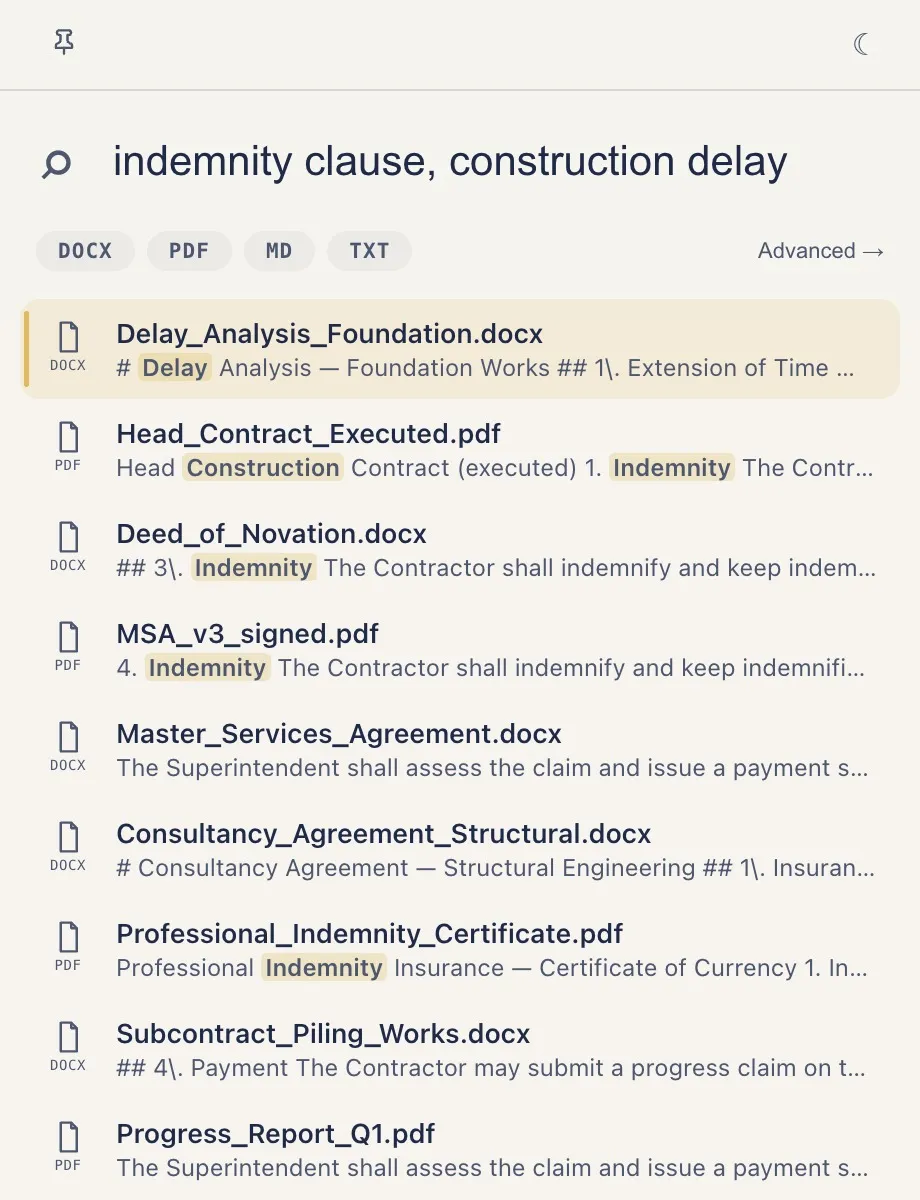
What "on-device AI search" actually means
On-device AI search is a way of finding your own documents by meaning rather than by filename or an exact string of text — with all the processing happening on your computer.
Break the phrase into three parts:
- On-device — indexing, analysis, and search run locally, on your CPU or GPU. There is no server round-trip.
- AI — the app uses a machine-learning model to represent the meaning of text as numbers, so it can match ideas, not just characters.
- Search — you get a ranked list of your files back. Nothing is written, summarised, or invented.
That last point trips people up, because "AI" has become shorthand for chatbots. On-device AI search borrows one useful capability from modern AI — understanding meaning — and deliberately leaves the rest out. For a fuller comparison of the two matching styles, see semantic search vs keyword search.
How local embeddings power meaning-based search
The engine behind meaning-based search is something called an embedding. An embedding is a list of numbers that captures the meaning of a chunk of text. Two passages about the same idea end up with similar numbers, even if they share no words.
Here is what happens on your machine, in order:
- The app reads each document and splits it into passages.
- A local model converts every passage into an embedding — a numeric fingerprint of its meaning.
- Those fingerprints are stored in a local index on your disk.
- When you search, your query is turned into an embedding too, and the app finds the stored passages whose meaning sits closest to it.
Because the model runs on-device, the text never travels anywhere. You could unplug the network entirely and the whole pipeline still works — which is the cleanest possible proof that nothing is being uploaded. This is the same idea explored in searching documents by meaning, applied end to end on your own hardware.
Search, not chat — why the difference matters
A chatbot reads your documents and generates new text — an answer, a summary, a paraphrase. To do that reliably at scale, most tools send your content to a cloud model. That is a real data-exposure decision, and for confidential files it is often the wrong one.
On-device AI search does something narrower and safer: it points you at the right file. There is no generative model, no answer being composed, no chance of a confident-but-wrong summary. You open the document and read it yourself.
For privacy-minded professionals, that trade is usually worth it:
- Nothing is fabricated, because nothing is written.
- Nothing leaves your machine, because there is no cloud model to feed.
- You stay in control of interpretation — the app just gets you to the source.
If you are weighing the two approaches for sensitive material, is it safe to search documents with AI? walks through the on-device versus cloud question in detail.
Why offline is the trust proof
Plenty of tools claim privacy. On-device search lets you verify it. If the software can find your files with the network disconnected, then indexing and search are genuinely happening locally — there is nowhere for your data to go.
This matters because privacy policies are promises, and promises can change. Architecture is harder to fake. A tool that never needs the internet to do its core job simply cannot leak documents it never transmits.
The practical upside is that on-device search also works where cloud tools fail: on a plane, in a secure facility, in a client's office with guest Wi-Fi you would rather not touch. Related reading: offline document search and private document search.
What it handles: PDFs, Word, text, and scanned images
Meaning-based search is only useful if it can actually read your files. That includes the awkward ones.
- PDFs and Word documents are parsed for their text content.
- Plain text and similar formats are indexed directly.
- Scanned PDFs and images — the paperwork that is really just a photo of a page — are run through OCR on-device to extract the text first, so a scanned contract becomes searchable by meaning like any other file.
That OCR step is what lets you find a phrase inside a screenshot or a scanned invoice without ever uploading the image. See how to search scanned PDFs and images locally with OCR for how that works end to end.
Where Fossick fits
Fossick is a desktop app for Windows and Mac that does exactly this: private, on-device AI search over your own local documents. You point it at your folders, it builds a local index, and you search by what you remember — a phrase, a concept, the gist of a paragraph — even if you can't recall the filename.
To be clear about what it is not: Fossick is search, not chat. There is no generative AI, no assistant writing answers, and no cloud account holding your files. Only licensing and billing ever touch the internet; your documents do not.
It is built for people with genuinely confidential material — lawyers, consultants, engineers, accountants, and researchers — who need to find things fast without creating a data-exposure risk. You can download it and try it risk-free for 14 days — it is a one-time US$14.99 purchase, and the pricing page has the details.
Frequently asked questions
Is on-device AI search the same as a chatbot for my files?
No. A chatbot generates new text — answers or summaries — usually by sending your content to a cloud model. On-device AI search only finds and ranks your existing files by meaning; it writes nothing and invents nothing. You open the document and read it yourself.
Does on-device AI search really keep my documents private?
Yes, when it runs entirely locally. If the app indexes and searches with the network disconnected, your files are never transmitted anywhere. That offline capability is the clearest proof that nothing is being uploaded, which is exactly how Fossick works.
How does it find files without matching the exact keywords?
It uses local embeddings — numeric fingerprints of meaning. Your query and your documents are converted into these fingerprints on your machine, and the app matches the ones whose meaning is closest. That lets you describe a document from memory instead of guessing its exact words.
Can it search scanned documents and images?
Yes. Fossick runs OCR on-device to extract text from scanned PDFs and image files like PNG and JPG, then indexes that text for meaning-based search. The image never leaves your computer during the process.
Do I need an internet connection to use it?
Not for searching. Indexing, embedding, OCR, and search all run locally, so the core app works fully offline. Only licensing and billing require the internet, never your documents.