Engineering Documentation Search: Find Any Spec, Drawing, or Manual Offline
Short answer: Engineering documentation search means finding the right spec, drawing, test report, or manual in your own files by describing what it contains. The most reliable private approach is an on-device semantic search tool that indexes PDFs, Word, Excel, and scanned pages locally, so you can search by meaning without uploading sensitive technical files.
Free to try (1 folder, 200 files) · US$14.99 to keep · Mac & Windows
Most engineers know the feeling: you remember the bracket failed a vibration test two projects ago, or that a vendor datasheet mentioned a derating curve above 85 °C, but you cannot remember the filename, the folder, or the exact wording. Your engineering documentation is all there on your drive. Finding it is the problem.
This article explains what counts as engineering documentation, why filename and keyword search struggle with it, and how to search your own technical library by meaning, entirely on your own computer, so confidential specs and client drawings never have to be uploaded anywhere.
What counts as engineering documentation?
Engineering documentation is the written and drawn record of how something is specified, designed, built, tested and maintained. In a typical engineer's local library that includes:
- Specifications and requirements – product specs, client requirements, standards excerpts
- Drawings – usually as PDF exports or scanned prints, with title blocks, notes and revision tables
- Calculations and analysis – Excel workbooks, design notes, FEA summaries
- Test and inspection reports – qualification tests, NCRs, commissioning records
- Manuals and datasheets – O&M manuals, installation guides, vendor datasheets
- Correspondence – RFIs, transmittals, emails saved as .eml or .msg
The difficulty is that these files arrive from many sources, follow many naming conventions (or none), and mix born-digital documents with scans. A folder structure that made sense at project kickoff rarely survives a few years of revisions and handovers.
Why keyword search struggles with engineering documents
Keyword search fails engineers because it only finds the exact words you type, and technical writing uses many words for the same thing.
One report says "fatigue cracking", another says "cyclic loading failure", and a third says "crack initiation at the weld toe". A datasheet says "thermal derating"; your memory says "loses capacity when it gets hot". Classic full-text indexes, like the SQLite FTS5 extension, are built to match terms, not concepts, so unless you guess the author's vocabulary, the document stays hidden.
The operating system tools have their own limits. Windows Search relies on an index of files and their properties or contents, which has to be configured and still matches words rather than meaning. Scanned drawings and old reports add another gap: if a PDF is just an image of a page, there is no text to match at all until OCR has been run.
If you have hit these limits already, our guides on why Windows Search may not index file contents and semantic vs keyword search go deeper.
How semantic engineering documentation search works on-device
Semantic search turns each passage of your documents into a numeric representation of its meaning, then finds the passages closest in meaning to your query.
Semantic search aims to match the intent of a query rather than its exact keywords. In practice that means a query like "weld cracked during shake table testing" can surface a report that only ever says "fatigue failure at the fillet weld during vibration qualification".
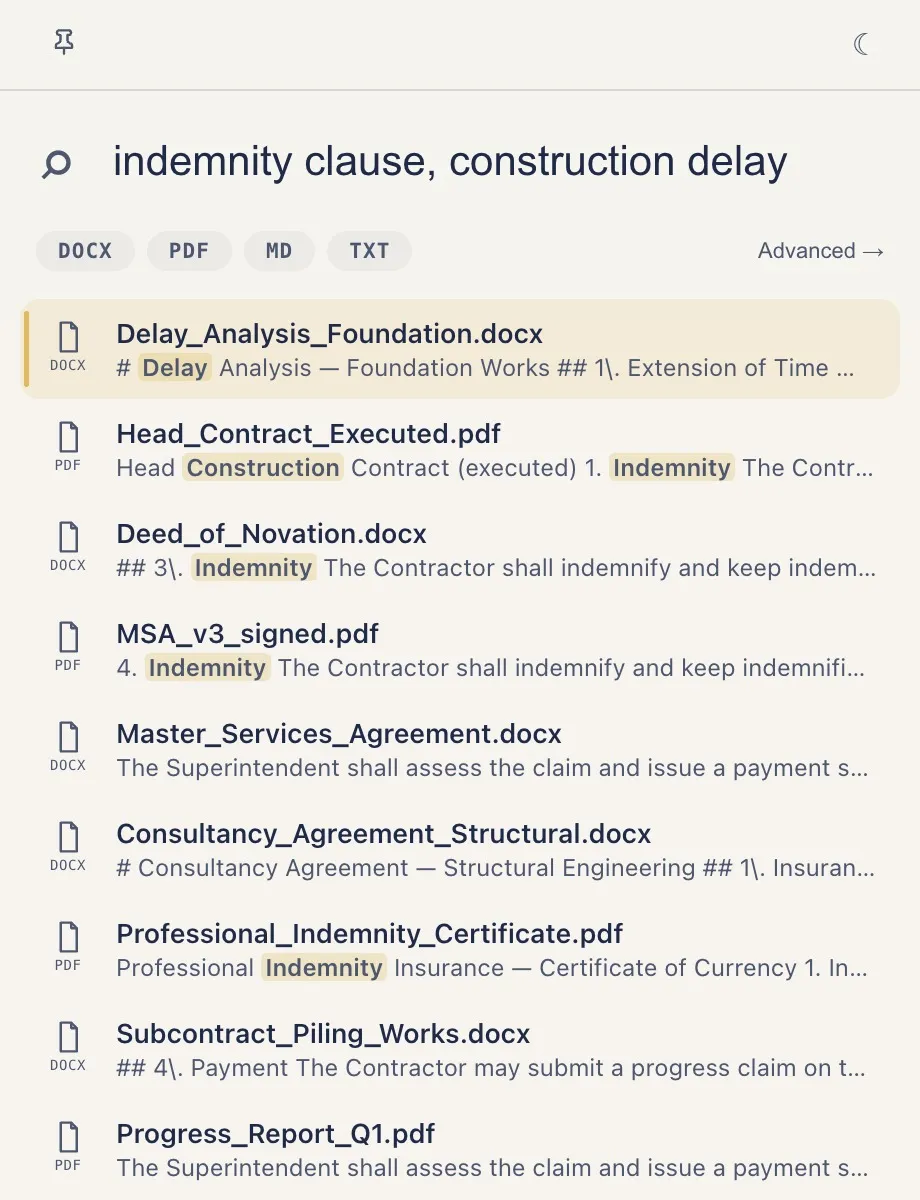
This can run entirely on a laptop. Fossick, a desktop app for Windows and Mac that searches your local documents by meaning, entirely offline, works like this:
- Extract text from PDFs, Word (.docx, .doc), Excel (.xlsx), PowerPoint (.pptx), OpenDocument text, plain text, Markdown, CSV, HTML and email (.eml, .msg).
- Run OCR on scanned PDFs and images (PNG, JPG), on-device, so scanned reports and drawing prints become searchable text.
- Embed each passage with the small all-MiniLM-L6-v2 sentence-embedding model (384 dimensions, quantized, about 22 MB), which runs locally.
- Search by comparing your query to that local index and returning the matching documents and passages.
For a sense of scale, in a measured test on an Apple M1 MacBook with 8 GB RAM, a 52-document mixed folder (Word, PDF including scanned pages, Excel, CSV, Markdown) was indexed from scratch in about 81 seconds, including model load and OCR. Searches over that folder took about 15-20 ms median, and the index was about 1.9 MB on disk. Re-indexing is incremental, so only new or changed files are re-processed; the same unchanged folder was re-checked in about 7 seconds.
It is important to be clear about what this is not: Fossick is search, not chat. There is no chatbot, no generative AI and no summaries. It finds the document; you read it and make the engineering judgement.
Comparing engineering documentation search options
The right tool depends on whether you know the exact words, where the files live, and how sensitive they are.
| Method | Matches by | Where files are processed | Scanned pages |
|---|---|---|---|
| Word Find (Ctrl+F) | Exact text, one open document | Local | No |
| Windows Search / Spotlight | Filenames and keywords | Local index | Limited |
| Cloud drive search | Keywords | Provider's servers | Varies |
| On-device semantic search (e.g. Fossick) | Meaning | Local, offline | Yes, via local OCR |
Word's built-in Find is ideal when you already have the right document open and know the term. Windows Search and Spotlight are good for filenames and known keywords across a drive. Cloud drives can search well, but only after your files are stored on someone else's servers. Semantic search fills the remaining gap: finding the right file across a whole library when you only remember what it was about.
Keeping sensitive technical files off the cloud
The safest way to search confidential engineering files is to never send them anywhere, which is what fully on-device search does.
Engineering libraries often contain client IP, unreleased designs, export-controlled data, tender documents and contractual drawings. Many NDAs and client agreements restrict where that material can be stored or processed. Uploading it to a cloud AI tool, even just to make it searchable, can create a question you then have to answer to a client or a compliance team.
With Fossick, text extraction, OCR, embedding and search all run on your device. Documents are never uploaded, and it works with the Wi-Fi turned off; only licensing touches the internet. That makes it easy to verify for yourself: disconnect, search, and confirm results still come back. Your existing device protections, such as full-disk encryption, continue to cover the files and the local index.
For a broader look at this trade-off, see is it safe to search documents with AI?.
Setting up a searchable engineering library
You get the best results by pointing the search tool at the folders you already use and letting it index them in place, with no restructuring needed.
Practical tips
- Start with one active project folder. Confirm the results match how you remember documents before adding archives.
- Prefer PDF exports of drawings. Semantic search indexes text, so it can find title block details, general notes and revision descriptions, but it does not read native CAD formats such as DWG or geometry.
- Keep scans legible. OCR quality depends on scan resolution and print condition; faint or skewed prints yield less searchable text.
- Write queries as you'd describe the document. "pump seal leaking after commissioning" tends to work better than a single keyword.
- Use keyword tools for exact identifiers. For a specific part number or drawing number, Windows Search, Spotlight or Ctrl+F remain quick and precise.
You can download Fossick and try it free on 1 folder of up to 200 files, with no sign-up or card. If it fits your workflow, a single one-time purchase of US$14.99 unlocks every folder and file, includes all future updates, and comes with a 14-day money-back guarantee; details are on the pricing page.
For a discipline-specific walkthrough, see offline search for engineers.
Frequently asked questions
What is engineering documentation?
Engineering documentation is the record of how a product or system is specified, designed, built, tested and maintained. It includes specifications, drawings, calculations, test reports, manuals, datasheets and project correspondence. In practice it is usually spread across PDFs, Word and Excel files, emails and scans.
Can I search scanned engineering drawings and old reports?
Yes, if the tool runs OCR, which converts images of text into searchable text. Fossick runs OCR on scanned PDFs and images (PNG, JPG) on your device, so title blocks, notes and scanned report pages become searchable. Results depend on scan quality, and it does not interpret drawing geometry or native CAD files.
Does Fossick upload my engineering files to the cloud?
No. Text extraction, OCR, embedding and search all run locally on your Windows or Mac computer, and documents are never uploaded. It works with Wi-Fi off; only licensing touches the internet.
Is Fossick an AI chatbot for engineering documents?
No. Fossick is semantic search, not chat: it finds the documents and passages that match what you describe. It has no generative AI, does not answer questions and does not write summaries.
Should I still use keyword search for part numbers?
Often, yes. Exact identifiers like part numbers, drawing numbers or standard references are well suited to keyword tools such as Windows Search, Spotlight or Ctrl+F. Semantic search is most useful when you remember what a document was about but not its exact wording.