Windows Search not finding text inside files? Why, and what works
Short answer: Windows Search usually misses text inside files for one of four reasons. The folder isn't an indexed location, or the file type is set to index properties only. There may be no filter for the format, which is common with PDFs. Or the file is a scan with no text layer. Most cases are fixed in Indexing Options.
Free to try (1 folder, 200 files) · US$14.99 to keep · Mac & Windows
You know the document exists. You remember a phrase from it, maybe a clause, a client name, or a figure. You type it into the Windows search box and get nothing, or only files whose names happen to match. If Windows Search is not indexing file contents, it is almost never random. It comes down to a handful of settings and file-format limits you can check in a few minutes.
This guide covers why Windows Search misses text inside files and the fixes that work. It gives PDFs and scanned documents extra attention, because that is where most failures happen. It also explains the limit that no setting can fix, and when a dedicated offline content-search tool is the more practical answer.
Why Windows Search misses text inside files
Windows Search misses file contents when the file sits outside its index, or when the index only records the file's properties and not its text.
Windows Search is fast because it doesn't read your disk at query time. It keeps a pre-built index of files, their properties and, where allowed, their contents. Microsoft explains that you can configure which locations and file types Windows indexes. The defaults are narrower than most people assume. The usual culprits:
- The folder isn't indexed. By default Windows indexes your user folders, such as Documents and Desktop. A project folder on D:\, an external drive or a synced folder somewhere else may not be included.
- The file type is set to 'properties only'. Each extension has its own setting. If it's set to index properties only, Windows knows the file's name, dates and author, but not a word of its text.
- There's no filter for the format. Windows reads contents through format-specific filters (IFilters). If none is registered for a type, commonly PDFs on some setups, the contents are skipped.
- The file has no text at all. A scanned contract or a photo of a receipt is an image. There is nothing to index until something converts it to text.
- The index is incomplete or stale. Indexing can pause on battery power, fall behind after large copies, or break after an update.
- Network locations. Mapped drives and shared folders are generally not in the local index, so searches there fall back to slow, limited scanning.
How to fix Windows Search not indexing file contents
Most cases are fixed by adding the folder to Indexing Options, switching the file type to index contents, and rebuilding the index.
Work through these steps in order:
- Check the service. Press Win+R, type
services.msc, and find Windows Search. It should be Running, with Startup type set to Automatic (Delayed Start). - Add the folder. Open the Start menu, type Indexing Options, then click Modify. Tick the drives or folders that hold your documents.
- Turn on content indexing for the file type. In Indexing Options, click Advanced, then open the File Types tab. Select the extension, for example
.pdf,.docxor.txt. Choose Index Properties and File Contents. Check which filter is listed for that extension. - Rebuild the index. On the Index Settings tab, click Rebuild. This can take a while on a large drive. Results stay incomplete until it finishes.
- Check search mode on Windows 11. Under Settings > Privacy & security > Searching Windows, Enhanced indexes the whole PC. Classic covers only libraries and the desktop, plus any locations you add. Also check whether the power-settings option is pausing indexing on battery.
- For one-off searches in unindexed folders: in File Explorer's Folder Options, the Search tab has an option to always search file names and contents. It is slow, but it works where the index doesn't reach.
| Symptom | Likely cause | Fix |
|---|---|---|
| Finds names, not text | Type set to properties only | File Types > Properties and File Contents |
| Nothing from one folder | Folder not indexed | Indexing Options > Modify |
| PDFs never match | No PDF filter registered | Install a PDF IFilter, then rebuild |
| Scans never match | No text layer | Run OCR on the files |
| Results out of date | Stale or paused index | Rebuild; check power settings |
Why PDFs and scanned documents are the usual blind spot
PDFs fail when no PDF filter is available to Windows Search, and scanned documents fail because they contain pictures of text rather than text.
A digital PDF, exported from Word or generated by software, contains real text. Windows can index it, but only if a PDF filter is registered. Whether one is present depends on your Windows version and on what PDF software you have installed. The File Types tab shows the filter in use. If .pdf shows no content filter, or is set to properties only, its text won't be searchable.
A scanned PDF is different. Each page is essentially a photograph. Optical character recognition is the step that turns images of text into machine-readable text. Windows Search does not reliably perform that step on scanned PDFs, PNGs or JPGs as part of indexing. You can run OCR with a PDF editor first, which adds a hidden text layer that Windows can then index. That works for a handful of files. It is tedious for an archive of hundreds of scans.
For more detail on both cases, see our guides to searching inside PDFs on Windows and searching scanned PDFs and images with OCR.
The limit no setting fixes: keyword matching
Even a perfectly configured Windows index finds words, not ideas, so it fails whenever you can't remember the exact wording.
Windows Search is a classic keyword index. Like most full-text search engines, it matches the terms you type against terms stored in the index. That works well when you know a distinctive word, such as a case number, a surname or a product code.
It works poorly for how people actually remember documents. Suppose you search for "clause about ending the agreement early". The contract you want says "termination for convenience upon 30 days' written notice." No keyword overlaps, so a keyword index returns nothing, or returns dozens of unrelated files that happen to contain "agreement."
Semantic search tackles this by comparing the meaning of your query with the meaning of passages in your documents. Windows Search doesn't do this for your file contents. If most of your failed searches are "I know it's in there, but not what it's called," fixing Indexing Options will only take you so far. Our comparison of semantic vs keyword search goes deeper.
When a dedicated offline content-search tool is the better answer
A dedicated tool makes sense when your documents include scans, you search by concept rather than exact words, or your files are too confidential to send to a cloud service.
Cloud options exist, but they mean your files live on, or are processed by, someone else's servers. For lawyers, accountants, consultants and engineers handling client material, that is often the wrong trade. The alternative is software that does everything on your own machine.
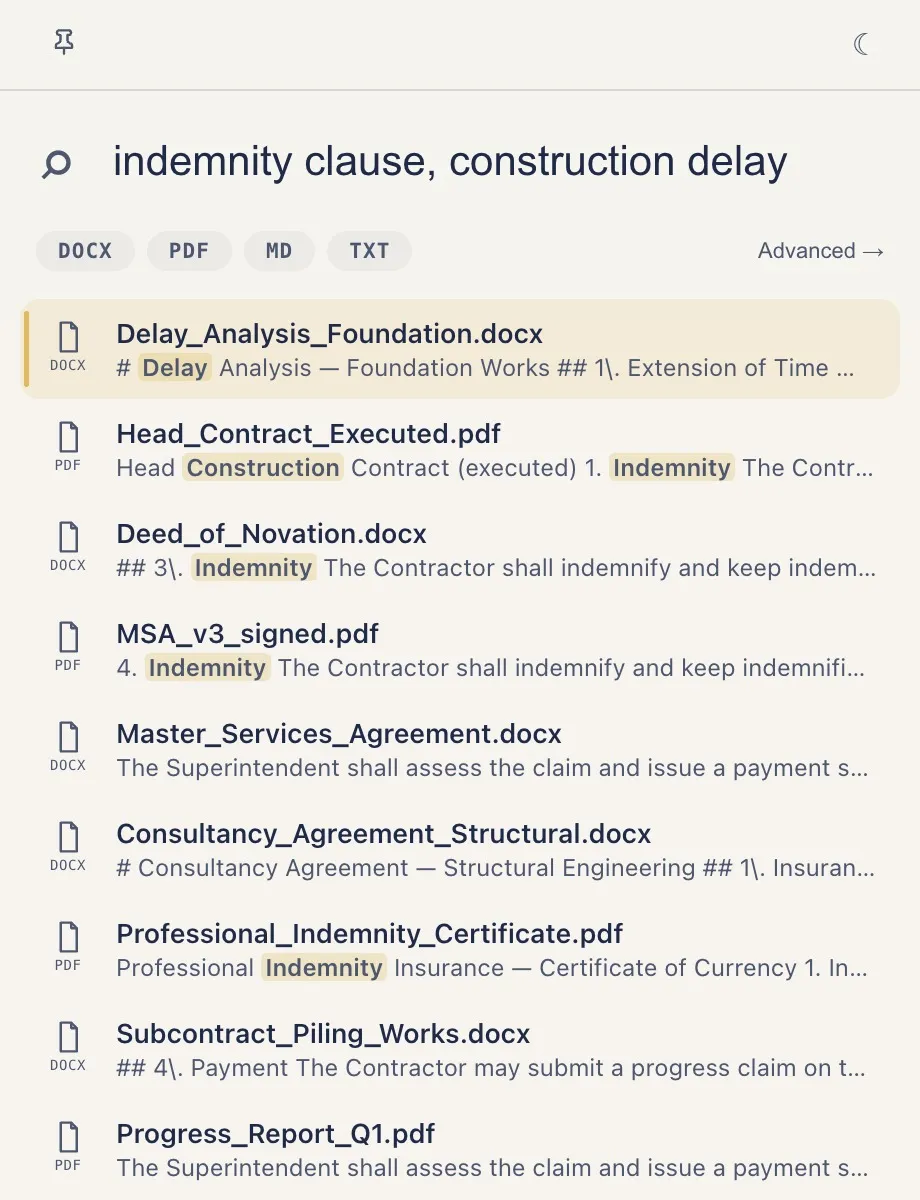
Fossick is one such option. It is a desktop app for Windows and Mac that searches your local documents by meaning, entirely offline. What that means in practice:
- All processing stays on your device. Text extraction, OCR, embedding and search all run locally. Documents are never uploaded, and it works with Wi-Fi turned off. Only licensing touches the internet.
- Scans are handled automatically. Scanned PDFs and images (PNG, JPG) are OCR'd on-device during indexing, with no separate step.
- Broad file support. It handles PDF, Word (.docx, .doc), Excel (.xlsx), PowerPoint (.pptx), .odt, plain text, Markdown, CSV, HTML and email (.eml, .msg).
- Search by meaning. It uses a small local embedding model (all-MiniLM-L6-v2, about 22 MB), so a query like "ending the agreement early" can surface the termination clause.
- Incremental updates. Only new or changed files are re-processed.
To give a sense of scale, here is one measured run on an 8 GB Apple M1 MacBook. A 52-document mixed folder, including scanned pages, indexed from scratch in about 81 seconds, including model load and OCR. Searches then took about 15-20 ms each.
Be clear on what it is not. Fossick is search, not chat. It has no chatbot and no generative AI, and it doesn't summarise or answer questions. It finds the document, and you read it. It also won't replace Windows Search for launching apps or finding settings.
It is free to try with no sign-up or card, on 1 folder of up to 200 files. That is enough to point it at the folder Windows Search keeps failing on. The full app is a one-time US$14.99 purchase with a 14-day money-back guarantee, and you can download it here. For a broader comparison of options, see our Windows Search alternative guide.
Frequently asked questions
Why does Windows Search find the file name but not the text inside it?
Usually the file type is set to Index Properties only, or the folder isn't an indexed location. Open Indexing Options, click Advanced, then the File Types tab. Set the extension to Index Properties and File Contents and rebuild the index.
Does Windows Search index the contents of PDF files?
Only if a PDF filter (IFilter) is registered and .pdf is set to index file contents. Check the File Types tab in Indexing Options to see which filter is listed. Even with a filter, scanned PDFs have no text to index until OCR is applied.
How do I rebuild the Windows Search index?
Type Indexing Options in the Start menu, open it, click Advanced, and on the Index Settings tab click Rebuild. Indexing runs in the background and can take a long time on large drives. Results stay incomplete until it finishes.
Can Windows Search find text in scanned documents or screenshots?
Not reliably, because scans and screenshots are images rather than text. You need OCR to convert them first, either by adding a text layer with a PDF editor or by using a search tool that runs OCR automatically. Tools that run OCR on-device keep the files on your computer.
Will switching to Enhanced search mode fix missing content results?
Enhanced mode widens which locations are indexed, which helps if your files sit outside your libraries. It doesn't change per-file-type content settings, add missing filters, or make scans searchable. You still need to check the File Types tab and rebuild the index.