How to search inside PDFs on Windows (text and scanned)
Free to try (1 folder, 200 files) · US$14.99 to keep · Mac & Windows
Windows is oddly bad at one thing you'd expect it to nail: finding the contents of your PDFs. You can search filenames all day, but if you can't remember what a file was called — only that it mentioned a specific clause, client, or part number — the built-in tools tend to come up empty. Scanned PDFs make it worse, because to Windows they're just pictures with no readable text.
This guide covers the practical ways to search PDFs on Windows, from the built-in options to a proper local index that reads inside every file. It also explains how to search scanned PDFs using OCR, and how to do all of it without your documents ever leaving your machine.
Why Windows struggles to search inside PDFs
Out of the box, File Explorer searches filenames far more reliably than file contents. Windows Search can index the text inside PDFs, but a few things have to line up first:
- The folder has to be included in the indexing locations (Settings → Search → Searching Windows).
- A PDF iFilter has to be installed so Windows can read PDF text — Adobe Reader or a third-party filter usually provides one.
- The PDF has to actually contain selectable text.
That last point is the catch. A huge share of real-world PDFs — signed contracts, scanned receipts, old case files, faxed forms — are just images of pages. There's no text layer, so there's nothing for Windows to index. You can search for a phrase you know is in the document and get zero results.
Even when indexing works, it's keyword matching. If your memory of the file is fuzzy, exact-word search doesn't help.
The built-in options and their limits
Before adding new software, it's worth knowing what you already have.
File Explorer search
Type a term in the search box and, with content indexing enabled, Explorer will look inside text-based PDFs. It's fine for a small, well-indexed folder, but slow across large document sets and useless on scanned files.
Adobe Acrobat Reader
Acrobat's Advanced Search (Shift+Ctrl+F) can search across a folder of PDFs at once and is more thorough than Explorer. It still relies on a text layer, though — scanned pages won't turn up unless they've already been run through OCR.
The core gap
Both approaches share two weaknesses: they can't read scanned documents, and they only match exact words. For a deeper look at when built-in search falls short, see a Windows Search alternative that actually finds docs. If your files are mostly image-based, the next section matters most.
Searching scanned PDFs: why you need OCR
A scanned PDF is a photo of a page. To make it searchable, the text in that image has to be recognised and turned into machine-readable characters — that's OCR (optical character recognition).
Once OCR has run, phrases inside the scan become findable just like any typed document. Without it, the file is a black box to every search tool you own.
There are two ways to add OCR:
- Convert each file — run PDFs through an OCR tool (Acrobat, various utilities) to bake a text layer into them. Thorough, but tedious across thousands of files, and it modifies your originals.
- Use a search tool that OCRs automatically — the index reads scanned pages during indexing, leaving your files untouched.
The second approach scales better. We cover the specifics in how to search scanned PDFs and images locally with OCR, and the same idea applies to text inside screenshots and images.
Keyword search vs. searching by meaning
Even perfect OCR doesn't fix the harder problem: you often don't remember the exact words. You remember the gist. You know a PDF discussed "early termination penalties" but the document actually says "liquidated damages upon cancellation." Keyword search returns nothing.
This is where semantic search helps. Instead of matching characters, it matches meaning — you describe what the document was about in your own words, and it surfaces files that cover that idea even when the wording differs.
For most people the two are complementary: keyword search for precise strings like an invoice number, semantic search for concepts and half-remembered content. If the distinction is new to you, semantic search vs keyword search for documents breaks it down, as does full-text search vs semantic search for a folder.
A local tool that reads inside every PDF
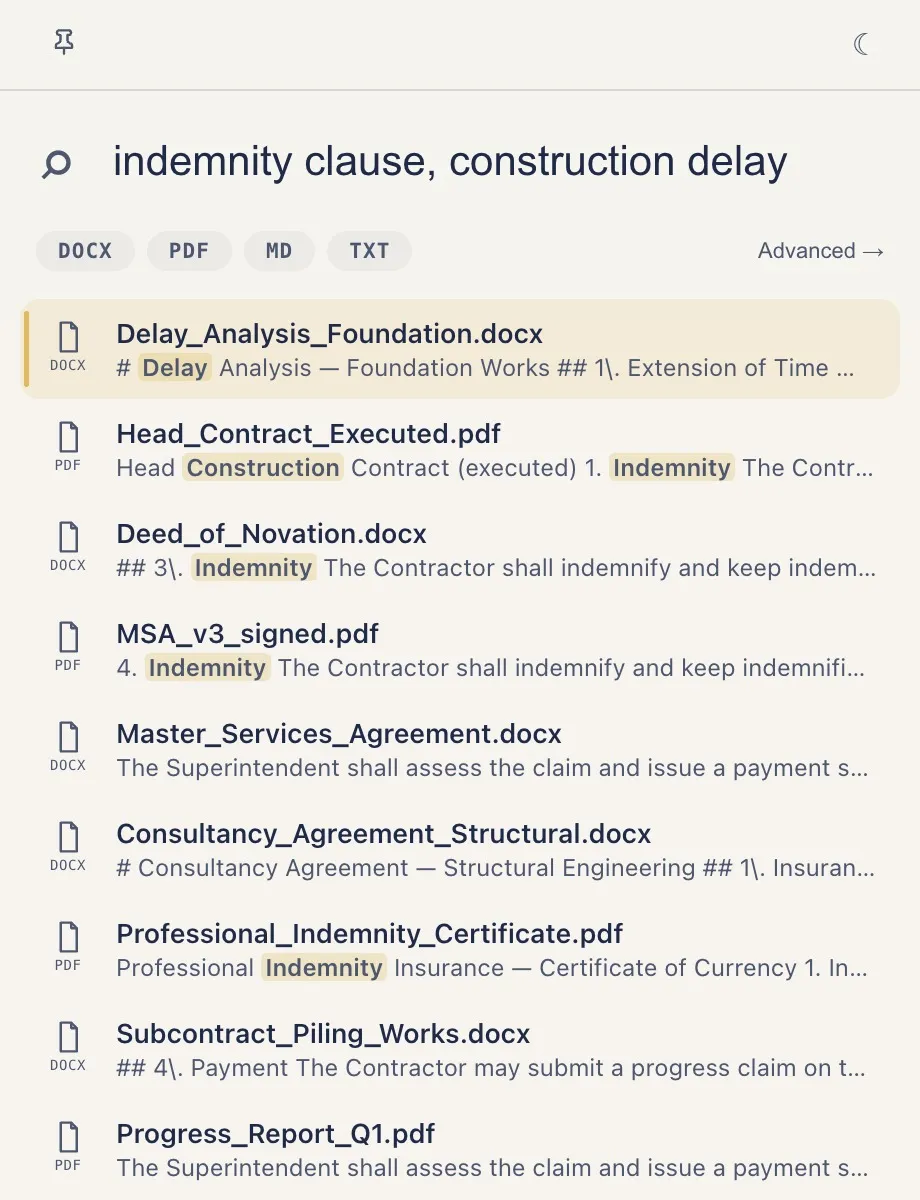
If you regularly hunt through large PDF collections — especially confidential ones — a dedicated local index is the practical answer. Fossick is a desktop app for Windows and Mac that searches your local documents by meaning, entirely offline. You point it at your folders, it builds an index, and then you search by describing what you remember.
What that looks like for PDFs on Windows:
- It reads the text inside text-based PDFs, Word files, and more.
- It runs OCR on scanned PDFs and images automatically, on your machine, so image-only documents become searchable without you converting anything.
- You search by meaning, so you can find the right file without recalling its filename or exact phrasing.
Importantly, Fossick is search, not chat. There's no chatbot, no generative AI, and nothing that summarises or answers questions — it finds and ranks your documents so you can open the real thing. That's a deliberate design choice for people who need to trust the source. You can download it here and try it risk-free for 14 days.
Keeping confidential PDFs on your own machine
For lawyers, accountants, consultants, and engineers, where search happens matters as much as how well it works. Many cloud search and AI tools require uploading documents to a server — a non-starter for privileged files, client records, or NDA-bound specs.
Fossick does all indexing, OCR, embedding, and searching on-device. Your PDFs are never uploaded; the app works with the Wi-Fi unplugged. The only thing that touches the internet is licensing. That's the trust proof — you can verify it by pulling the network cable and watching search keep working.
If that's your priority, these are worth reading:
- Search PDFs without uploading: a local, private guide
- How to search confidential files without them leaving your PC
- Private document search: find files without a data risk
Fossick is a one-time US$14.99 purchase with a 14-day money-back guarantee, and the pricing page has the details — one payment, with no subscription.
Frequently asked questions
Can Windows Search find text inside PDFs?
Yes, but only under conditions: the folder must be in your indexing locations, a PDF iFilter must be installed, and the PDF must contain a real text layer. Scanned or image-based PDFs have no text layer, so Windows Search can't find anything inside them.
How do I search scanned PDFs on Windows?
Scanned PDFs need OCR to convert their page images into readable text first. You can OCR each file with a tool like Acrobat, or use a search app that runs OCR automatically during indexing. Fossick does the latter on-device, so scanned PDFs and images become searchable without you converting anything.
What if I don't remember the exact words in the PDF?
Exact-keyword tools will fail if your memory of the wording is off. Semantic search solves this by matching meaning instead of characters — you describe what the document was about in your own words and it surfaces files covering that idea, even if the phrasing differs.
Do these tools upload my PDFs anywhere?
Cloud-based search and AI tools often require uploading your files. Fossick does not — indexing, OCR, and search all run locally on your PC, and documents are never uploaded. You can confirm it by disconnecting from the internet and searching offline.
Is Fossick an AI chatbot that answers questions about my PDFs?
No. Fossick is search, not chat. It has no generative AI and does not summarise or answer questions — it finds and ranks your actual documents so you can open the real source yourself.