How to search confidential files without them leaving your computer
Free to try (1 folder, 200 files) · US$14.99 to keep · Mac & Windows
If your work involves privileged, regulated, or client-confidential documents, the usual search tools put you in an awkward spot. Cloud search and AI assistants often need to upload or sync your files to work — which may breach a retainer, an NDA, or a compliance policy before you have even found what you were looking for.
This article explains how to search confidential files by meaning without them ever leaving your computer, what "local and offline" should actually mean, and how to verify the claim yourself rather than taking a vendor's word for it.
Why searching confidential files is different
For most people, search is a convenience. For a lawyer, accountant, consultant, or engineer, it is a compliance decision. The moment a document is indexed by a service, you have to ask where the copy went and who can read it.
Many modern tools quietly move your data to answer a query:
- Cloud drives index file contents on their servers.
- AI assistants upload documents so a model can process them.
- Browser-based "search your PDF" tools send the file to a remote endpoint.
Each of these can be a problem when the file is a signed settlement, a client tax return, or an unreleased design spec. The safe default for sensitive work is the opposite: nothing leaves the machine unless you explicitly send it.
What "local and offline" actually needs to mean
Vendors use private and secure loosely, so it helps to be precise. For confidential work, three separate steps all have to happen on your device:
- Indexing — reading your files to build a searchable catalogue.
- Embedding — turning the text into the mathematical representation that powers meaning-based search.
- Search — matching your query against that index.
If any one of these runs in the cloud, your documents (or close derivatives of them) have left your control. "Encrypted in transit" is not the same as "never transmitted." The standard you want is that the raw text and the embeddings both stay on disk, on your machine.
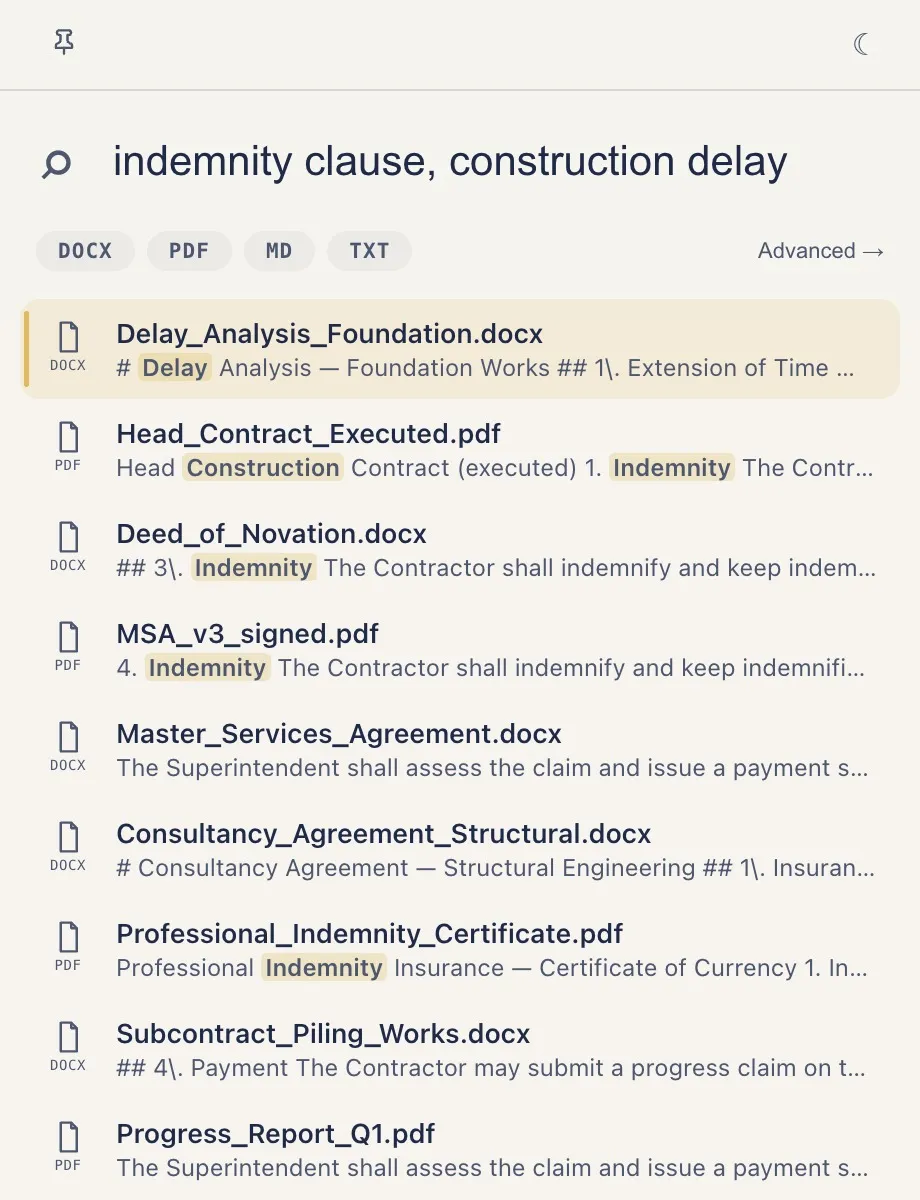
This is the model behind Fossick, a desktop app that searches your local documents by meaning, entirely offline. Indexing, embedding, and search all run on-device, and your files are never uploaded. For a fuller treatment of the risks, see private document search: find files without a data risk.
Search by meaning, not by remembering the filename
Confidential archives are often the hardest to search precisely because you cannot name every file cleanly. Contracts get saved as final_v3_signed.pdf, scans arrive as IMG_4471.jpg, and matters span hundreds of folders.
Keyword search only finds files that contain the exact words you type. Semantic search finds files by what they mean, so you can describe the document from memory:
- "indemnity clause capping liability at fees paid"
- "email approving the revised budget for the Q3 rollout"
- "engineering note about the bearing failure at low temperature"
You get the relevant documents even when your wording does not match the text on the page. If you want the underlying distinction, semantic search vs keyword search for documents walks through it with examples.
Scanned contracts and images count too
A large share of confidential material is not typed text — it is scanned signatures, faxed agreements, photographed whiteboards, and screenshots. Those are invisible to plain text search until the words inside them are recognised.
A local search tool should run OCR (optical character recognition) on-device so scanned PDFs and images become searchable without being uploaded to a recognition service. Fossick does this automatically for PDFs, PNGs, JPGs, and similar files, so a scanned NDA is as findable as a Word document. If most of your archive is scans, how to search scanned PDFs and images locally with OCR covers the workflow in detail.
Search, not chat — and why that matters for privacy
There is an important line between a search tool and an AI assistant. Fossick is search, not chat. It finds and ranks your files and opens them; it does not summarise them, answer questions about them, or generate text.
That is a deliberate boundary. A generative assistant needs to feed your document contents into a language model — and for confidential work, that is exactly the data movement you are trying to avoid. Because there is no model answering questions, there is no reason to send your text anywhere. You read the source document yourself, which is usually what a professional needs anyway: the actual clause, not a paraphrase. If you are weighing the two approaches, is it safe to search documents with AI? compares on-device and cloud.
How to prove your files never leave the machine
Trust in this category should be verifiable, not assumed. Here are concrete ways to confirm a tool is genuinely local before you point it at sensitive files.
Pull the plug
The simplest test is the most convincing: disconnect from the internet — unplug Ethernet, turn off Wi-Fi — and run a search. If indexing and results still work offline, the processing is happening on your device. Fossick is built to pass this test; the app functions with the network disconnected.
Watch the network
More technical evaluators can run a network monitor (or a firewall that logs outbound connections) while indexing a folder. You should see no uploads of file contents. Only licensing and billing checks touch the internet, and those carry no document data.
Check where the index lives
A local tool stores its index on your own disk. You can locate that data, back it up, and delete it — it is not sitting in someone else's account.
Run these checks once, and you can adopt the tool with the confidence that a compliance review would expect.
Getting started on your own documents
Setting up local search over a confidential archive is straightforward:
- Download the app for Windows or Mac.
- Point it at the folders you want searchable — a matter directory, a client workspace, a research library.
- Let it index and OCR in the background, on your machine.
- Search by describing what you remember; open the source file directly from the results.
Because everything is on-device, you can index tens of thousands of files without a single one being uploaded. The app is a one-time US$14.99 purchase with a 14-day money-back guarantee, so you can run the offline test above before committing. The one-time US$14.99 price is on the pricing page — and it includes the full app and all updates.
Frequently asked questions
Does Fossick upload my documents to the cloud?
No. Indexing, embedding, OCR, and search all run locally on your computer, and your files are never uploaded. Only licensing and billing communicate with the internet, and they carry no document contents. You can confirm this by disconnecting your network and running a search — it still works.
Can I search confidential files that are scanned or in images?
Yes. Fossick runs OCR on scanned PDFs and image files such as PNG and JPG automatically, entirely on-device. That makes the text inside a scanned contract or a photographed page searchable without sending the file to any external service.
Is this an AI chatbot for my documents?
No. Fossick is semantic search, not chat. It finds and ranks the relevant files and lets you open them; it does not summarise documents, answer questions, or generate text. That boundary is part of why your files never need to leave the machine.
How is semantic search different from the search built into Windows or Mac?
Built-in search largely matches filenames and exact keywords. Semantic search finds documents by meaning, so you can describe a file from memory and still retrieve it. See our Windows search alternative and Spotlight alternative articles for platform-specific comparisons.
How much does Fossick cost?
The app is a one-time US$14.99 purchase with a 14-day money-back guarantee. After that, there is a single one-time purchase of US$14.99, which includes the full app and all future updates. Current details are on the pricing page.