A Spotlight Alternative That Searches Document Contents on Mac
Free to try (1 folder, 200 files) · US$14.99 to keep · Mac & Windows
Spotlight is fast at finding an app or a filename you already remember. But ask it to find a document by what's inside it — a clause you half-remember, a figure buried in a scanned PDF, a report you can't name — and it often comes up short.
This article looks at exactly where macOS Spotlight falls down on document contents, why that happens, and what a private, meaning-based Spotlight alternative for document contents looks like. The goal is a search that reads your files the way you remember them, without sending anything to the cloud.
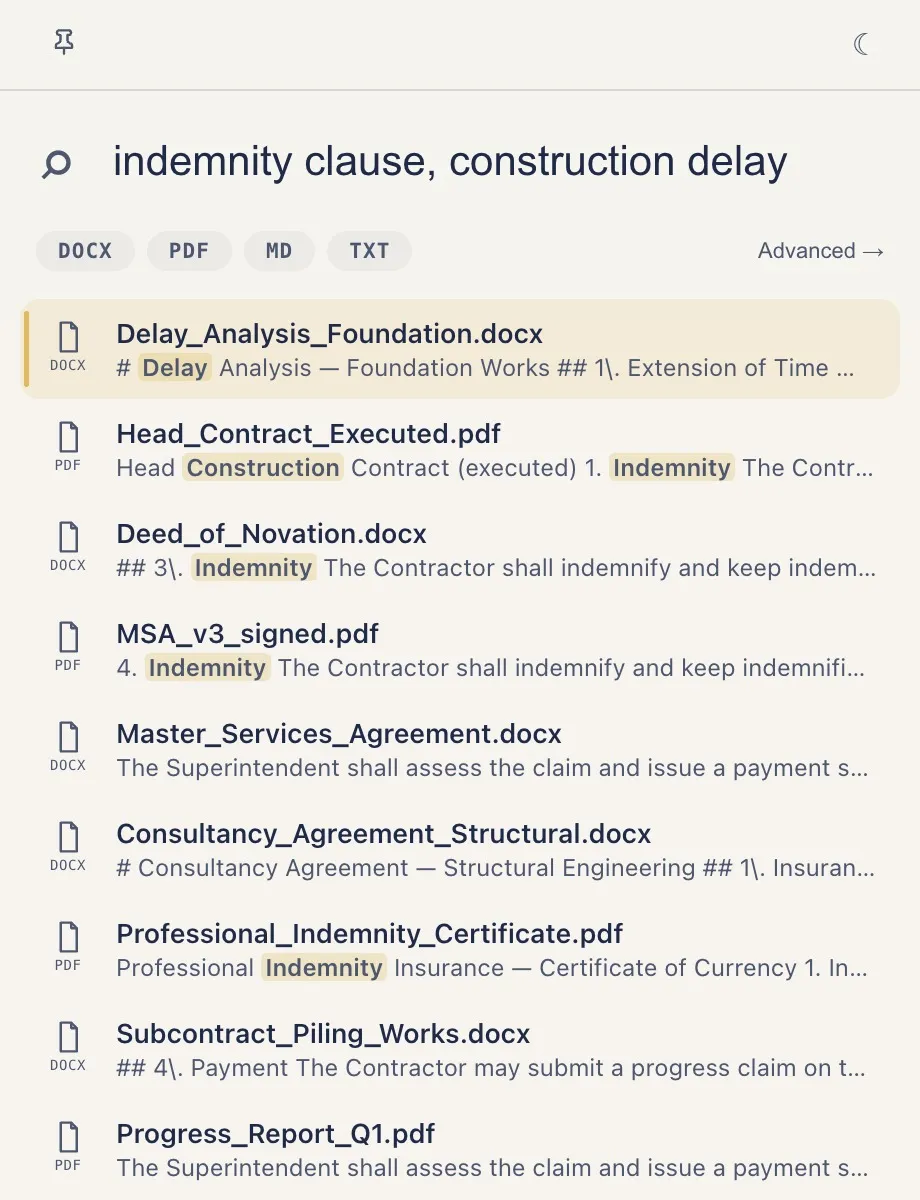
Where Spotlight falls short on document contents
Spotlight is genuinely good at what it was built for: launching apps, opening System Settings, doing quick calculations, and finding a file when you already know roughly what it's called. For everyday Mac navigation, it's hard to beat.
The trouble starts when you need to search within your documents. A few recurring gaps stand out:
- It leans heavily on filenames and metadata. If a file is named
Draft_v3_final_FINAL.docx, Spotlight can find it — but only if you remember that name. - Content indexing is shallow and inconsistent. Spotlight does index some text inside documents, but coverage varies by file type, and large or complex PDFs are often only partially indexed.
- It matches exact words, not ideas. Search for termination clause and Spotlight looks for those literal words. A contract that says ending the agreement won't surface.
- Scanned documents are invisible. A PDF that is really a photo of a page contains no text layer, so there's nothing for Spotlight to match against.
None of this means Spotlight is broken. It's just aimed at a different job than deep document search.
Why keyword matching misses the document you need
The core limitation is that Spotlight is a keyword tool. It compares the letters you type against the letters in your files. That works when your memory and the document use the same words — and fails the moment they diverge.
In real work, they diverge constantly. You remember the gist of a memo, not its phrasing. You recall that a report discussed staff turnover, but the document calls it attrition or retention. Keyword search treats those as unrelated.
This is the difference between keyword search and semantic search. Semantic search matches on meaning, so related concepts turn up even when the wording differs. We cover the distinction in more depth in semantic search vs keyword search for documents and full-text search vs semantic search for a folder.
For professionals who search by memory rather than filename, this is the single biggest reason Spotlight feels frustrating.
The scanned-document blind spot
A large share of professional documents are scans: signed contracts, receipts, historical records, PDFs exported from a copier. Visually they look like text, but technically they're images. There is no character data underneath for a keyword engine to read.
Spotlight will happily index the filename of a scanned PDF, but not a single word of its contents — because, as far as the file is concerned, there are no words.
The fix is OCR (optical character recognition), which converts the picture of text into actual searchable text. The catch is that many OCR workflows involve uploading files to a web service, which is a non-starter for confidential material. A good local alternative runs OCR on your own machine, so the text becomes searchable without ever leaving it. We walk through this in how to search scanned PDFs and images locally with OCR.
What a better Spotlight alternative looks like
If Spotlight's weak spots are contents, meaning, and scans, then a strong alternative should be defined by three things:
- It reads inside files, thoroughly. PDFs, Word documents, plain text, and more — indexed by their actual content, not just their names.
- It searches by meaning. You type what you remember in plain language, and it returns the documents that are about that, even if the words don't match.
- It handles scans automatically. OCR runs in the background so images and scanned PDFs become searchable like everything else.
One more requirement matters just as much for professionals: privacy. Search that works only by shipping your files to a server isn't an option when those files are privileged, regulated, or under NDA.
That's the gap Fossick is built for — a desktop app that searches your local documents by meaning, entirely offline. It isn't a chatbot and it doesn't answer questions; it's search that actually finds the right file.
How Fossick stays private and offline
The trust proof is simple: you can unplug the Wi-Fi and Fossick still works.
Everything that touches your documents happens on your Mac:
- Indexing reads your folders locally.
- Embedding — the step that lets it understand meaning — runs on-device.
- Search queries that local index. No round trip to a server.
- OCR for scans and images is processed on your machine.
Your documents are never uploaded. There's no cloud account holding your files, and no third party in the loop. The only thing that ever touches the internet is licensing and billing — never your content. If offline search is new to you, our guide to offline document search explains the model in full.
It's worth being clear about what Fossick is not. It's not generative AI. It won't summarise a document or write you an answer. It finds the files you're looking for and gets out of the way — which, for confidential work, is exactly the point.
Who this matters most for
Meaning-based, offline search on Mac tends to matter most for people whose files are both confidential and numerous:
- Lawyers searching case files and contracts by concept rather than exact phrasing — see how lawyers search case files by meaning, offline.
- Consultants hunting for a slide or framework from a deck they can't name — see document search for consultants.
- Accountants locating records and statements across years of folders — see document search for accountants.
- Engineers and researchers digging specs, papers, and notes out of large archives.
If your day involves thinking "I know I have a document about this somewhere" more than "I know exactly what that file is called", that's the workflow this replaces.
Fossick runs on Mac and Windows, and it's a one-time US$14.99 purchase with a 14-day money-back guarantee — you can download it here and point it at a folder to see what it surfaces. Pricing details for when you're ready are on the pricing page.
Frequently asked questions
Doesn't Spotlight already search inside documents?
To a degree, yes — Spotlight indexes some text in some file types. But coverage is inconsistent, large PDFs are often only partly indexed, and it matches exact keywords rather than meaning. It also can't read scanned documents that have no text layer.
Can it find a document if I only remember what it was about?
That's the main advantage of semantic search. You describe the content in plain language — the topic, an idea, a phrase you half-remember — and it returns documents that are about that, even if they don't contain your exact words. Spotlight's keyword matching can't do this reliably.
Does it search scanned PDFs and images?
Yes. Fossick runs OCR on scanned PDFs and image files like PNG and JPG automatically, on your Mac, so their contents become searchable. Spotlight generally can't, because those files contain no underlying text to match.
Are my documents ever uploaded anywhere?
No. Indexing, embedding, search, and OCR all run locally on your device, and it works with the internet disconnected. Only licensing and billing ever touch the network — never your file contents.
Is Fossick an AI chatbot that answers questions?
No. Fossick is search, not chat. It has no generative AI and doesn't summarise or answer questions — it finds the right documents and leaves the reading to you, which keeps confidential material fully under your control.