How to Search the Text Inside Images and Screenshots
Free to try (1 folder, 200 files) · US$14.99 to keep · Mac & Windows
You screenshotted a contract clause, photographed a whiteboard, or saved a scan as a PNG — and now you cannot find it. The words are right there in the picture, but your computer treats the file as pixels, not text. Standard search looks at filenames and metadata; it never reads what is in the image.
This guide explains how to search text inside images and screenshots locally, using optical character recognition (OCR) that runs on your own machine. No cloud upload, no account for your files, no waiting on a web service. Just the ability to type what you remember and land on the right image.
Why you can't search text inside images by default
An image file — a PNG, JPG, or screenshot — is a grid of colored dots. When you take a screenshot of an email or photograph a printed page, the words look like text to you, but to your operating system they are just a picture. There is no underlying text layer to match against.
That is why searching your computer for a phrase you clearly remember seeing returns nothing. Tools like Windows Search or Spotlight index filenames, folders, and some document contents, but they generally do not read the text painted inside an image.
The same problem affects scanned PDFs, which are often just images wrapped in a PDF container. If a document was scanned rather than typed, it usually has no searchable text either. We cover that case in detail in how to search scanned PDFs and images locally with OCR.
What OCR does — and why it matters
Optical character recognition (OCR) is the process of analyzing an image and extracting the text it contains. It looks at the shapes of letters and words and produces machine-readable text that can then be indexed and searched.
Once OCR has run, a screenshot of a meeting agenda or a photo of an invoice becomes as searchable as a typed document. You can find it by the words it contains rather than by guessing the filename you assigned six months ago.
OCR handles a wide range of everyday sources:
- Screenshots of emails, chats, dashboards, and web pages
- Photos of printed contracts, receipts, and business cards
- Scanned pages saved as PNG or JPG
- Diagrams and slides captured as images
The quality of the result depends on the clarity of the image. Clean, high-contrast text reads very well; a blurry, angled phone photo will read less reliably. But for most captured documents, OCR turns an unsearchable picture into findable text.
The privacy problem with online OCR tools
Plenty of websites offer to OCR an image for you. You upload the file, they process it in the cloud, and they hand back the text. For a photo of your lunch that is fine. For a photographed settlement agreement, a client's tax return, or a screenshot of internal financials, it is a real problem.
Uploading a confidential image means a copy now lives on someone else's server, subject to their retention policies, their staff access, and their security posture. For lawyers, accountants, consultants, and researchers, that can breach confidentiality obligations before you have even found the file.
The alternative is to run OCR on-device, so the image never leaves your computer. That is the approach we recommend and the one we describe in private document search: find files without a data risk. The test is simple: if you can search your images with the Wi-Fi unplugged, nothing was uploaded.
How to search text inside images on your own machine
Here is the practical workflow for making your screenshots and photographed documents searchable without sending them anywhere:
- Gather your images. Point your search tool at the folders where screenshots and photos pile up — your Desktop, Downloads, a Screenshots folder, or a scans directory.
- Let OCR run locally. The tool reads each image and extracts its text on your machine. This happens once, during indexing, so searches afterward are fast.
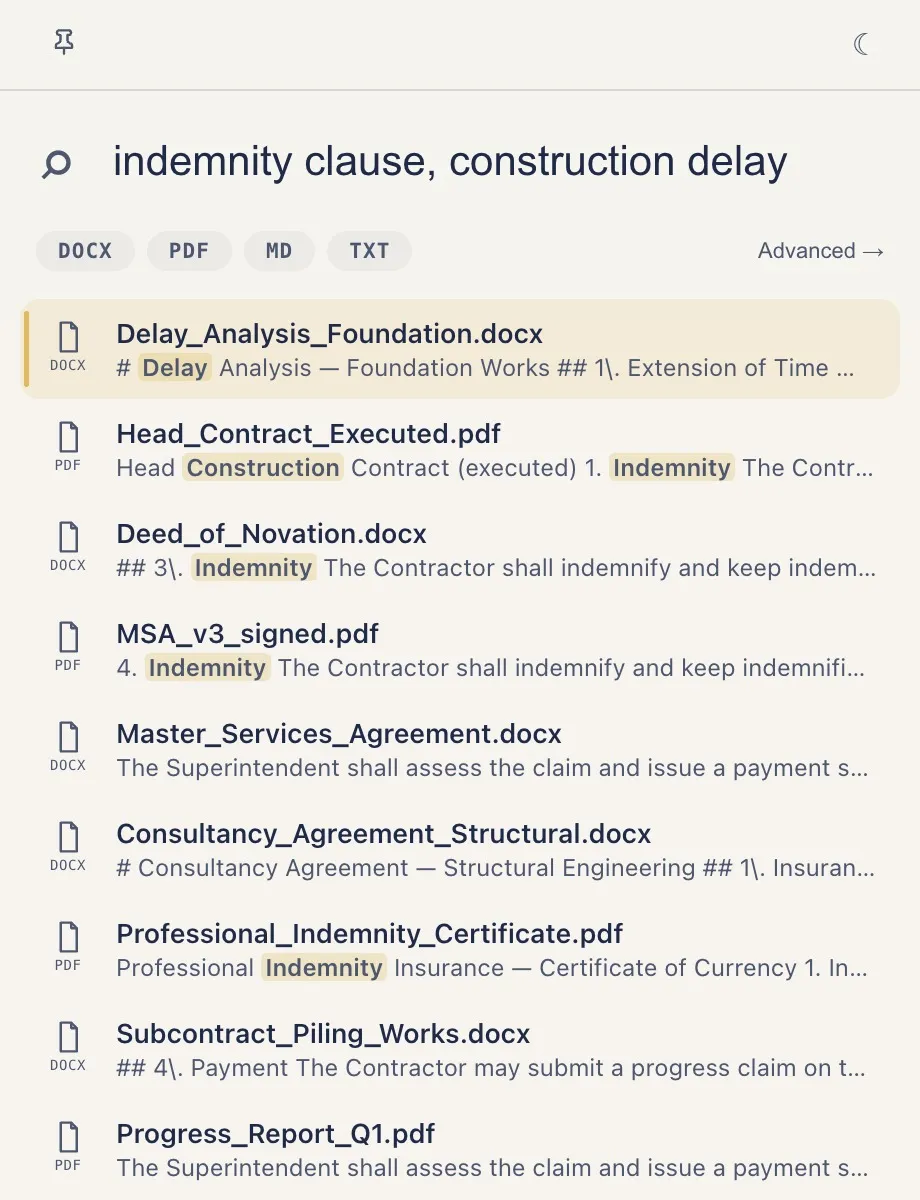
- Search by what you remember. Type a phrase, a name, or a description of the content. The tool matches against the extracted text and shows you the matching images.
- Open the original. You jump straight to the screenshot or photo you were looking for.
Fossick, a desktop app that searches your local documents by meaning, entirely offline, does all of this automatically. When it indexes a folder, it runs OCR over scanned PDFs and images — PNG, JPG, and similar — on-device, so the text inside those files becomes searchable alongside your Word docs and text files. Nothing is uploaded at any stage.
Keyword match vs. searching by meaning
Once your images carry a text layer, you can search them in two different ways.
Keyword search looks for the exact words you type. It works when you remember the precise phrasing — but images add a wrinkle: OCR is not perfect, and a misread character can cause an exact-match search to miss the file entirely.
Semantic search matches on meaning rather than exact characters. If you search for quarterly revenue forecast it can surface a screenshot that says Q3 sales projection, even though none of your words appear verbatim. That tolerance is especially useful for OCR text, where the extracted words may not be a flawless copy of the original.
We compare the two approaches in depth in semantic search vs keyword search for documents. For finding a half-remembered screenshot, searching by meaning tends to win, because you rarely recall the exact wording of something you captured months ago.
Search, not chat: what Fossick is and isn't
It is worth being clear about what this kind of tool does. Fossick is a search tool. It finds the images and documents that match what you are looking for and takes you to them.
It is not a chatbot. There is no generative AI, it does not summarize your files, and it does not answer questions in prose. It will not invent an answer or paraphrase a contract. It points you to the exact file so you can read the source yourself — which is what you want when the stakes are confidential.
That distinction also matters for trust. Because the work is search and OCR rather than a large language model calling out to the cloud, everything can run locally. If you are weighing cloud AI against on-device tools, is it safe to search documents with AI? walks through the trade-offs.
Fossick runs on Windows and Mac and is a one-time US$14.99 purchase with a 14-day money-back guarantee; when you are ready, the pricing page lays out the options, including a one-time purchase.
Frequently asked questions
Can I search the text inside screenshots without uploading them?
Yes. With on-device OCR, the text inside your screenshots is extracted and indexed locally, so you can search it without sending any image to the cloud. Fossick does this entirely offline, meaning you can index and search with the Wi-Fi disconnected and nothing ever leaves your computer.
What image formats can be searched with OCR?
Common raster formats like PNG and JPG are well supported, along with scanned pages saved as images or inside PDFs. As long as the image contains legible text, OCR can extract it and make it searchable. Clear, high-contrast images produce the most accurate results.
How accurate is OCR on phone photos and screenshots?
Screenshots and clean scans usually read very accurately because the text is sharp and evenly lit. Phone photos taken at an angle or in low light can produce errors. Searching by meaning rather than exact keywords helps here, since it can still surface the right file even when a few characters are misread.
Does Fossick answer questions about my images like a chatbot?
No. Fossick is a search tool, not a chat assistant. It has no generative AI and does not summarize or answer questions — it finds the exact image or document that matches your query and takes you to it, so you read the original source yourself.
Is searching image text different from searching scanned PDFs?
The underlying step is the same: OCR extracts a text layer from pixels so it can be searched. Standalone images like PNG and JPG and scanned PDFs both start out unsearchable, and on-device OCR fixes both. You can read more in our guide to searching scanned PDFs and images locally with OCR.