The Best Alternative to Copernic Desktop Search: Private, Offline Semantic Search for Your Own Files
Short answer: A strong alternative to Copernic Desktop Search is a local semantic search tool that finds documents by meaning instead of exact keywords, while keeping every file on your computer. Fossick does this on Windows and Mac. It indexes, OCRs, and searches entirely on-device, works with Wi-Fi off, and is search only, with no chatbot.
Free to try (1 folder, 200 files) · US$14.99 to keep · Mac & Windows
If you have used Copernic Desktop Search, you know the appeal. It builds a local index, you type a word, and matching files appear. That works well when you remember the exact term. It works less well when you remember the idea of a document but not the words inside it, which is how most people actually recall old contracts, reports, and client notes.
This article compares Copernic's keyword-based approach with on-device semantic search. It explains what each does well, where they differ on privacy and file coverage, and how to decide whether looking for an alternative to Copernic is worth your time or whether the tool you have is already enough.
What Copernic Desktop Search does well, and where keyword search stops
Copernic Desktop Search is good at exact-match lookup across a local index of your files. Like other desktop search tools that index files on a local computer, it crawls your folders ahead of time so results come back quickly instead of scanning every file on demand.
The limit is the matching method. Classic full-text search stores the terms in each document and returns files that contain the terms you type. The SQLite FTS5 documentation shows how this kind of index works: it matches tokens, not meaning. That is precise and predictable, but it means:
- A search for termination will not find a clause that only says either party may end this agreement.
- A search for budget overrun misses a memo that talks about costs exceeding the approved estimate.
- You need to guess the author's vocabulary, not your own.
For lawyers, consultants, and engineers with years of documents, that guessing game is often where the time goes. If this sounds familiar, our semantic search vs keyword search guide goes deeper on the trade-off.
How a semantic alternative to Copernic works
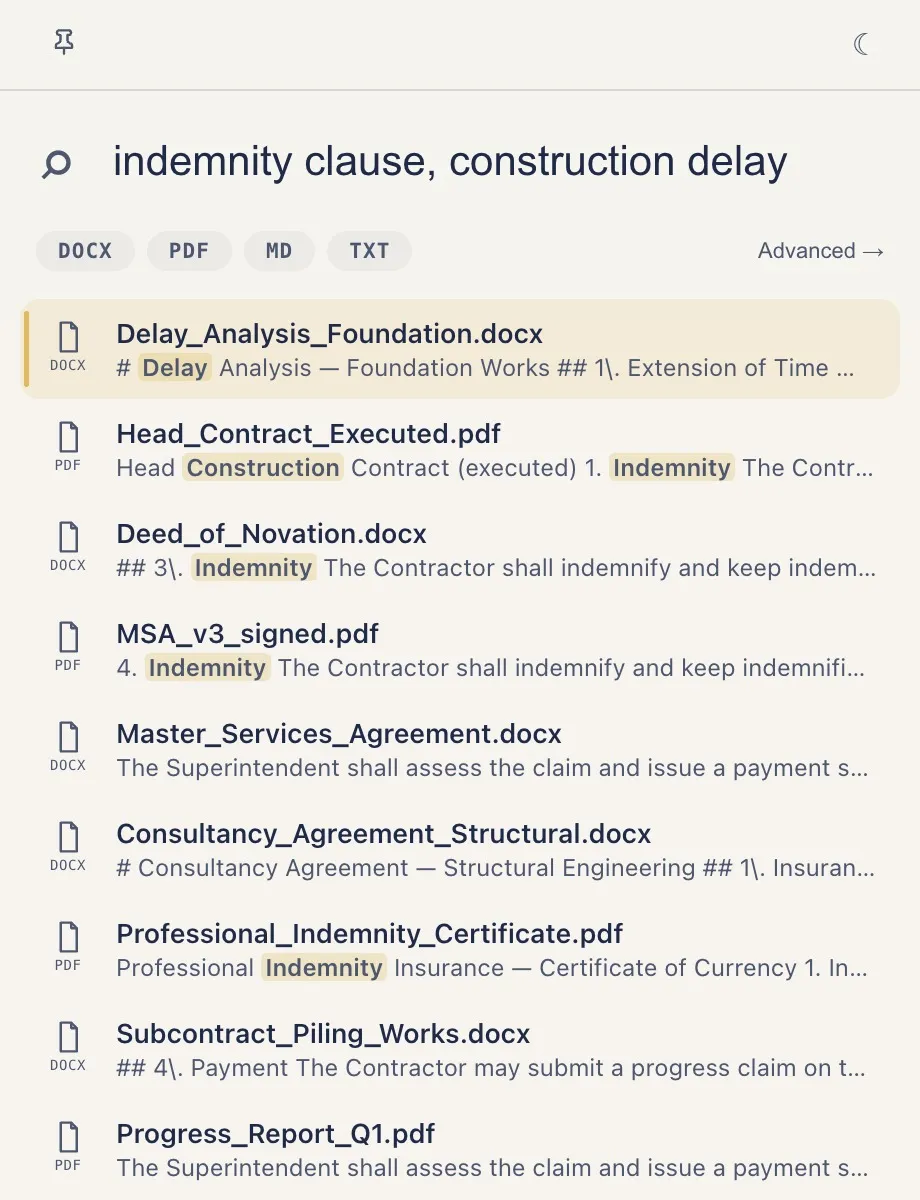
A semantic alternative to Copernic finds documents by what they mean, not only by which words they contain. Semantic search aims to match the intent of a query, so you can describe what you remember in plain language.
Fossick, a desktop app that searches your local documents by meaning entirely offline, does this with sentence embeddings. Each passage of text is converted into a list of numbers that represents its meaning; your query is converted the same way, and the closest passages are returned. This is the technique described in the Sentence-BERT paper.
The specifics:
- Model: all-MiniLM-L6-v2, a small open sentence-embedding model producing 384-dimension vectors, quantized to about 22 MB, running locally.
- Speed: about 15-20 ms median per semantic search over a 52-document folder (Apple M1 MacBook, 8 GB RAM, measured 2026-09-21).
- Index size: about 1.9 MB on disk for that same 52-document folder.
It is important to be clear about what it is not. Fossick has no chatbot and no generative AI. It does not summarise documents or write answers. You type what you remember, and it shows you the files and passages that match. You still read the document yourself.
Copernic vs Fossick at a glance
The core difference is keyword matching versus meaning-based matching, with Fossick also covering Mac and running OCR on-device.
| Copernic Desktop Search | Fossick | |
|---|---|---|
| Matching method | Keywords / full text | Meaning (semantic) |
| Platforms | Windows | Windows and Mac |
| Scanned PDFs and images | Depends on version and setup | On-device OCR, automatic |
| Where processing happens | Local index | 100% on-device, works with Wi-Fi off |
| Chat or generative AI | No | No, search only |
Fossick handles PDF, Word (.docx, .doc), Excel (.xlsx), PowerPoint (.pptx), OpenDocument text (.odt), plain text, Markdown, CSV, HTML, email files (.eml, .msg), and images (PNG, JPG). Scanned PDFs and images are made searchable with on-device OCR, so a photographed receipt or a scanned signed contract becomes findable by its content. See how to search scanned PDFs locally for more on that workflow.
One honest caveat: if your main need is searching a live mail client mailbox, check that your email is exported to .eml or .msg files, since Fossick searches files in folders you choose.
When switching makes sense, and when it does not
Switching makes sense when you regularly search for concepts rather than exact words, or when you need the same tool on Windows and Mac.
Good reasons to switch
- You often remember what a document was about but not its title or wording.
- You work across a Windows PC and a Mac and want one search approach on both.
- A meaningful share of your archive is scanned PDFs or images.
- You want a clear, verifiable guarantee that nothing is uploaded, because you handle privileged or regulated material.
Reasons to stay with keyword search
- You mostly search for exact identifiers: case numbers, invoice IDs, part numbers. Keyword tools are excellent at this.
- Your current setup already finds what you need in seconds.
- You depend on features specific to your current tool that you would miss.
Many people run both: a keyword tool or the built-in Windows index for exact strings, and semantic search for the I know it exists somewhere moments.
Privacy: what stays on your machine
With Fossick, your documents never leave your computer: text extraction, OCR, embedding, and search all run locally. The only part of the app that touches the internet is licensing and billing.
The simplest way to verify this is to unplug. Turn off Wi-Fi, index a folder, and search it. It still works, because nothing depends on a remote server. For professionals bound by client confidentiality or data-protection rules, that removes a whole category of question about third-party processors, since no third party ever receives the files.
This also differs from cloud search tools and AI assistants that process your content on a provider's servers. If you are weighing those options, our guide on whether it is safe to search documents with AI walks through the differences. On-device search does not replace good device hygiene, though: keep full-disk encryption and a strong login on the laptop that holds your files.
How to test an alternative to Copernic without disrupting your work
The lowest-risk approach is to point the new tool at one real folder and run the searches you actually struggle with.
- Download Fossick for Windows or Mac. It is free to try with no sign-up or card, limited to 1 folder and up to 200 files.
- Pick a folder you know well, such as one client matter or one project, so you can judge whether results are right.
- Run five or six searches phrased the way you remember things, not the way you think the author wrote them.
- Compare against what your keyword tool returns for the same questions.
Indexing is quick on modest hardware: in testing, 52 mixed documents (Word, PDF including scanned pages, Excel, CSV, Markdown) were indexed from scratch in about 81 seconds on an 8 GB M1 MacBook, including model load and OCR. Re-indexing is incremental, so only new or changed files are processed again; re-checking that same unchanged folder took about 7 seconds.
If it earns a place in your workflow, the full app is a single one-time purchase of US$14.99 with no subscription, covering every folder, every file type, and all future updates, backed by a 14-day money-back guarantee.
Frequently asked questions
Is Fossick a direct replacement for Copernic Desktop Search?
It replaces the main job, finding documents on your own computer, but works differently. Copernic matches keywords, while Fossick matches meaning, so you can search with a description of what you remember. Some people keep a keyword tool for exact IDs and use Fossick for concept searches.
Does Fossick work on Mac?
Yes. Fossick is a desktop app for both Windows and Mac, and on both it runs indexing, OCR, and search entirely on the device.
Does Fossick upload my files or use a chatbot?
No. Documents are never uploaded, and the app works with Wi-Fi turned off; only licensing touches the internet. It is search only, with no chatbot, no generative AI, and no summaries.
Can it search scanned PDFs and photos of documents?
Yes. Scanned PDFs and images such as PNG and JPG are processed with on-device OCR automatically, so their text becomes searchable by meaning just like a Word file or native PDF.
Can I still search for exact words and numbers?
Semantic search is designed for meaning, so it is strongest when you describe a topic or situation. For strict exact-string lookups like an invoice number, a keyword tool or your operating system's built-in search is often the better fit, and the two approaches work well side by side.