How to Search a Document for a Word (and for Ideas It Doesn't Contain Word-for-Word)
Sometimes you know the exact word you're looking for. Other times you remember the idea — a clause about early termination, a paragraph on soil settlement, a figure someone quoted — but not the precise phrasing the author used. Both are legitimate searches, and they call for slightly different tools.
This guide covers both. First, the fast, reliable way to search a document for a specific word inside a single file. Then, the harder problem: finding the right passage when your memory doesn't match the words on the page — and how to do all of it without your confidential documents ever leaving your computer.
The quick answer: Find within a single document
If the document is already open, every major app has a built-in Find feature. Press:
- Ctrl+F on Windows
- Cmd+F on Mac
A small search box appears. Type the word, press Enter, and the app jumps to the first match and highlights it. Press Enter again (or click the arrows) to cycle through every occurrence.
This works in Microsoft Word, Adobe Acrobat and most PDF readers, web browsers, Notepad, TextEdit, and code editors. In Word you can also open the Navigation pane (View → Navigation) to see a list of every match at once, which is handy in long reports.
A few things that trip people up:
- Case sensitivity. Most Find boxes ignore case by default, but some have a Match case toggle. If a search returns nothing, check it isn't set.
- Whole words. Searching plan will also match planning and explanation unless you enable Match whole word.
- Scanned PDFs. If a PDF is a picture of a page (a scan or photo), Find won't work at all — there's no text layer to search. More on that below.
For a deeper walkthrough of finding text inside one file, see how to search within a document and how to search within a PDF.
When you need to search across many documents at once
Ctrl+F has one hard limit: it only searches the document that's open in front of you. The moment your answer could be in any of fifty contracts, a folder of research papers, or three years of reports, opening files one at a time to press Ctrl+F is hopeless.
This is where desktop search tools come in. They build an index of the text inside your files so you can search all of them from one box. Windows Search and macOS Spotlight do a version of this, but they lean heavily on filenames and often miss text buried deep inside documents.
A dedicated tool searches the contents of every file — Word docs, PDFs, plain text, and more — and returns the exact documents that contain your word, no matter where they sit on disk. If that's your situation, see the fastest way to search a folder of documents and how to search across thousands of files at once.
When searching for a word isn't enough
Keyword search — whether Ctrl+F or a full-text index — has one blind spot: it can only find the exact characters you type. It matches strings, not meaning.
That's fine when you remember the precise term. It fails constantly when you don't:
- You search termination but the contract says right to cancel.
- You search revenue but the report says top-line growth.
- You search foundation cracks but the inspection note says structural settlement.
- You look for a headcount figure but the deck labels it FTEs.
Every one of those is the same idea in different words. A literal search returns nothing, and you're left convinced the document doesn't exist — when really you just guessed the wrong synonym. The more documents you have, and the longer ago you wrote them, the worse this gets, because you no longer remember the author's exact vocabulary.
The fix isn't a better keyword. It's a different kind of search.
How semantic search finds ideas, not just words
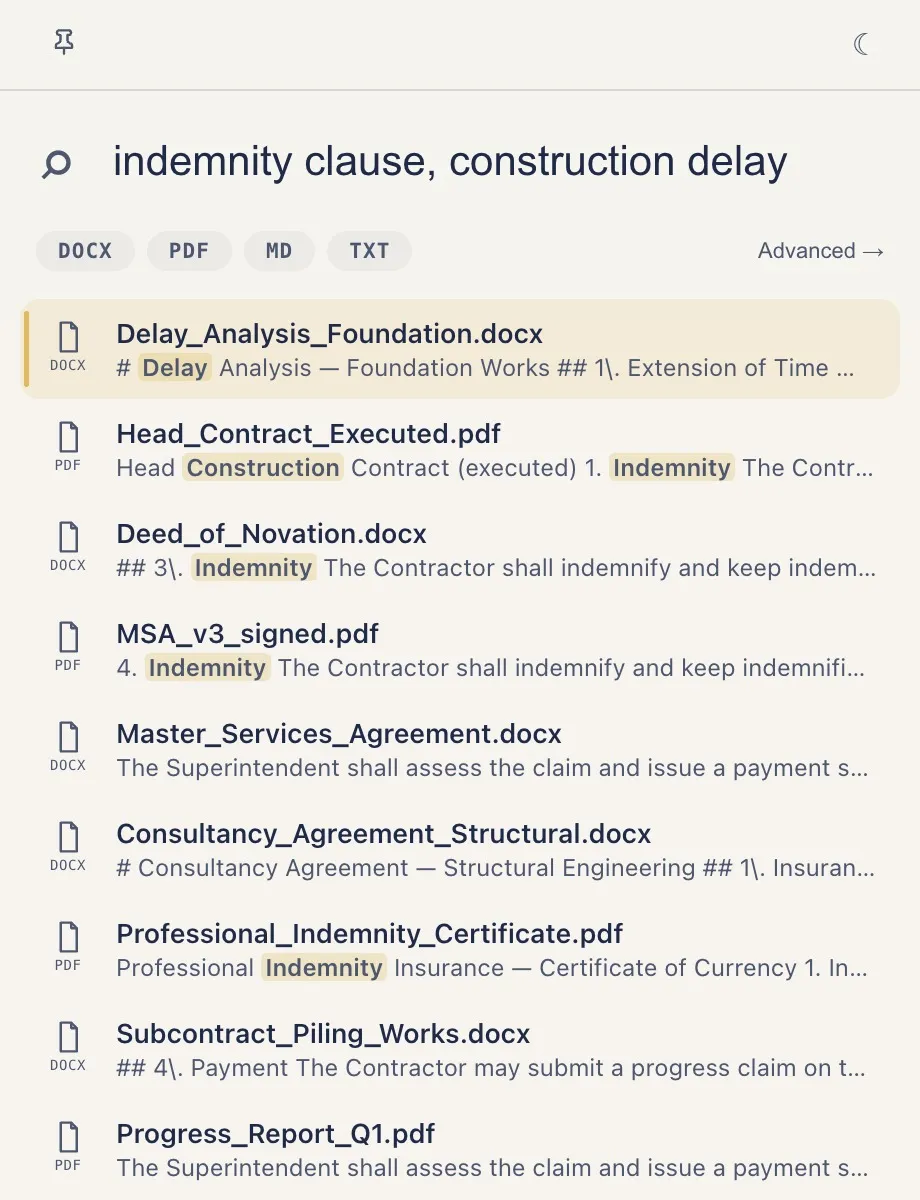
Semantic search matches on meaning. Instead of comparing the letters you typed against the letters on the page, it represents both your query and each passage as points in a mathematical space where related concepts sit close together. A search for lease exit terms lands near a clause that reads the tenant may surrender the premises, even though they share almost no words.
In practice, that means you can type what you remember — plain, approximate language — and still find the right document:
- the part about penalties for late delivery
- client concerns about data retention
- the section comparing two materials for corrosion resistance
You don't need the exact phrase. You describe the idea, and the tool ranks the passages that mean the same thing.
To be clear about what this is and isn't: semantic search finds and ranks your documents. It is not a chatbot. It does not write summaries or answer questions in prose — it points you to the real passage in the real file so you can read it in context and trust it. If you want the full comparison, we cover it in semantic search vs keyword search for documents and full-text search vs semantic search for a folder.
Doing all of this privately, with the Wi-Fi unplugged
For anyone handling confidential material — lawyers, accountants, consultants, engineers, researchers — there's a catch with most "AI" search tools: they upload your documents to a server to process them. For privileged, regulated, or NDA-bound files, that's often a non-starter.
Fossick is a desktop app for Windows and Mac that does private, offline semantic search over your own local documents. It combines keyword and meaning-based search in one place, and the important part is where the work happens: indexing, embedding, and search all run on your device. Your files are never uploaded.
You can prove it to yourself — pull the Wi-Fi and Fossick keeps working, because nothing about your documents needs the internet. (Only licensing checks ever touch the network; your files never do.)
That combination matters:
- Exact-word search for when you know the term.
- Meaning-based search for when you only remember the idea.
- Fully offline, so confidential files stay on your machine.
More on the privacy model in private document search and do you have to upload files to search them with AI?.
Searching scanned documents and images for a word
A common reason Ctrl+F "finds nothing" is that the document is a scan — a photograph of a page saved as a PDF, or a screenshot. There's no selectable text underneath, so keyword search has nothing to match.
The answer is OCR (optical character recognition), which reads the text out of the image so it becomes searchable. Fossick runs OCR automatically and on-device on scanned PDFs and image files (PNG, JPG, and similar) as it indexes them — so a word buried in a scanned invoice or a photographed contract page becomes findable, and it happens without sending the image anywhere.
If most of your archive is scanned, see how to search scanned PDFs and images locally with OCR and how to search text inside images and screenshots.
Which approach should you use?
Match the tool to what you actually know:
- You know the exact word, and the file is open → Ctrl+F / Cmd+F. Nothing beats it for speed in a single document.
- You know the exact word, but it could be in any of many files → a full-text desktop search that indexes file contents.
- You remember the idea, not the wording → semantic search, which finds passages by meaning across your whole library.
- The document is a scan or image → a tool with built-in OCR, or the word simply won't be searchable.
Fossick covers all four in one app, and it's free to try during the beta — you can download it here and point it at a folder to see it index and search your own files. If you decide to keep it, simple one-time and subscription options are available, and every plan includes the full app.
Frequently asked questions
How do I search a document for a specific word?
Open the document and press Ctrl+F on Windows or Cmd+F on Mac. Type the word, press Enter to jump to the first match, and use the arrows or Enter again to move through every occurrence. In Microsoft Word, the Navigation pane also lists all matches at once.
Why can't I find a word I know is in the document?
There are three common reasons: the Match case or Match whole word option is on and filtering out matches; the document is a scanned image with no text layer, so there's nothing to search; or the author used a different word than the one you typed. For that last case, meaning-based search finds the passage even when the exact word differs.
Can I search for a word across many documents at once?
Yes, but not with Ctrl+F, which only searches the open file. You need a desktop search tool that indexes the contents of every document in a folder. Fossick does this across Word docs, PDFs, text, and images, and returns the exact files that contain your word or idea.
Does searching my documents mean uploading them to the cloud?
It doesn't have to. Many AI search tools upload files to a server, but Fossick runs entirely on your device — indexing, OCR, and search all happen locally, and your documents are never uploaded. You can confirm it by disconnecting from the internet and searching anyway.
Is Fossick a chatbot that answers questions about my files?
No. Fossick is search, not chat. It finds and ranks the real passages inside your documents so you can read them in context — it does not generate summaries or write answers, and there is no LLM involved in searching your files.