How to Search Within a Document: Find Any Word or Phrase Fast
You know the information is in there somewhere. Maybe it's a clause in a 60-page contract, a figure buried in a report, or a sentence you skimmed last week. The question is how to search within a document quickly, without scrolling for ten minutes.
This guide covers the practical tools already on your computer for searching inside a single file, where they fall short, and how semantic search finds the passage you mean even when you don't remember the exact words — all of it running offline on your own machine.
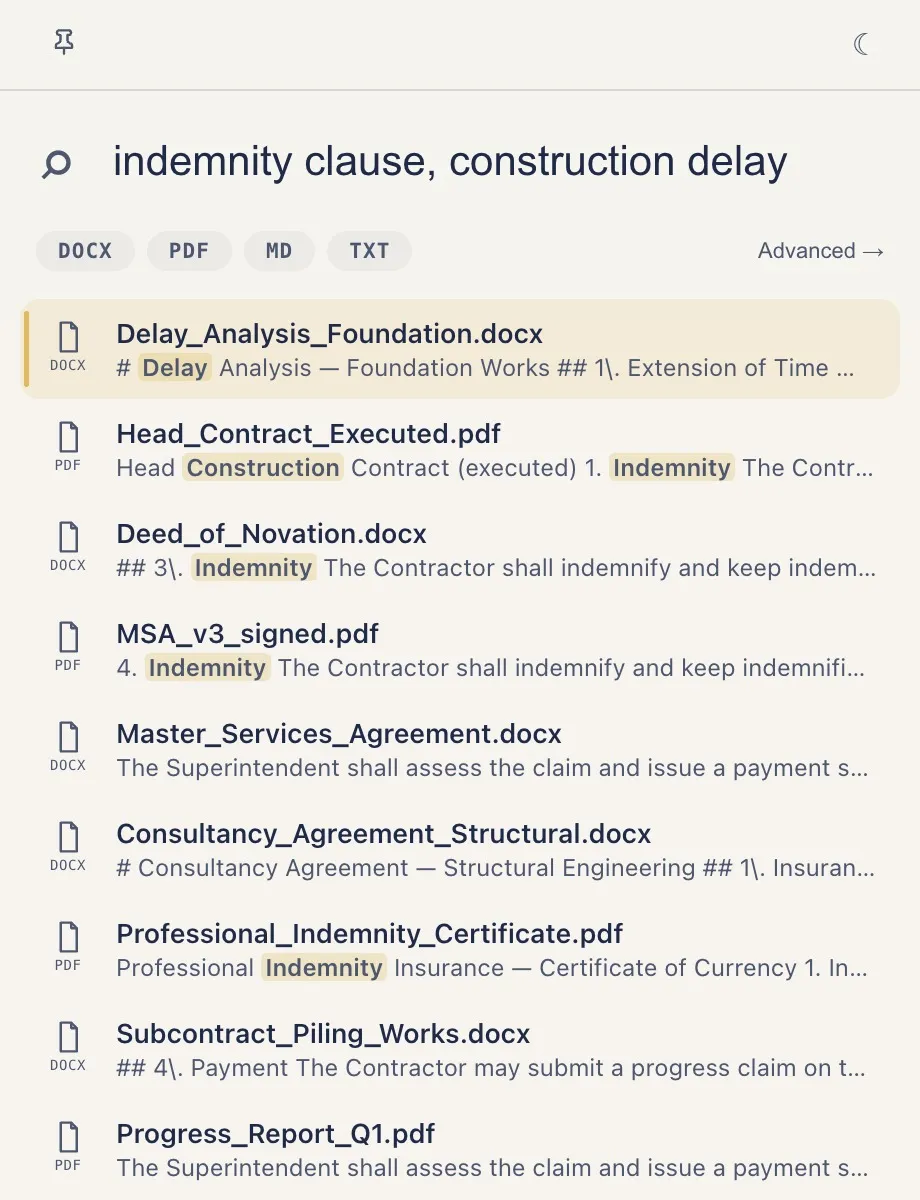
The fastest way to search within one document
Nearly every program that opens documents has a built-in find function. It's the first thing to reach for when you already know the exact word or phrase you're looking for.
- Web browsers, PDF readers, text editors: press Ctrl+F (Windows) or Cmd+F (Mac) to open a find bar, type your term, and press Enter to jump between matches.
- Microsoft Word: Ctrl+F opens the Navigation pane, which lists every match and lets you click through them. Use Find & Replace (Ctrl+H) for more control.
- Adobe Acrobat / most PDF viewers: Ctrl+F searches the current PDF; Ctrl+Shift+F often opens an advanced search with whole-word and case options.
- Apple Preview and Pages: Cmd+F searches the open file and highlights results in the sidebar.
For a single, known term inside a file you already have open, this is unbeatable — instant and precise.
Why built-in find falls short
Ctrl+F is literal. It matches the exact characters you type and nothing else. That works until it doesn't, and in real documents it often doesn't.
- You remember the meaning, not the wording. You search "payment deadline" but the contract says "remittance shall be due within thirty days." No match.
- Synonyms and phrasing vary. "Layoff," "redundancy," and "reduction in force" mean the same thing to a reader, but not to a text-match tool.
- The file is a scanned image. A PDF made from a scanner or photo has no selectable text, so Ctrl+F finds nothing even though you can clearly see the words.
- It only searches one file at a time. If you're not sure which document holds the answer, find-in-page can't help you.
These are the gaps that meaning-based search is designed to close. For a deeper comparison, see full-text search vs semantic search for a folder.
Searching by meaning, not exact words
Semantic search matches concepts instead of characters. Instead of hunting for a specific string, you describe what you remember in plain language, and the tool ranks passages by how closely their meaning lines up with your query.
So a search for "how much notice to cancel the lease" can surface a paragraph that reads "tenant may vacate upon sixty days' written notification" — no shared keywords required. This is the difference between finding text and finding information.
This matters most in exactly the situations where Ctrl+F breaks down: long documents, unfamiliar phrasing, and large collections of files where you're not sure where the answer lives. If you often lose files entirely, how to find a document you can't remember the name of covers that case.
Doing it privately, offline, on your own machine
Many meaning-based search tools work by uploading your documents to a cloud service. For anyone handling confidential material — contracts, client records, financials, research — that's a non-starter.
Fossick is a desktop app for Windows and Mac that searches your local documents by meaning, entirely offline. Indexing, embedding, and search all run on your device. Your files are never uploaded — you can pull the Wi-Fi cable and it still works. Only licensing checks ever touch the internet.
A few things to be clear about what it is and isn't:
- It is search, not chat. There's no chatbot, no generated summaries, and no answers written for you. It finds and ranks the real passages in your real files.
- It reads PDFs, Word documents, text files, and more, and runs OCR automatically on scanned PDFs and images so you can search text that isn't selectable.
- Nothing about your documents leaves your computer, which is the whole point for a private document search workflow.
Searching across many documents at once
Once you stop thinking about a single file, meaning-based search changes how you work. Instead of opening documents one by one and pressing Ctrl+F in each, you describe what you need and search your whole library in one pass.
That's useful when:
- You know a detail exists somewhere in a folder of hundreds of files but not which one.
- You're reviewing a set of contracts and want every clause about, say, liability caps, regardless of how each was worded.
- You inherited a shared drive with inconsistent filenames and no structure.
Fossick indexes a folder and lets you query the whole set at once, ranking the best-matching passages across every file. See how to search across thousands of files at once for how this scales.
A practical workflow
Combine the two approaches based on what you're doing:
- Know the exact word and the file is open? Use Ctrl+F / Cmd+F. It's the fastest tool for the job.
- Remember the idea but not the phrasing? Use semantic search to surface passages by meaning.
- Not sure which document holds the answer? Point a meaning-based index at the folder and search everything at once.
- Working with scans or images? Make sure OCR runs first so the text becomes searchable.
Fossick is free to use during its beta, so you can index a folder of your own files and test whether meaning-based search finds what Ctrl+F misses. When it moves to paid plans, there's a one-time lifetime option alongside monthly and annual — details on the pricing page. You can download it here to try it on your own documents offline.
Frequently asked questions
What is the keyboard shortcut to search within a document?
On Windows, press Ctrl+F; on Mac, press Cmd+F. This opens the find bar in almost every app — browsers, PDF readers, Word, and text editors — and jumps to matching text. Press Enter or the arrows to move between results.
Why can't I search text inside a scanned PDF?
A scanned PDF is really an image of a page, so there's no selectable text for Ctrl+F to match. You need OCR (optical character recognition) to convert the image into searchable text first. Tools like Fossick run OCR automatically and on-device, so scanned PDFs and images become searchable without uploading them anywhere.
How is semantic search different from Ctrl+F?
Ctrl+F matches the exact characters you type. Semantic search matches meaning, so it can find a relevant passage even when it uses different words than your query. That makes it far better when you remember the idea but not the precise wording, or when phrasing varies across documents.
Can I search inside my documents without uploading them?
Yes. Built-in find tools work entirely on your machine, and on-device apps like Fossick perform meaning-based search and OCR locally too. Your files are never sent to a server — it works with the internet disconnected, which matters for confidential material.
Does Fossick answer questions about my documents?
No. Fossick is search, not chat. It has no generative AI and doesn't write summaries or answers. It finds and ranks the actual passages in your files so you can read them yourself, which keeps results grounded in your real documents.