How to Search Across Thousands of Files at Once
Free to try (1 folder, 200 files) · US$14.99 to keep · Mac & Windows
If your work lives in thousands of PDFs, Word documents, and scanned pages, the hard part is rarely storing them — it is finding the one file you need right now. Folder trees grow faster than your memory of what is in them, and filenames like final_v3_REVISED.pdf stop meaning anything.
This article explains how to search across thousands of files at once without uploading anything to the cloud: how indexing works, how to keep an index current with incremental updates, and how to find a single document by what it means rather than the exact words it contains.
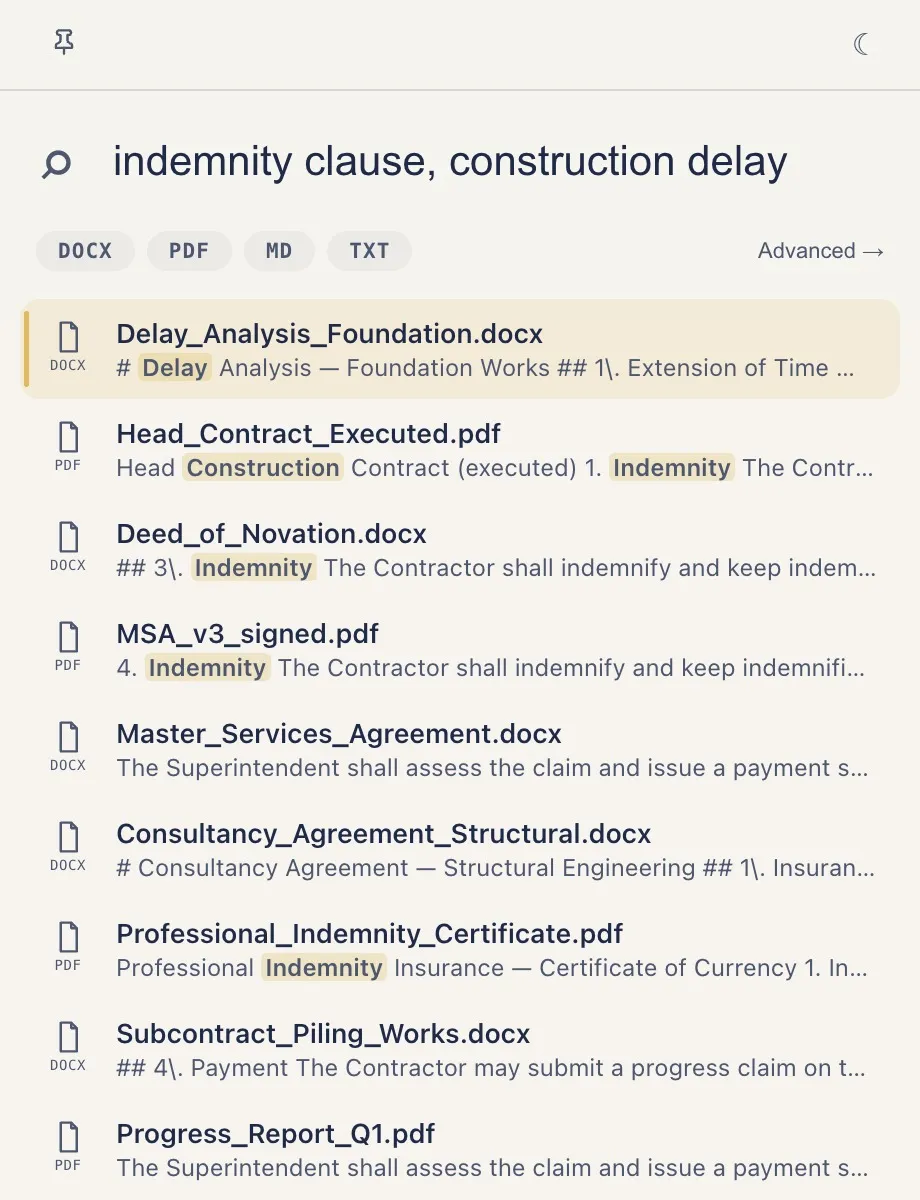
Why folder browsing breaks down at scale
A few hundred files are manageable by memory and tidy folders. A few thousand are not. Once a document set crosses that threshold, three problems appear:
- Filenames lie. They reflect what you thought a file was when you saved it, not what it actually contains.
- Folders overlap. The same document could plausibly live in three places, so you check all three.
- Keyword search is brittle. Standard search matches exact words. If the report says "terminated" and you search "cancelled," you get nothing.
The result is the familiar time sink: opening files one by one, scanning for the right paragraph, and closing them again. To search across thousands of files at once, you need a tool that has already read every document and can rank them by relevance in a fraction of a second.
How indexing makes large searches instant
Fast search over large sets is possible because of an index built ahead of time. When you point a search tool at your folders, it reads each document once and stores a compact representation of the text. Later searches query that index instead of re-reading files.
Fossick, a desktop app that searches your local documents by meaning, entirely offline, builds this index on your own machine. The first pass takes time — it has to open every file — but after that, searches return in moments even across thousands of documents.
What gets indexed
- Text from PDFs, Word files, and plain text
- Content inside scanned PDFs and images (PNG, JPG, and similar), extracted with on-device OCR
- The meaning of passages, not just the raw words, so related phrasing still matches
Because the index lives locally, the size of your library is limited by your disk, not by an upload quota or a monthly cloud bill.
Search by meaning, not exact keywords
The reason semantic search matters more as your library grows is simple: the bigger the set, the less likely you are to remember the exact words. You remember the gist.
With semantic search you can type a description — "the memo about the vendor missing a delivery deadline" — and get the right document even if it never uses the word "memo" or "deadline." This is the core difference explained in semantic search vs keyword search for documents.
To be clear about what this is: it is search, not chat. Fossick returns your actual files, ranked by relevance. It does not summarise them, answer questions, or generate text. There is no large language model writing responses — you get the real document, then you read it. For confidential work, that distinction matters, because nothing is invented and nothing is sent anywhere. If you often forget names, see how to find a document you can't remember the name of.
Keeping a large index current with incremental updates
A one-time index goes stale fast. You add new client files, revise a draft, drop a scanned contract into a folder. Re-processing thousands of files every time would be wasteful.
Incremental indexing solves this. Instead of rebuilding from scratch, the tool detects what changed and updates only those files:
- New files get read and added to the index.
- Modified files get re-read and their entries refreshed.
- Deleted files drop out of results.
This keeps the cost of staying current proportional to what actually changed, not to the size of your whole library. In practice it means you can keep a growing archive searchable indefinitely without a slow, disruptive re-scan each week.
Finding one file fast among thousands
Once the index exists, the day-to-day workflow is short:
- Type a phrase describing what you remember about the document.
- Scan the ranked results, which put the closest matches first.
- Open the file directly and jump to the relevant part.
A few habits make large-set search more effective:
- Describe content, not filenames. "Settlement terms for the roofing dispute" beats guessing what you named it.
- Include distinguishing details. A client name, a product, or a specific concept narrows a big set quickly.
- Trust ranking over exhaustive reading. The top few results usually contain what you need; you rarely have to scroll far.
Professionals in document-heavy fields already work this way — see how lawyers search case files by meaning and how consultants find past decks fast.
Doing it all offline, on confidential material
For anyone handling privileged, regulated, or commercially sensitive files, where the search happens is not a detail. Many cloud search tools require uploading your documents to a server first.
Fossick does the opposite. Indexing, OCR, embedding, and search all run on your device. Documents are never uploaded. You can literally unplug the Wi-Fi and it still works — that is the trust proof, and it is the simplest way to verify the claim yourself. Only licensing checks touch the internet; your files do not. More on this approach in private document search and offline document search.
For scanned archives — the folders full of image-only PDFs that ordinary search ignores — on-device OCR reads the text so those pages become searchable too. The details are in how to search scanned PDFs and images locally with OCR.
Fossick runs on Windows and Mac. You can download it and index your own files to see how it handles your library, and review the one-time US$14.99 price whenever you are ready.
Frequently asked questions
How many files can Fossick actually search?
There is no fixed cap tied to a cloud plan — the practical limit is your local disk and machine. Because the index is built once and updated incrementally, searching across thousands of files stays fast even as the library grows.
Does indexing thousands of files take a long time?
The first pass takes time because every document has to be read once, including OCR on scanned pages. After that, incremental updates only process files that are new or changed, so keeping the index current is quick.
Will searching my files send them to the cloud?
No. Indexing, OCR, and search all run on your device, and documents are never uploaded. You can disconnect from the internet entirely and search still works; only licensing checks use the network.
Can it search inside scanned PDFs and images?
Yes. Fossick runs OCR locally on scanned PDFs and image files like PNG and JPG, so text trapped in images becomes searchable alongside your regular documents — no separate step and no uploading required.
Does Fossick answer questions about my documents like a chatbot?
No. Fossick is search, not chat. It finds and ranks your actual files by meaning and opens them for you to read; it does not summarise, generate text, or use a large language model to answer questions.