How to Search Inside Word Documents Offline on Your Own Device
You know the paragraph exists. You wrote it, or a colleague sent it, buried somewhere inside one of the hundreds of Word documents on your machine. But you cannot remember the filename, the folder, or the exact wording — and Word's built-in search only helps once you already have the right file open.
This guide covers how to search a Word doc the way you actually think about it: by what the content means, not by a filename or an exact keyword. It also shows how to do all of this offline, so confidential drafts, contracts, and reports never leave your device.
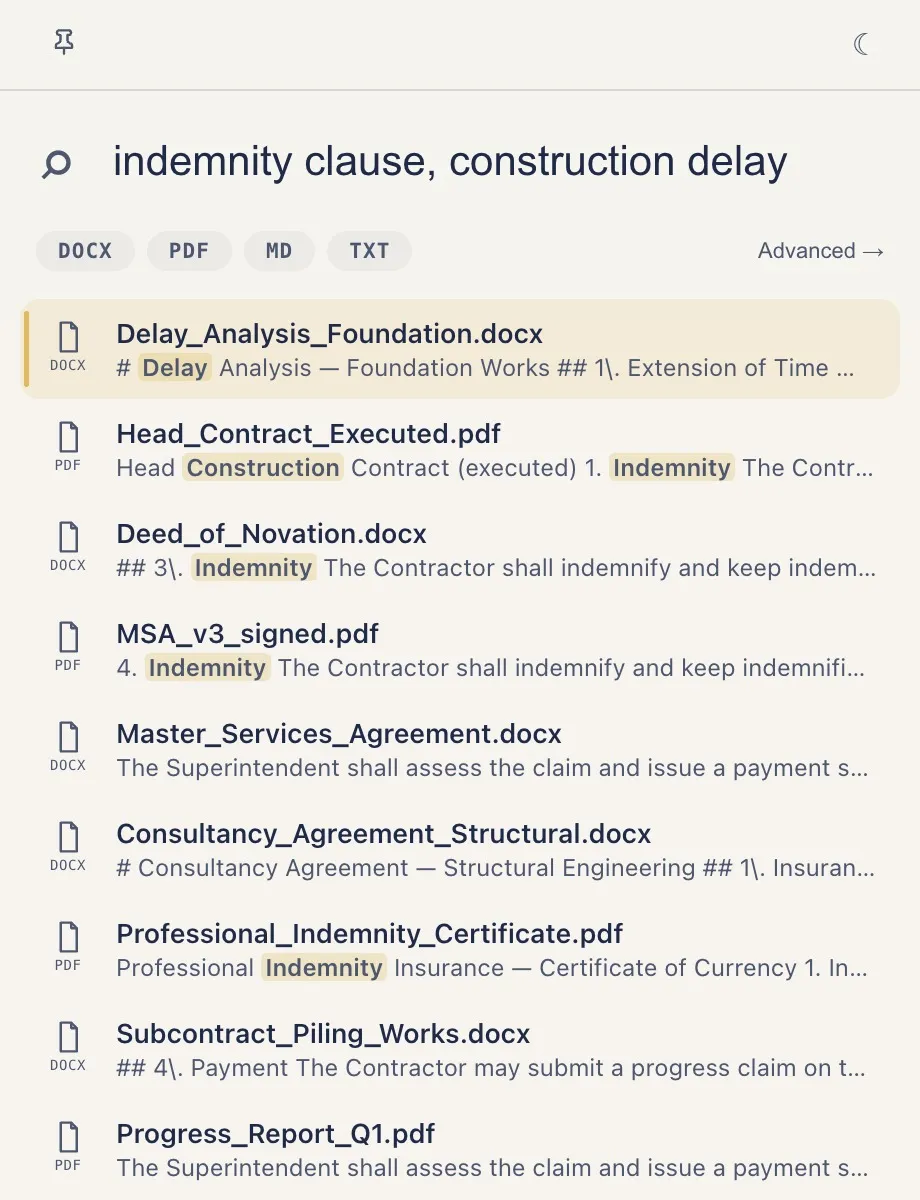
Why searching a Word doc is harder than it should be
Microsoft Word has a capable Find tool (Ctrl+F, or Cmd+F on Mac). It jumps to the next match of a word or phrase — but only inside the document that's already open. If you don't know which file holds the text you need, Find can't help.
The operating system isn't much better. File Explorer on Windows and Finder on Mac are built to search filenames first. They can look inside file contents, but indexing is inconsistent, slow across large folders, and easy to misconfigure. If a document was named Draft_v3_FINAL.docx, its title tells you nothing about what's inside.
The result is a familiar problem: you're sure the content exists, but you end up opening file after file, skimming for the paragraph you half-remember. For a working overview of the alternatives, see how to search within a document.
Keyword search vs. searching by meaning
There are two fundamentally different ways to find text inside your Word files.
Keyword (full-text) search matches the exact words you type. It's fast and precise when you remember the phrasing — but it fails when your memory is fuzzy or the document used different terminology. Searching for termination clause won't surface a file that says ending the agreement early.
Semantic search matches on meaning. It understands that ending the agreement early, early exit, and termination clause are related concepts, so it returns the right document even when your wording doesn't match the file's wording. This is the difference between remembering exact text and remembering the idea.
For most professionals, the ideal is both: precise keyword matching when you know the phrase, and meaning-based matching when you don't. We break the trade-offs down in semantic search vs keyword search for documents.
Search across every Word doc at once, by content
The real unlock is searching content across an entire folder tree — not one file at a time. A tool that indexes the text inside your .doc and .docx files lets you type a query once and see every document that contains the relevant passage, ranked by how well it matches.
Fossick, a desktop app that searches your local documents by meaning, does exactly this. You point it at the folders where your Word files live, it builds an index of what's inside them, and then a single query searches every document at once. Results show you the matching file and the surrounding text, so you can confirm you've found the right one before opening it.
Because it reads the content and not just the name, it doesn't matter that a file is called Notes.docx or Untitled(4).docx. If the paragraph you need is in there, it surfaces. For a deeper look at this specific workflow, see how to search Word documents by content, not filename.
Doing it offline, so confidential files stay private
If you handle contracts, client memos, financial records, or unpublished research, where the search happens matters as much as how well it works.
Many "AI search" tools upload your documents to a server to process them. For confidential Word files, that's often a non-starter — it means your drafts leave your control and land on someone else's infrastructure.
Fossick runs entirely on-device. Indexing, the semantic matching, and every search happen locally on your own computer. Your Word documents are never uploaded. The simplest proof: unplug your Wi-Fi and it keeps working, because nothing about your files ever needed the internet in the first place. (Only licensing touches the network.)
That design is why it suits regulated and sensitive work. If privacy is your main concern, how to search confidential files without them leaving your PC covers the reasoning in full.
It's search — not a chatbot
One important clarification: Fossick is a search tool, not a generative assistant. It does not summarize your documents, answer questions in prose, or invent text. There's no chatbot and no large language model producing paragraphs.
That's deliberate. When you're looking for a specific clause or figure in a Word doc, you want the actual source document, not a paraphrase that might quietly get a detail wrong. Fossick points you to the real file and the real passage so you can read it yourself and trust what you see.
If you've been comparing it to AI writing tools, on-device AI search, explained clarifies what "AI search" does and doesn't mean here.
More than Word: PDFs, scans, and images too
Your Word documents rarely live in isolation. The same project folder usually holds PDFs, exported reports, and scanned pages. A search tool that only reads .docx leaves half your material invisible.
Fossick indexes Word files alongside:
- PDFs, including text-based and exported documents
- Plain text and other common document formats
- Scanned PDFs and images (PNG, JPG, and similar), using on-device OCR to read text inside them automatically
So a query for a specific term can surface the .docx draft, the signed PDF, and the scanned page that mentions it — in one result list. The OCR step also runs locally; nothing is sent out to be read. See how to search scanned PDFs and images locally with OCR for how that works.
Getting started
Setting up meaning-based search over your Word files takes three steps:
- Install the app. Download Fossick for Windows or Mac.
- Point it at your folders. Add the directories where your .doc and .docx files live. Fossick indexes them locally — no upload, no account needed for your documents.
- Search by meaning. Type what you remember about the content. Fossick returns the matching documents with surrounding context so you can confirm the right one before opening.
Fossick is free to try during the beta, and pricing is straightforward when you're ready — monthly, annual, or a one-time lifetime option, each including the full app and all updates.
Frequently asked questions
Can I search inside a Word document without opening it?
Yes. A desktop search tool that indexes file contents lets you find text inside .doc and .docx files without opening each one. Fossick reads the content locally, so a single query surfaces the right document and shows the matching passage before you open it.
How do I search across all my Word docs at once?
Word's built-in Find only works inside one open file. To search every Word document in a folder at once, use a tool that indexes the whole folder — point Fossick at your directories and it searches all of them together, ranking results by relevance.
Is my Word document uploaded when I search it?
With Fossick, no. Indexing and searching happen entirely on your own device, and your files are never uploaded. You can disconnect from the internet and it still works, which is the clearest proof that nothing leaves your machine.
What's the difference between searching by keyword and by meaning?
Keyword search matches the exact words you type, which is precise but fails when you don't remember the phrasing. Semantic search matches on meaning, so a query like early exit can find a document that says termination clause. See our semantic vs keyword guide for details.
Does Fossick summarize or answer questions about my Word files?
No. Fossick is search, not chat. It has no generative AI and does not summarize or paraphrase. It points you to the actual source document and passage so you can read the real text yourself.