How to Search a Document: A Complete Guide to Finding Anything Fast
You know the information is in there somewhere. Maybe it's a clause in a contract, a figure in a report, or a paragraph you wrote months ago. The problem isn't that the document is lost — it's that you can't remember the exact words to find it.
This guide covers how to search a document properly: the built-in tools you already have, their limits, and how searching by meaning changes what's possible. Everything here can be done on your own machine, with nothing leaving your computer.
Start with the tools you already have
Before reaching for anything new, know the basics. Nearly every document viewer has a built-in find function:
- Ctrl+F (Windows) or Cmd+F (Mac) opens a search bar inside the open file.
- Type a word or phrase and press Enter to jump to each match.
- Adobe Acrobat, Word, and most browsers also offer Advanced Find with options like whole-word or case-sensitive matching.
This is the fastest way to search a single document you already have open. For a deeper walkthrough of finding text in one file, see how to search within a document.
The catch: this only works one file at a time, and only for text you can name precisely.
When keyword search breaks down
Ctrl+F is literal. It matches the characters you type — nothing more. That creates three common dead ends:
- You remember the concept, not the wording. You search termination notice but the contract says ending the agreement. No match.
- The document is a scan. A photographed or scanned PDF is a picture of text. There's nothing for the search bar to read, so it finds nothing.
- You don't know which file it's in. In-document search assumes you've already opened the right document. If you're staring at a folder of hundreds, you're stuck opening files one by one.
Keyword search is precise but rigid. If your query has to exactly match the text, you're relying on memory that's often fuzzy. The difference between the two approaches is covered in semantic search vs keyword search.
Searching by meaning, not exact words
Semantic search solves the wording problem. Instead of matching characters, it matches meaning. You describe what you're looking for in plain language, and it ranks documents by how closely their content relates to your query — even if they share no keywords.
Ask for the memo about the vendor missing a deadline and it can surface a document that actually says supplier failed to deliver on schedule. You didn't need the exact phrase; you needed the idea.
This is especially useful when:
- You wrote or received the document long ago and only recall the gist.
- Different files describe the same concept in different terms.
- You can't remember the filename at all — a common problem covered in how to find a document you can't remember the name of.
Don't forget scanned documents and images
A large share of professional documents — signed contracts, receipts, historical records — exist only as scans or photos. To search them, you first need OCR (optical character recognition), which reads the pictures of text and converts them into real, searchable text.
Good OCR runs automatically in the background, so a scanned PDF becomes just as searchable as one you typed. That includes screenshots and image files (PNG, JPG) too. If you work with paper-based or photographed records, see how to search scanned PDFs and images with OCR.
Without OCR, those files are invisible to any search — the text simply isn't there to find.
Searching across many documents at once
The biggest gap in built-in tools is scale. Ctrl+F searches one open file. But most real questions are which of my files mentions this?
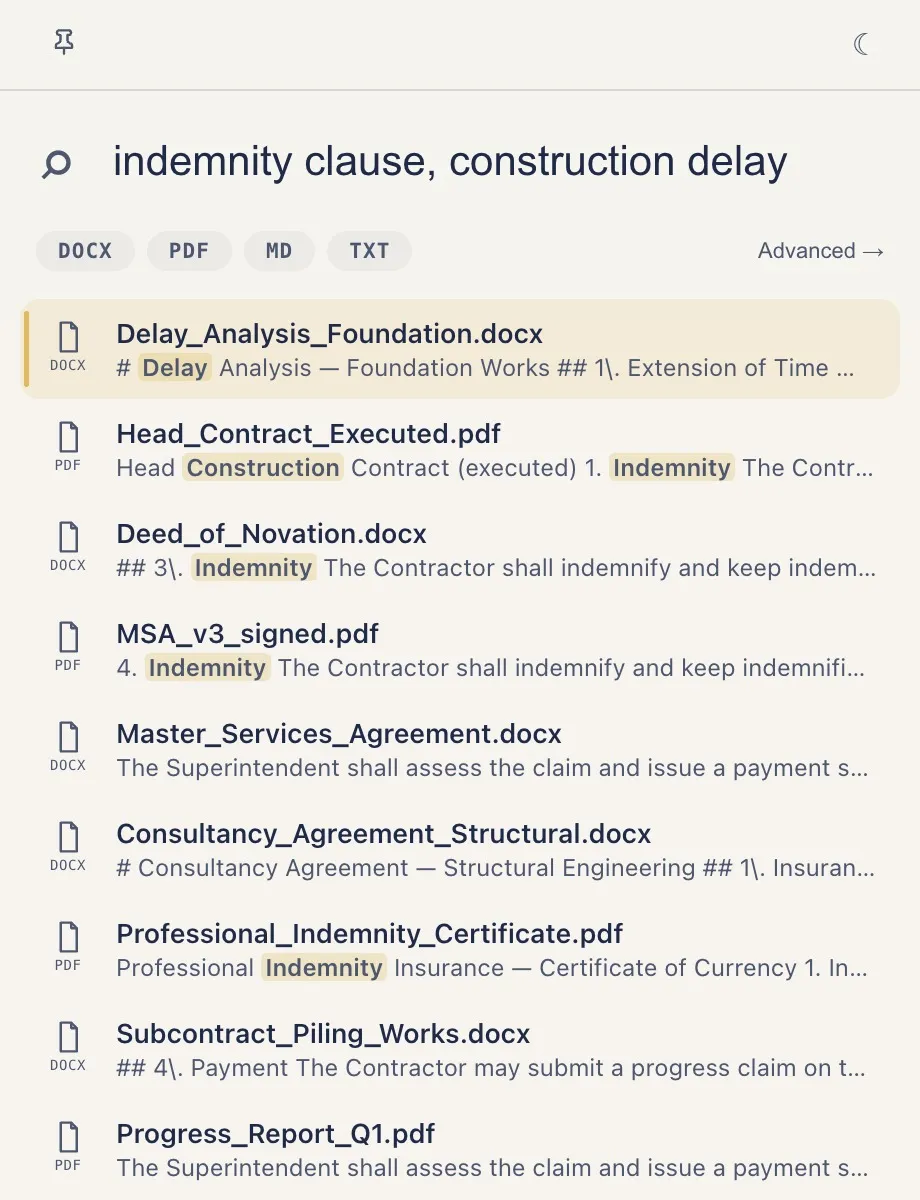
To answer that, you need an index — a searchable map of the contents of every file in a folder or drive. With one built, a single query scans thousands of documents in seconds and returns the ones that match, ranked by relevance.
This is where a dedicated tool earns its place. Fossick, a desktop app that searches your local documents by meaning, entirely offline, builds this index on your own machine. It handles PDFs, Word files, text, and scanned images with automatic on-device OCR, then lets you search all of them by keyword or by meaning.
It's worth being clear about what this is and isn't. Fossick is search, not chat. There's no chatbot, no generative AI, and it does not summarise or answer questions — it finds documents and takes you to them. For more on searching large collections, see how to search across thousands of files.
Keeping confidential documents private
For anyone handling privileged or sensitive material — lawyers, accountants, consultants, engineers, researchers — where your search happens matters as much as how well it works.
Many modern "AI search" tools upload your files to a server to process them. That's a real concern for confidential work. The alternative is on-device search, where indexing, OCR, and every query run locally and your documents never leave the machine.
Fossick runs entirely offline. You can pull the Wi-Fi cable, and search still works — the clearest proof that nothing is being uploaded. The only time it touches the internet is for licensing. If privacy is your priority, read more on private document search or try it yourself from the download page. It's free to use during the beta; details are on the pricing page.
Frequently asked questions
What is the fastest way to search a document I already have open?
Press Ctrl+F on Windows or Cmd+F on Mac to open the find bar, then type your word or phrase. This jumps to each match instantly. It's ideal for a single open file, but it only matches exact text and works one document at a time.
How do I search a document when I can't remember the exact words?
Use semantic search, which matches meaning rather than exact characters. You describe what you're looking for in plain language, and it finds documents that express the same idea even with different wording. This is far more forgiving than keyword search when your memory is fuzzy.
Can I search text inside a scanned PDF or image?
Yes, but only after OCR (optical character recognition) converts the pictures of text into real text. Tools that run OCR automatically make scans and screenshots searchable just like typed documents. Without OCR, a scanned file has no readable text to match.
Is it safe to search confidential documents with software?
It depends on where the search runs. Cloud tools often upload your files to a server, which is risky for privileged material. An on-device app keeps indexing and search entirely local — your documents never leave your computer, and search still works with the internet disconnected.
Does Fossick answer questions about my documents like a chatbot?
No. Fossick is search, not chat. It has no generative AI and does not summarise or answer questions — it finds the relevant documents and takes you to them, so you read the source yourself. This keeps results grounded in your actual files.