How to Search Within a PDF: Find Any Text Inside Your PDF Files
You know the information is somewhere in that PDF — a clause, a figure, a paragraph you skimmed weeks ago — but the built-in find box only matches the exact words you type, and it only looks in the file that's open. When the text is spread across hundreds of documents, or the words you remember aren't the words on the page, that approach falls apart.
This guide explains how to search within a PDF properly: how the standard tools work, where they stop, and how on-device semantic search finds text by meaning across your whole library — including scanned pages — without any file ever leaving your computer.
The quick way: search within one open PDF
For a single document, every PDF reader has a built-in search. Open the file and press Ctrl+F (Windows) or Cmd+F (Mac). Type your term and the reader jumps to each match, usually with a count and next/previous arrows.
This works well when three things are true:
- You already have the right PDF open.
- The text is real text, not a scanned image.
- You know the exact word or phrase used on the page.
When any of those breaks down, the find box goes quiet. It can't tell you which of your fifty contracts mentions a termination clause, it returns nothing on a scanned document, and it won't match "remote work policy" if the file actually says "telecommuting arrangement." Those are the limits worth understanding before you reach for a bigger tool.
Why searching *inside* PDFs is harder than it looks
Two problems make PDFs uniquely awkward to search.
PDFs are containers, not plain text
A PDF can hold selectable text, or it can be a picture of a page — a scan or a photo — with no text layer at all. To your reader, both look identical. But a search only finds what it can read as characters, so a scanned PDF returns zero results even when the words are right there on screen.
The find box only sees one file
The native search is scoped to the document in front of you. If you're trying to remember which report, invoice, or filing contains a detail, you'd have to open each file and search it one by one. That doesn't scale past a handful of documents. For anything larger, you need a tool that has already read and indexed the contents of every PDF in a folder — the approach covered in our guide to searching a folder of documents.
How to search across many PDFs at once
To search within all your PDFs together, you need desktop search software that builds an index of file contents. Instead of scanning every file each time, it reads them once, stores what it learned, and answers instantly afterwards.
The important question is what kind of index it builds:
- Keyword (full-text) index — records the literal words in each file. Fast, but you have to guess the exact terms the author used.
- Semantic index — records the meaning of passages, so a description close to the content still finds it.
Both beat opening files one at a time. The difference between them shows up whenever your memory of a document is fuzzy — which, in practice, is most of the time. We break down the trade-offs in full-text search vs semantic search for a folder.
Semantic search: find text by meaning, not exact words
Keyword search demands precision you rarely have. You remember what a document was about, not the specific phrasing. Semantic search is built for that gap.
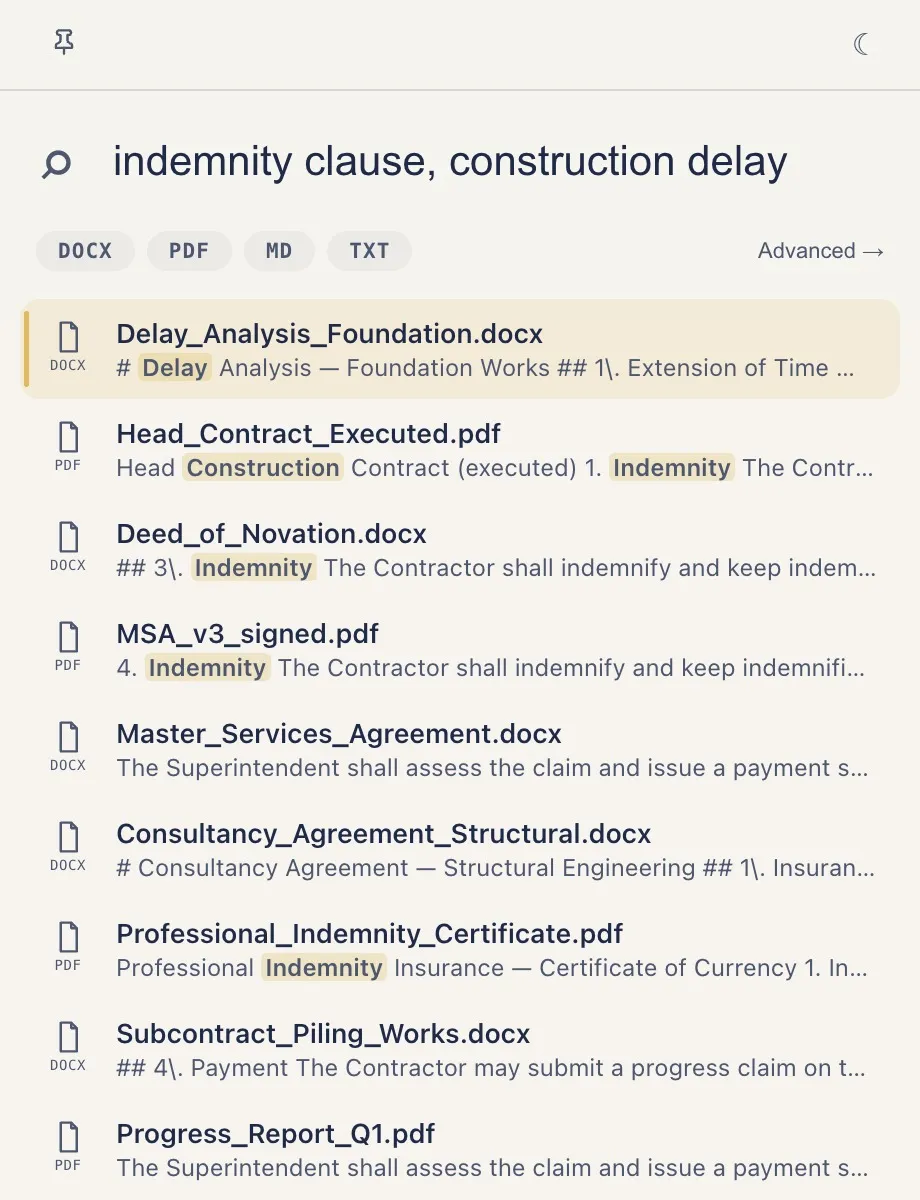
Instead of matching characters, it compares the idea behind your query with the ideas inside your PDFs. Type what you remember in plain language and it surfaces the passages that mean the same thing, even when none of your exact words appear on the page.
Some examples of what that unlocks:
- Searching "penalty for late delivery" finds a contract clause that actually reads "liquidated damages for delayed shipment."
- Searching "who approved the budget increase" surfaces the email or memo describing the sign-off, whatever verbs it used.
- Searching "client complaint about billing" finds the relevant thread even if it never uses the word "complaint."
This is finding, not answering — you land on the real document and read it in context. For a fuller comparison, see semantic search vs keyword search for documents.
Searching scanned PDFs and images
A large share of professional PDFs are scans: signed agreements, filed forms, receipts, older records. These are images, so no amount of typing in a plain find box will match them.
The fix is OCR (optical character recognition), which reads the pixels and reconstructs the text. Once a scan has been OCR'd, its contents become searchable like any other document. The catch is that many OCR services run in the cloud — meaning your confidential pages get uploaded to a third party just to be read.
That's avoidable. OCR can run entirely on your own machine, so scanned contracts and statements become searchable without ever leaving your computer. If most of your archive is scanned, our walkthrough on searching scanned PDFs and images locally with OCR covers the workflow in detail.
Doing it privately: search within PDFs offline
If your PDFs are confidential — case files, client records, financials, engineering specs — where the search runs matters as much as how well it works. Any tool that uploads files to search them creates a copy you no longer control.
Fossick is a desktop app for Windows and Mac that searches your local documents by meaning, entirely offline. Point it at your folders and it indexes the contents of your PDFs, Word files, text files, and more — running OCR on scanned pages and images automatically, on-device. Then you search the way you'd describe a document to a colleague, and it finds the file.
A few things worth being clear about:
- Everything stays local. Indexing, embedding, and search all run on your machine. Your documents are never uploaded — it works with the Wi-Fi unplugged, which is the simplest way to prove it.
- It's search, not chat. Fossick finds and ranks your real files. It has no chatbot and no generative AI; it never summarises or answers questions, so there's no invented text to second-guess.
- It's built for scale. One query searches across thousands of PDFs at once instead of file by file.
You can download Fossick and try it during the beta. When you're ready to keep it, a one-time lifetime option and subscription plans are on the pricing page.
Frequently asked questions
How do I search for a word inside a single PDF?
Open the PDF in any reader and press Ctrl+F on Windows or Cmd+F on Mac. Type your word and use the next/previous arrows to move between matches. This works only for real (selectable) text in that one open file — not scans, and not across multiple documents.
Why does my PDF search return no results even though the text is visible?
The PDF is almost certainly a scan or photo — an image of a page with no underlying text layer. Ordinary search can't read pixels. You need OCR to convert the image into searchable characters first, after which the words become findable like any other document.
Can I search within many PDFs at once instead of one at a time?
Yes, but not with the built-in find box, which only sees the open file. You need desktop search software that indexes the contents of every PDF in your folders. A tool like Fossick reads them once and then answers queries across your whole library instantly.
Is it safe to search confidential PDFs without uploading them?
It is, if you use an on-device tool. Fossick indexes and searches everything locally, so your files are never uploaded and there's no cloud copy to secure. You can verify this by disconnecting from the internet — search still works. See our guide on searching PDFs without uploading.
What's the difference between searching by keyword and searching by meaning?
Keyword search matches the exact characters you type, so you must know the precise wording used in the file. Semantic search matches the meaning of your query, so a plain-language description finds the right passage even when the document phrases it differently — helpful when you only half-remember the content.