Secure Document Scanning for AI Search: How On-Device Indexing Keeps Your Files Private
Free to try (1 folder, 200 files) · US$14.99 to keep · Mac & Windows
If you want to make a stack of scanned contracts, reports, or research papers searchable by an AI that understands meaning, one question decides everything: does the scanning and indexing happen on your machine, or does your document leave the building?
Most "AI document" tools answer that by uploading your files to a server first. This article explains a different path — secure document scanning for AI search that runs entirely offline — how on-device OCR turns scans into searchable text, how local indexing builds a private search layer, and how to verify that nothing is being sent anywhere.
What "secure document scanning for AI" actually means
The phrase gets used loosely, so it helps to be precise. When people talk about scanning documents "for AI," they usually mean two separate steps:
- Scanning / OCR — turning a paper scan, a photo, or an image-only PDF into machine-readable text.
- Indexing for AI search — feeding that text into a system that can retrieve it later by meaning, not just exact keywords.
Secure is the word that matters. A process is only genuinely secure if both steps happen on hardware you control. If the scan is uploaded to be OCR'd, or the text is sent to a cloud model to be embedded, your confidential content has already left your device — regardless of what the privacy policy promises.
On-device processing removes that risk at the source. There is no upload to intercept, no server-side copy to breach, and no third party in the chain of custody for your files.
Why cloud scanning is a problem for confidential files
For a lawyer, accountant, or consultant, the issue isn't whether a vendor is trustworthy — it's whether you can promise a client that their documents never left your possession.
Cloud-based AI document tools break that promise in a few ways:
- Upload exposure. The file is transmitted and stored, at least temporarily, on infrastructure you don't control.
- Retention ambiguity. "We delete after processing" is a policy, not a guarantee you can audit.
- Third-party sub-processors. Many services route OCR or embeddings through additional vendors.
- Compliance friction. Privilege, NDAs, and data-residency rules often make cloud upload a non-starter.
We cover the broader trade-off in Is It Safe to Search Documents With AI? On-Device vs Cloud. The short version: the safest file is the one that never moves.
How on-device OCR turns scans into searchable text
A scanned PDF or a phone photo of a page is, to a computer, just an image — there is no selectable text inside it. That's why searching a folder of scans usually returns nothing.
OCR (optical character recognition) reads the pixels and reconstructs the words. The important part for privacy is where that reading happens. On-device OCR does it locally: the image never leaves your machine, and the recovered text is stored in a private index on your own disk.
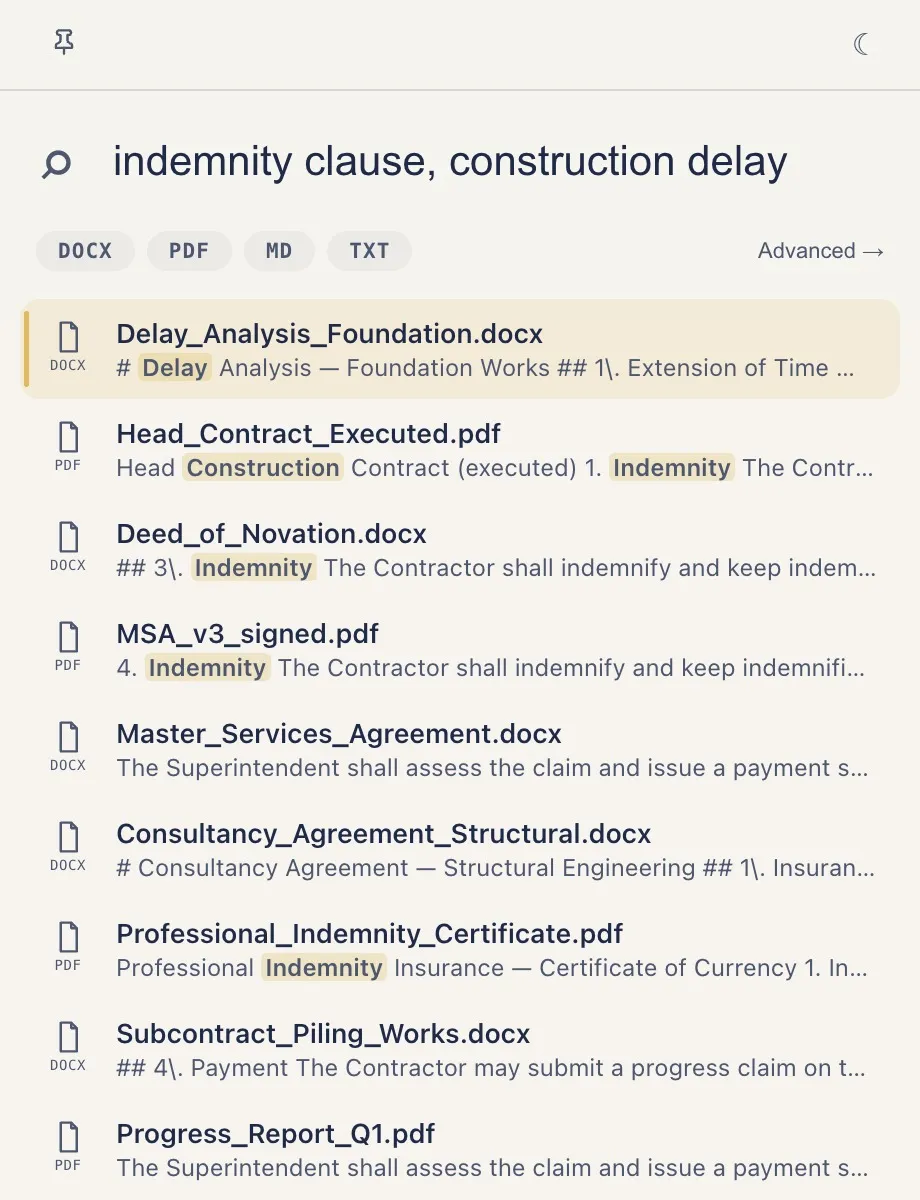
Fossick, a desktop app that searches your local documents by meaning entirely offline, runs OCR automatically on scanned PDFs and image files (PNG, JPG, and similar) as it indexes them. You don't run a separate scanning tool or convert files by hand — dropping a folder of scans in is enough.
If your library is mostly scanned material, the mechanics are worth understanding in more detail: see How to Search Scanned PDFs and Images Locally with OCR and How to Search Text Inside Images and Screenshots.
From scanned text to AI search — without the cloud
Once your scans are readable text, the next step is making them findable the way you actually think about them.
Keyword search only matches the exact words you type. If a report says "terminated for convenience" and you search "cancel the contract," keyword search comes up empty. Semantic search understands that those phrases are related, so it surfaces the right document anyway.
That's the "AI" part — but it's a specific, contained kind of AI. On-device semantic search works by:
- Converting your document text into mathematical representations (embeddings) locally.
- Comparing your query against that private index to rank the closest matches by meaning.
- Returning the actual files, so you open and read the source yourself.
There's more on the difference in Semantic Search vs Keyword Search for Documents and On-Device AI Search, Explained.
Search, not chat: what on-device AI search does and doesn't do
It's worth being clear about the boundary, because "AI" now usually implies a chatbot.
Fossick is search, not chat. It has no generative model, doesn't answer questions, and doesn't write summaries. It finds and ranks your documents by relevance and hands them back to you. Nothing is drafted, paraphrased, or invented.
That's a deliberate design choice for confidential work:
- There is no LLM that could hallucinate a fact about your case or client.
- There is no cloud account holding your file contents.
- The only thing you're trusting the tool to do is find the right file — which is exactly what you can verify yourself.
If you've been evaluating chatbots for confidential material, ChatGPT Alternative for Confidential Documents explains why a retrieval tool is often the safer fit.
How to verify the process is truly offline
Claims are easy; proof matters. The strongest test of secure, on-device document scanning is simple and takes a minute:
- Point the app at a folder of documents and let it index and OCR them.
- Disconnect from the internet — unplug Ethernet or turn off Wi-Fi.
- Run a semantic search.
If results come back with the network off, the scanning, indexing, and search are all happening locally. There's no server the tool could have quietly relied on. With Fossick, only licensing and billing ever touch the internet; your documents don't.
This air-gap test is the honest way to evaluate any tool that claims to be private. For a fuller walkthrough of offline-first search, see Offline Document Search: Find Files Without the Cloud and Do You Have to Upload Files to Search Them With AI? No.
Getting started on your own machine
Setting up secure, searchable scans doesn't require a data-migration project:
- Install locally. Fossick runs on Windows and Mac. Download it and install as you would any desktop app.
- Point it at your folders. It indexes PDFs, Word documents, text files, and more, and runs OCR on scanned PDFs and images automatically.
- Search by meaning. Type what you remember about a document — a concept, a phrase, a party's name — and open the match.
- Verify privacy. Run the offline test above before you trust it with anything sensitive.
Fossick is a one-time US$14.99 purchase that includes the full app and all updates, with the details on the pricing page. The point isn't the tooling — it's that your scanned, confidential documents become instantly findable while never leaving your device.
Frequently asked questions
Does scanning documents for AI search require uploading them to the cloud?
No. With on-device tools, OCR and indexing run locally, so scanned files never leave your computer. Cloud-based services upload your files, but a local app like Fossick keeps everything on disk — you can confirm this by searching with the internet disconnected.
Can it read scanned PDFs and photos, not just digital text?
Yes. Image-only PDFs and photos contain no selectable text, so Fossick runs OCR on them automatically as it indexes, reconstructing the words locally. That makes scans and screenshots searchable by meaning without any manual conversion step.
Is this an AI chatbot that summarizes my documents?
No. Fossick is search, not chat. It has no generative AI and does not answer questions, write summaries, or paraphrase content. It finds and ranks your own files by meaning and hands them back to you to read, so there's nothing that can hallucinate about confidential material.
How can I prove my documents stay private?
Index a folder, then disconnect from the internet and run a search. If results still appear, the scanning, indexing, and search are all happening on your device. Only licensing and billing ever use the network — your document contents do not.
What file types can it scan and search?
Fossick handles PDFs, Word documents, plain text, and more, and runs on-device OCR for scanned PDFs and common image formats like PNG and JPG. You point it at your folders and it builds a private, searchable index locally on Windows or Mac.