How to Search a PDF: Find Any Word, Phrase, or Idea Inside Your Documents
Short answer: To search a PDF, open it and press Ctrl+F on Windows or Command+F on Mac, type the word or phrase, and press Enter to jump between matches. The same shortcut works in Word and most document apps. If nothing is found, the PDF may be a scan that needs OCR, or you may need search by meaning.
Free to try (1 folder, 200 files) · US$14.99 to keep · Mac & Windows
You know the information is in there somewhere: a clause in a contract, a figure in a report, a sentence in a scanned letter. The question is how to get to it without scrolling through 80 pages.
This guide covers how to search a PDF, and how to search a document for a word in general. It starts with the one-file shortcut everyone should know, then covers searching many files at once, what to do when a scanned PDF returns no results, and how to find a passage when you remember the idea but not the exact wording. All of it runs on your own computer, which matters if your files are confidential.
How to search a PDF for a word or phrase
Press Ctrl+F on Windows or Command+F on Mac in whichever app has the PDF open, type your term, and step through the highlighted matches. The details vary slightly by viewer:
- Adobe Acrobat Reader: Ctrl+F (Command+F on Mac) opens a find bar. Press Enter or use the arrows to move to the next match. The options menu includes whole-words-only and case-sensitive matching.
- Chrome, Edge or another browser: open the PDF in a browser tab. Ctrl+F searches the document text and shows a running match count.
- Preview on Mac: Command+F places the cursor in the search field, and the sidebar lists every result with a snippet of surrounding text so you can click straight to the right page.
A few habits make this faster:
- Search the most distinctive word you remember. Indemnity narrows things down far more than agreement.
- Shorten phrases that return nothing. Line breaks, hyphenation and columns in PDFs can split a phrase, so search one unusual word from it instead.
- Try spelling variants. Organisation and organization are different strings to a find tool.
How to search a Word document (or any document) for a word
The same shortcut works almost everywhere: Ctrl+F or Command+F searches whatever document is currently open. In Microsoft Word, Ctrl+F opens the Navigation pane, which lists every match in context and highlights it on the page. Ctrl+H opens Find and Replace, where More reveals options such as Match case and Find whole words only, as described in Microsoft's guide to finding and replacing text in Word.
Other common cases:
- Google Docs: Ctrl+F (Command+F) for a quick find; Ctrl+H (Command+Shift+H on Mac) for find and replace with case matching.
- Excel: Ctrl+F searches cells; under Options, set Within to Workbook to search every sheet.
- Text, Markdown and CSV files: any text editor's find command works the same way.
For more detail, see our guides on how to search a Word document and how to search a document for a word.
The limitation is the same in every app: find searches one open file. If you are not sure which document holds the information, you need a different approach.
How to search inside many PDFs at once
To search across a folder of PDFs, use a tool that reads file contents rather than a single open document: Acrobat's Advanced Search, your operating system's search, or a dedicated desktop search app.
- Acrobat Reader Advanced Search: press Shift+Ctrl+F (Shift+Command+F on Mac), choose All PDF Documents in, and pick a folder. Results are grouped by file. It covers PDFs only, so Word files and emails in the same folder are ignored.
- Spotlight on Mac: press Command+Space and type your term. Spotlight searches the contents of files as well as their names, and a Finder window search lets you limit results to one folder.
- Windows File Explorer: open the folder and type in the search box. Whether it looks inside files depends on your indexing settings; if results only match filenames, see Windows Search not indexing file contents.
All three are keyword tools: they find files that contain the exact text you type. That works well when you know a distinctive term, and less well when you only remember the gist. For very large collections, see how to search across thousands of files at once.
Why Ctrl+F finds nothing: scanned PDFs need OCR
If a search returns zero results in a PDF you know contains the word, the PDF is most likely a scanned image with no text layer. A scanner or phone camera captures a picture of the page; to the computer it is pixels, not letters.
Quick test: try to select a single word with your cursor. If you can only draw a box around the whole page, or nothing highlights, there is no searchable text.
The fix is OCR (optical character recognition), which reads the image and produces machine-readable text. Options include:
- Acrobat Pro's Scan & OCR tool, which adds a text layer to the file.
- Your scanner's software, which often has a searchable PDF setting worth turning on for future scans.
- A desktop search app that runs OCR automatically while indexing, so you don't have to convert files one by one.
OCR is not perfect on faded or skewed scans, so search for shorter, distinctive terms in scanned material. Our guide to searching scanned PDFs and images locally covers this in more depth.
When you can't remember the exact word: search by meaning
Keyword find only works if you type the words that are actually in the document; semantic search finds passages that mean what you describe, even when the wording is different. Semantic search aims to match the intent of a query rather than its exact terms.
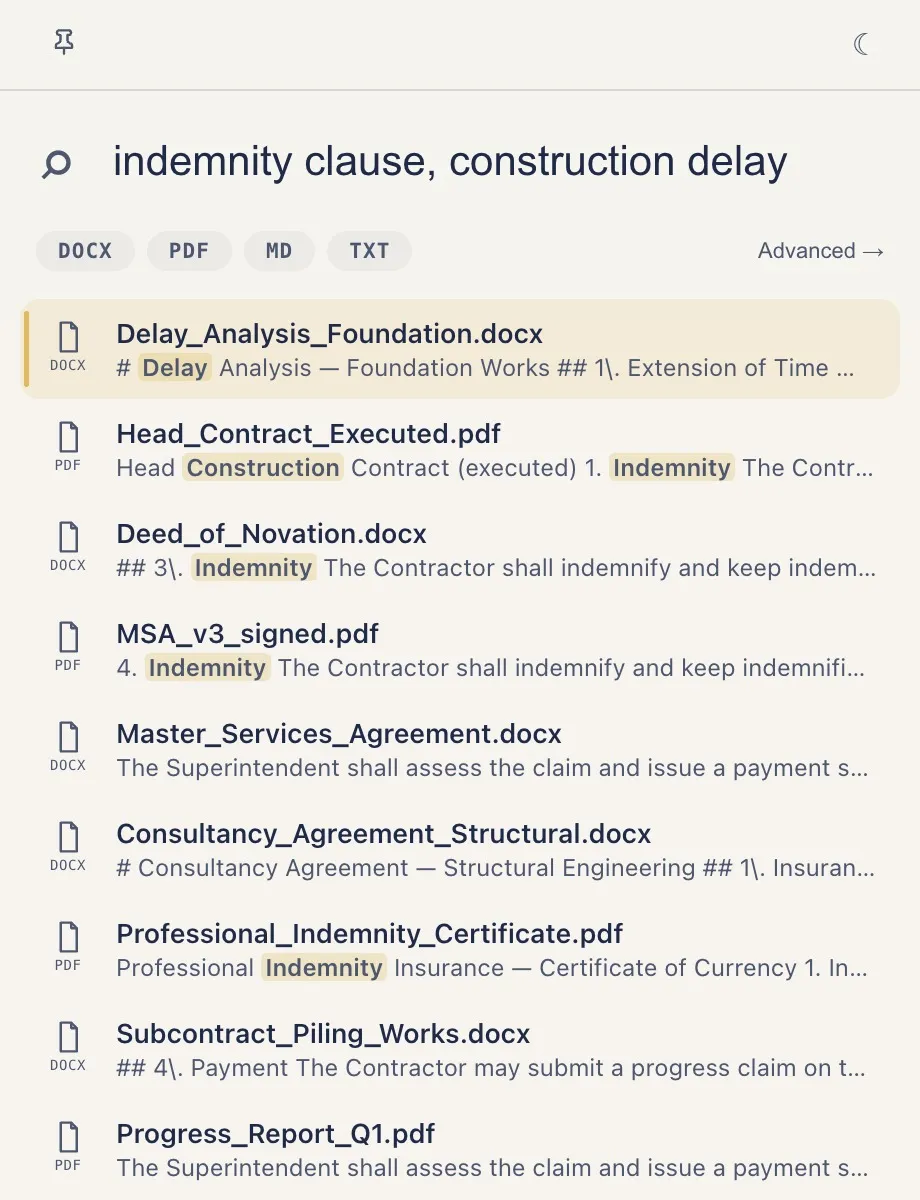
A typical example: you remember the clause about who pays if the project runs late, but the contract says liquidated damages. Searching for late might return dozens of irrelevant hits, or none.
This is the problem Fossick is built for. Fossick is a desktop app for Windows and Mac that searches your local documents by meaning, entirely offline. You point it at a folder; it extracts text from PDFs, Word, Excel, PowerPoint, email and other files, runs OCR on scanned PDFs and images, and builds a local index using a small sentence-embedding model (all-MiniLM-L6-v2, about 22 MB) that runs on your computer. Then you type what you remember and it returns the documents that best match.
For scale: in a test on an 8 GB Apple M1 MacBook, a folder of 52 mixed documents, including scanned pages, was indexed from scratch in about 81 seconds including OCR, and each search took about 15-20 ms (median). After that, only new or changed files are re-processed.
Fossick is search, not chat. There is no chatbot and no generative AI; it does not summarise documents or answer questions. It shows you where the information is, and you read the source yourself.
Which way to search a PDF should you use?
Start with Ctrl+F for a file you already have open, and move to broader tools only when you don't know which file, or which words, to look for.
| Method | What it searches | What it matches | Best for |
|---|---|---|---|
| Ctrl+F / Command+F | One open file | Exact words | Quick lookups in an open document |
| Acrobat Advanced Search | PDFs in a folder | Exact words | Keyword hunts across PDFs only |
| Spotlight / Windows Search | Indexed files on your computer | Words in names and contents | Finding a file by a known term |
| OCR first, then search | Scanned pages and images | Text recognised from images | Scans with no text layer |
| Semantic search (e.g. Fossick) | Whole folders, many formats | Meaning, even with different wording | When you remember the idea, not the words |
The methods combine well. Use semantic search to find the right document, then open it and press Ctrl+F to jump to the exact line. For a fuller comparison, see semantic search vs keyword search.
How to search confidential PDFs without uploading them
The safest way to search confidential PDFs is with tools that run on your own computer; avoid websites that ask you to upload a file before you can search or chat with it. Ctrl+F, Acrobat Reader, Spotlight and Windows Search all work locally. The risk comes from online PDF tools and cloud AI assistants, which put a copy of your document on someone else's server.
For a lawyer's client file, a patient record or an unreleased financial report, that copy can raise questions about privilege, data-protection obligations and client confidentiality that a local search simply avoids. Our guide to searching PDFs without uploading them goes into the trade-offs.
Fossick keeps text extraction, OCR, embedding and search on the device; documents are never uploaded, and only licensing touches the internet. You can download it and try it free on 1 folder of up to 200 files, with no sign-up or card. The full version is a one-time US$14.99 purchase covering every folder and file type, with a 14-day money-back guarantee.
Whatever tool you choose, one simple check tells you a lot: switch off Wi-Fi and run a search. If it still works, your documents are not being sent anywhere to be searched.
Frequently asked questions
How do I search a document for a word?
Open the document and press Ctrl+F on Windows or Command+F on Mac, then type the word and press Enter to move between matches. This works in Word, PDF readers, Google Docs, browsers and most text editors. To search many documents at once, use Spotlight, Windows Search or a desktop search app instead.
How do I search for a word in a Word document?
Press Ctrl+F (Command+F on Mac) to open the Navigation pane, which lists every match in context. For options such as Match case or Find whole words only, press Ctrl+H to open Find and Replace and click More. The search covers the whole open document, including headers and tables.
Why can't I search for words in my PDF?
The most common reason is that the PDF is a scanned image with no text layer, so there are no characters for the find tool to match. Run OCR to make it searchable, either in Acrobat Pro, your scanner software, or a search app that applies OCR automatically. Less often, the PDF was exported in a way that stores text unusually, in which case OCR also helps.
Can I search multiple PDFs at once?
Yes. Acrobat Reader's Advanced Search (Shift+Ctrl+F) can search every PDF in a folder, and Spotlight or Windows Search can find words inside indexed files. A desktop search app can cover PDFs alongside Word files, spreadsheets and email, and some, like Fossick, match by meaning rather than exact keywords.
Is it safe to search a PDF with an online tool?
Online tools generally require uploading the file, which places a copy on a third-party server. For anything confidential, such as contracts, financial records or health information, it is safer to use software that searches on your own computer. A quick test is whether the tool still works with Wi-Fi switched off.