Why You Can't Use ChatGPT to Search Confidential Documents
Free to try (1 folder, 200 files) · US$14.99 to keep · Mac & Windows
You have a folder full of client contracts, case files, or engineering specs, and you want to find the one that mentions a specific clause you half-remember. It is tempting to paste it into ChatGPT and ask. Don't.
For professionals bound by confidentiality, uploading private files to a cloud chatbot is a non-starter — and often a breach of the duties you owe your clients. This article explains exactly why, and lays out a practical ChatGPT alternative for confidential documents: a local, search-only tool that never sends your files anywhere.
The confidentiality problem with ChatGPT
When you paste text or upload a file to ChatGPT, that content leaves your computer and travels to a remote server you don't control. For a casual question about a public topic, fine. For a signed NDA, a privileged legal memo, a patient record, or an unpublished financial model, it is a different matter entirely.
The issues stack up quickly:
- You lose custody of the data. Once uploaded, the file exists on someone else's infrastructure, subject to their retention, logging, and access policies rather than yours.
- You may breach a duty. Lawyers owe confidentiality to clients; accountants, doctors, and consultants have equivalent obligations. Many NDAs explicitly forbid disclosure to third-party processors.
- Consent is usually absent. Your client almost certainly did not agree to have their documents processed by a consumer AI service.
- Enterprise settings help, but don't eliminate the question. Even where data is excluded from training, the file still leaves your device and sits on external servers.
The safest assumption for confidential work is simple: if a document must not leave the building, it must not leave your device.
ChatGPT isn't a document search engine anyway
Set the privacy problem aside for a moment. Even on its own terms, a chatbot is the wrong tool for finding a specific file among thousands.
ChatGPT generates text. It does not maintain a searchable index of the documents sitting in your folders, and it cannot point you to the file on your disk that contains what you're after. Ask it about a document and, at best, it works only with the snippet you happened to paste — and it may confidently invent details that aren't there.
What professionals usually need is more modest and more reliable:
"I know I wrote something about an indemnity cap in one of last year's contracts. Find me that file."
That is a search problem, not a generation problem. You don't want a paragraph written about your documents; you want to open the actual document. As we cover in semantic search vs keyword search for documents, the real gap in most people's toolkit is being able to search by meaning rather than exact keywords — without inventing anything.
What a private alternative actually needs to do
If a cloud chatbot is out, what should replace it for confidential work? A credible alternative has to meet a few non-negotiable requirements:
- Everything stays on-device. Indexing, processing, and searching all run locally. No file uploads, no cloud account for your documents.
- Search by meaning, not just filename. You should be able to type what you remember — a concept, a phrase, the gist of a clause — and find the right file even if those exact words aren't in it.
- No generative layer inventing answers. For evidence, contracts, and specs, you want the source document, not a paraphrase that might be wrong.
- Handles real-world files. PDFs, Word docs, plain text, and scanned images — including running OCR on scans so text inside them becomes searchable.
- Verifiable privacy. You should be able to prove the claim, not just read it in a policy.
That last point is the one that matters most for a skeptical professional. A privacy promise you can test yourself is worth more than a paragraph of marketing.
How Fossick fits — search, not chat
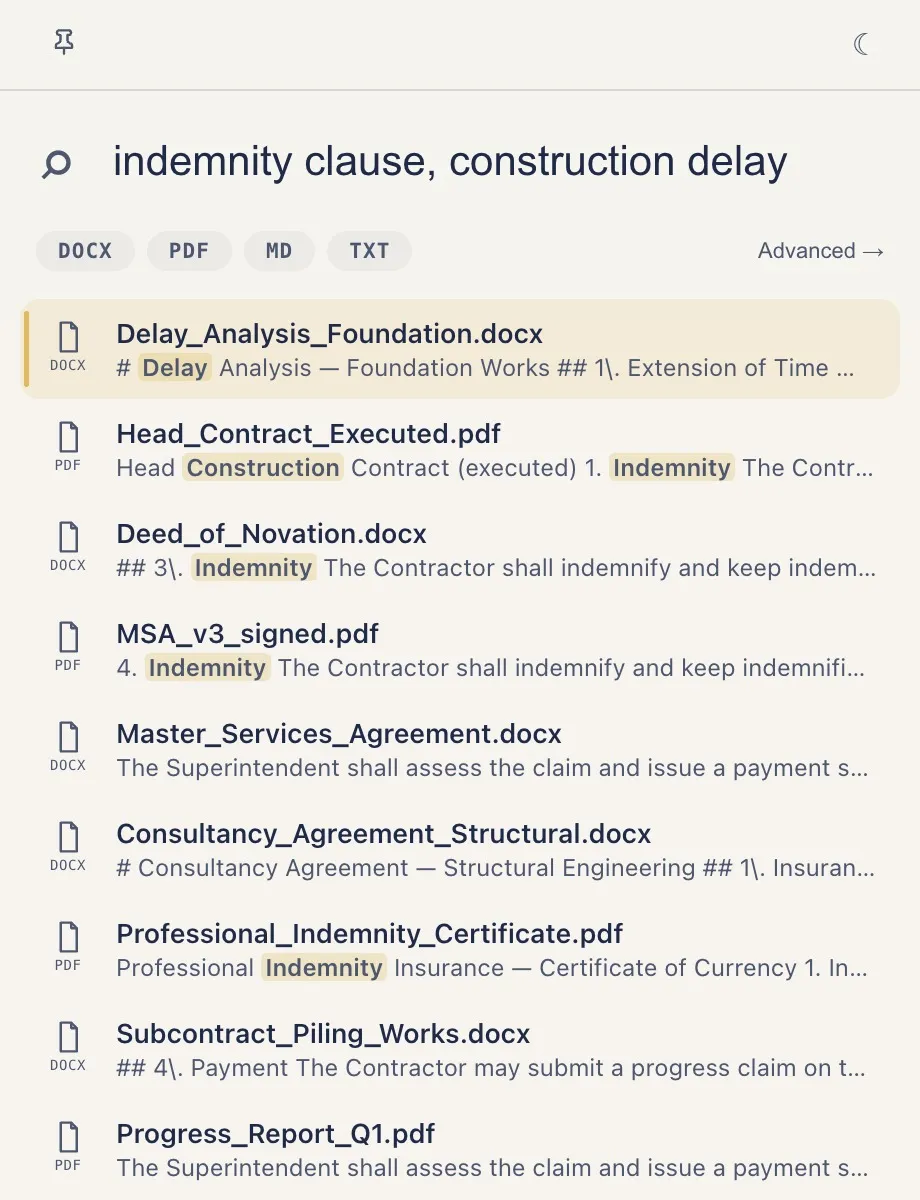
Fossick is a desktop app for Windows and Mac that searches your local documents by meaning, entirely offline. It builds an index of the files on your own machine, then lets you find the right document by describing what it's about — the way you'd describe it to a colleague — rather than guessing the exact filename or keyword.
Crucially, it is search, not chat. There is no chatbot, no generative AI writing answers, and no cloud account holding your files. It finds and ranks your documents and opens the real thing. Nothing is summarised, rephrased, or invented.
Under the hood:
- Indexing, embedding, and search all run on your device. Your documents are never uploaded.
- It reads PDFs, Word documents, text files, and more, and runs OCR on scanned PDFs and images automatically, so even a photographed contract becomes searchable. There's more on that in searching scanned PDFs and images locally with OCR.
- The only thing that ever touches the internet is licensing — never your files.
Because everything is local, you get the fast, meaning-based recall you were hoping to borrow from a chatbot, without handing your clients' documents to anyone.
The trust proof: unplug the Wi-Fi
Privacy claims are easy to write and hard to trust. So here is the test that settles it.
- Disconnect from the internet — unplug the Ethernet cable or turn off Wi-Fi.
- Open Fossick and index a folder of documents.
- Search across them by meaning.
It all works, offline, because nothing was ever going to leave your machine in the first place. If a tool needs the cloud, it stops working when the cloud isn't reachable. Fossick doesn't.
This is the same reasoning many privacy-conscious professionals apply when choosing tools — see is it safe to search documents with AI: on-device vs cloud for a fuller comparison. For confidential material, an air-gap-friendly tool isn't a nice-to-have; it's the baseline.
Who this is for
The professionals who feel the pull toward ChatGPT for document work are precisely the ones who can least afford the risk:
- Lawyers searching privileged case files and contracts — see how lawyers search case files by meaning, offline.
- Consultants hunting through years of client decks and reports, covered in document search for consultants.
- Engineers locating the right spec by meaning, as in offline search for engineers.
- Accountants and researchers working with sensitive financials, records, and unpublished data.
If your work involves documents that carry a duty of confidentiality, the calculation is straightforward: the convenience of a cloud chatbot is never worth the exposure. A local search tool gives you the recall without the risk. Fossick is a one-time US$14.99 purchase with a 14-day money-back guarantee — you can download it and test the offline claim yourself before deciding, and review the pricing options if you choose to keep it.
Frequently asked questions
Is it safe to upload confidential documents to ChatGPT?
For genuinely confidential material, no. Uploading sends the file to a third-party server outside your control, which can breach client-confidentiality obligations, NDAs, and data-protection rules. If a document must not leave the building, it should not leave your device — use a fully offline tool instead.
What's the best ChatGPT alternative for confidential documents?
For finding documents, an on-device semantic search tool is a better fit than a chatbot. Fossick searches your local files by meaning, entirely offline, and never uploads anything. It is search, not chat, so it points you to the real document rather than generating an answer that could be wrong.
Does Fossick use AI to answer questions about my files?
No. Fossick has no generative AI and no chatbot. It uses on-device semantic search to find and rank your own documents by meaning, then opens the actual file. It never summarises, rephrases, or invents content — you always work from the source.
How can I verify my documents never leave my computer?
Disconnect from the internet, then index a folder and run a search. Everything continues to work because all indexing, OCR, and search happen locally. The only thing that ever uses the internet is licensing — never your files.
Can it search scanned PDFs and images?
Yes. Fossick runs OCR on scanned PDFs and image files such as PNG and JPG automatically and on-device, so the text inside them becomes searchable alongside your regular PDFs, Word documents, and text files.