Do You Have to Upload Files to Search Them With AI? No — Here's How
Free to try (1 folder, 200 files) · US$14.99 to keep · Mac & Windows
If you have tried an "AI search" tool lately, you have probably been asked to sign in, connect a cloud drive, or drag your files into a browser window. It is easy to conclude that AI search requires uploading — that the smart matching happens on someone else's servers, so your documents have to go there too.
That assumption is wrong. The short answer to do you have to upload files to search them with AI is no. The technology that makes AI search feel intelligent — turning text into meaning — can run entirely on your own computer. This article explains how that works, why so many tools upload anyway, and how to tell the difference.
Why people assume AI search needs the cloud
The confusion is understandable. The best-known AI products — chatbots and cloud assistants — genuinely do send your text to a remote server. When you paste a contract into a chat window and ask about it, that text travels to a data centre, gets processed, and comes back.
So when a document tool advertises "AI search," people reasonably assume the same pipeline: upload first, get results second. Vendors reinforce this by building browser-based products that ask you to connect Google Drive, Dropbox, or a company account before you can search anything.
But uploading and AI are two separate things that often get bundled together. One is about where your files live. The other is about how the search understands them. You can have the second without the first.
How AI search actually works under the hood
Modern AI search — often called semantic search — works by converting text into numbers that capture meaning. This is the part that feels intelligent.
- A small model reads a chunk of text and produces an embedding: a list of numbers representing what that text is about.
- Your search query gets the same treatment — it becomes an embedding too.
- The tool compares your query's numbers against every document's numbers and returns the closest matches by meaning, not by exact keyword.
That is why you can type "the memo about the delayed shipment penalty" and find the right file even if it never used those exact words. If you want the deeper contrast, see semantic search vs keyword search.
Here is the key point: the embedding model is small enough to run on an ordinary laptop. It does not need a data centre. The intelligence lives in the model, and the model can sit on your hard drive.
So why do so many tools upload anyway?
If the smart part can run locally, why do most AI search products still ask you to upload? The reasons are practical for the vendor, not necessary for you:
- A browser can't read your disk. Web apps have no direct access to your file system, so they must receive a copy of your files to work with them.
- One codebase is cheaper. Running everything on a server means the vendor maintains a single system instead of native Windows and Mac apps.
- Uploaded data has value. Files on a vendor's servers can support analytics, model training, or add-on features — and they lock you into an account.
None of these benefit you as someone handling confidential material. They are engineering and business choices. A desktop app makes the opposite choice: it reads your files where they already are and keeps them there. That distinction is covered in more depth in is it safe to search documents with AI.
What on-device AI search looks like in practice
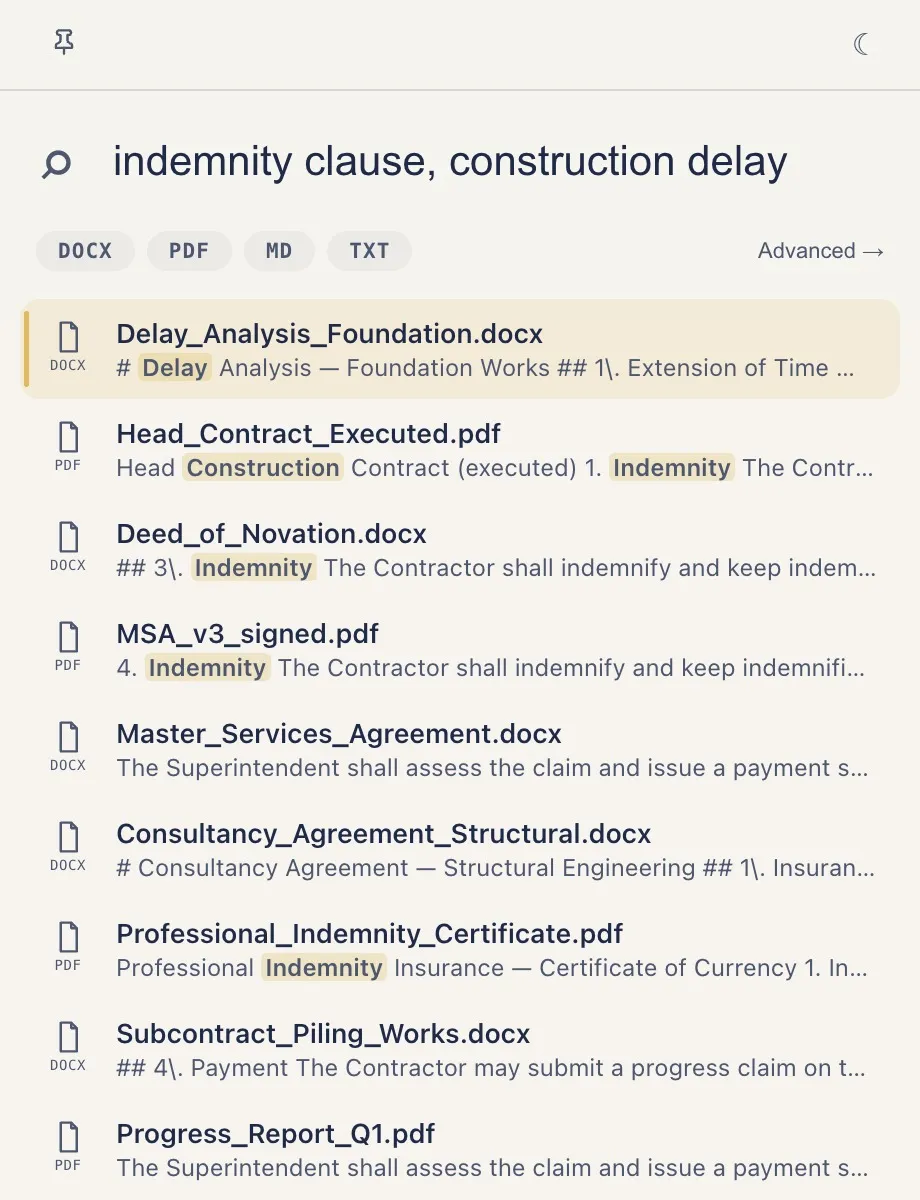
Fossick is a desktop app that searches your local documents by meaning, entirely offline. It shows what AI search looks like when nothing is uploaded.
When you point it at a folder, it does the whole pipeline on your own machine:
- Indexing reads your PDFs, Word files, and text documents locally.
- Embedding — the AI part — runs on your CPU, turning that text into the meaning-based numbers described above.
- Search compares your query against the local index and returns matching files instantly.
Scanned PDFs and images are handled too: Fossick runs OCR on-device to pull text out of photos and screenshots before embedding them, so a scanned contract is just as findable as a typed one.
The trust proof is simple and physical: unplug your Wi-Fi and search anyway. Everything still works, because your documents never needed the internet to begin with. You can download it and try that test yourself.
Search, not chat — an important distinction
It is worth being precise about what on-device AI search does not do, because "AI" now implies chatbots to many people.
Fossick finds documents. It does not answer questions about them, summarise them, or generate text. There is no large language model sitting on top writing prose, and no cloud account holding your files. You type what you remember; it hands you the right document to open and read yourself.
That is a feature, not a limitation, for confidential work. A search tool that never generates an "answer" also never invents one, and never needs to ship your text somewhere to compose a reply. If you are comparing this against a chatbot workflow, ChatGPT alternative for confidential documents walks through the trade-offs.
How to tell whether a tool uploads your files
When you evaluate any "AI search" product, a few questions cut through the marketing:
- Is it a website or a native desktop app? Browser tools almost always upload; native apps can read files in place.
- Does it require an account before you can search? If your files are tied to a login, they are probably on a server.
- Does it work with the internet disconnected? This is the cleanest test. If search still runs offline, your files are staying local.
- What does the privacy policy say about storage and training? Look for explicit statements that content is not retained or used to train models.
Apply those checks and the answer to do you have to upload files to search them with AI becomes clear on a case-by-case basis. With a genuinely on-device tool, the answer is no — and you can prove it in about ten seconds by turning off your network.
Fossick is a one-time US$14.99 purchase, and if you decide to keep it, the pricing page confirms the price — a single one-time purchase, with no subscription at all.
Frequently asked questions
Do you have to upload files to search them with AI?
No. The part of AI search that understands meaning — the embedding model — is small enough to run on an ordinary laptop. Tools that upload do so because a browser cannot read your disk, not because the technology requires the cloud. An on-device app like Fossick keeps every file local.
How can AI work without an internet connection?
The AI model that converts text into meaning-based numbers can be stored and run directly on your computer's processor. Once it is installed, it does not need to contact a server to work. You can disconnect from Wi-Fi entirely and semantic search will still return results.
Is offline AI search as accurate as cloud search?
For finding documents by meaning, on-device embedding search works the same way cloud search does — same math, just run locally. The main difference is that a cloud chatbot can also write answers, while an on-device search tool hands you the actual document. For confidential work, that is usually what you want.
Does Fossick summarise or answer questions about my documents?
No. Fossick is search, not chat. It has no generative AI and no large language model writing responses. It finds and ranks the documents that match what you are looking for, then you open and read them yourself — nothing is ever composed, summarised, or uploaded.
How do I verify that a tool isn't uploading my files?
The simplest test is to disconnect from the internet and try to search. If it still works, your files are staying on your machine. You can also check whether it is a native desktop app rather than a website, and read the privacy policy for statements about data retention and training.