The Fastest Way to Search a Single Folder of Documents
Free to try (1 folder, 200 files) · US$14.99 to keep · Mac & Windows
Most of us keep one folder that matters more than the rest — a case, a client, a project, a year of records. It fills up fast, and finding the right file inside it becomes a chore. You remember what a document said, but not what you named it or which subfolder it landed in.
This article walks through a simple, reliable way to search a folder of documents by meaning rather than filename — and to do it without uploading a single file. If you have one key working folder you return to every day, this is the workflow that turns it from a pile into something you can actually query.
Why searching a single folder is harder than it should be
A working folder starts tidy and ends up crowded. Downloads pile in, subfolders multiply, and files inherit whatever name a scanner or an email client gave them — scan_0043.pdf, Final_v2_REVISED.docx, IMG_2291.png.
Built-in tools don't help much. Windows and macOS search were designed to find files by name and, sometimes, exact text. They stumble when:
- You remember the idea in a document but not its filename.
- The content lives inside a scanned PDF or image, where there is no selectable text to match.
- The word you type isn't the exact word the author used.
The result is the familiar routine: open the folder, sort by date, and scroll. For a busy professional, that is minutes lost several times a day. If this sounds familiar, our guide on how to find a document you can't remember the name of covers the underlying problem in more depth.
Semantic search: find files by what they mean
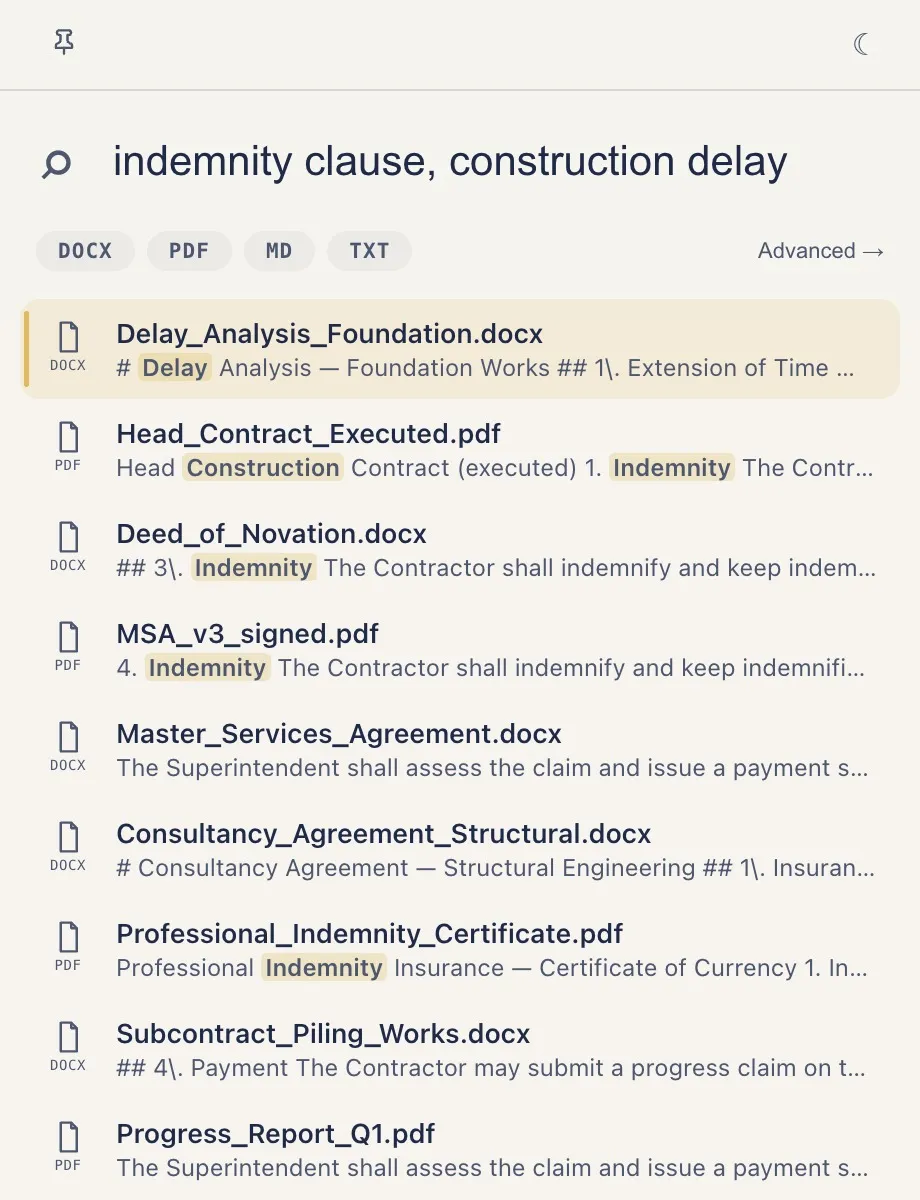
Semantic search matches documents by meaning instead of by literal characters. You describe what you're looking for in plain language — "the settlement offer we rejected last spring" or "the spec with the revised tolerances" — and the tool surfaces files whose content is about that, even if none of those exact words appear.
This matters inside a single folder because the folder already narrows the where. Semantic search solves the what. Together they let you go straight to the document instead of guessing at keywords.
The difference from traditional keyword matching is worth understanding before you commit. We compare the two approaches directly in full-text search vs semantic search for a folder and, more broadly, in semantic search vs keyword search for documents.
The point-at-a-folder workflow, step by step
The cleanest way to make a folder searchable is to point a local tool at it once and let it build an index. Here's the workflow with Fossick, a desktop app that searches your local documents by meaning, entirely offline:
- Choose the folder. Pick your one key working folder — a matter, a client, a research archive. Subfolders are included.
- Let it index. The app reads the documents, extracts their text, and builds a local index. Scanned PDFs and images are passed through OCR automatically, so their contents become searchable too.
- Search by meaning. Type what you remember. Results rank by how closely each document's content matches your description, not by filename.
- Open the file. Click through to the original document in its original location. Nothing is moved or copied to the cloud.
That's the whole loop. Index once, then query as often as you like. When you add new files to the folder, they get picked up on a re-index — the folder stays current without any manual tagging.
Everything stays on your machine
For anyone handling confidential material, the important part of this workflow is where the work happens. With Fossick, indexing, text extraction, OCR, and search all run on your device. Your documents are never uploaded, and there is no cloud account holding your files.
The simplest proof is the one you can run yourself: unplug the Wi-Fi. The app still indexes and still searches. The only thing that ever touches the internet is licensing and billing — never the contents of your folder.
That design is what makes it appropriate for privileged case files, client engagements, financial records, and unpublished research. If the privacy model is your main question, private document search: find files without a data risk and offline document search go deeper on how offline search protects confidential material.
Scanned pages and images in the folder
Real working folders are messy. Alongside clean digital PDFs, you'll find scanned contracts, photographed whiteboards, and screenshots dropped in for reference. Traditional search treats these as opaque — there's no text layer to match against.
Fossick runs OCR (optical character recognition) on-device for scanned PDFs and image formats like PNG and JPG. That means the words locked inside a scanned signature page or a photographed spec sheet become part of the searchable index, without sending the image anywhere.
For folders heavy on scans and photos, see how to search scanned PDFs and images locally with OCR and how to search text inside images and screenshots.
Search, not chat — and what that means for you
It's worth being precise about what this workflow is and isn't. Fossick is a search tool. It finds and ranks your documents so you can open the right one. It does not write answers, summarise files, or run a chatbot over your folder — there is no generative AI involved.
That is a deliberate choice, and for confidential work it's a feature, not a limitation. You get fast, transparent retrieval you can verify by opening the source file, without a language model interpreting or reshaping your content. If you've been weighing an AI assistant against a search tool for sensitive files, is it safe to search documents with AI? lays out the trade-offs.
Fossick runs on Windows and Mac. You can download it and point it at a folder to try the workflow yourself, and it's a one-time US$14.99 purchase with a 14-day money-back guarantee. When you're ready to keep it, the pricing page confirms the one-time US$14.99 price.
Frequently asked questions
Can I search just one folder instead of my whole drive?
Yes. You point the app at a specific folder and it indexes only that folder and its subfolders. This keeps results focused on the working folder you care about and keeps indexing fast, rather than scanning your entire machine.
Does searching a folder upload my documents anywhere?
No. Indexing, OCR, and search all run locally on your device, and your files are never uploaded. You can confirm this by disconnecting from the internet — the app continues to index and search normally. Only licensing and billing ever use a network connection.
What happens when I add new files to the folder?
New files are picked up when the folder is re-indexed, so your search stays current without manual tagging or filing. You keep working the way you already do, and the index reflects what's actually in the folder.
Does it handle scanned PDFs and images in the folder?
Yes. Fossick automatically runs OCR on scanned PDFs and image files like PNG and JPG, entirely on-device. That makes the text inside those documents searchable alongside your regular digital files, without sending images to a server.
Is this a chatbot that answers questions about my documents?
No. Fossick is a search tool, not a chat tool. It finds and ranks the relevant documents so you can open them yourself — there is no generative AI writing answers or summaries, which is intentional for confidential work.