How to Search PDF Files for Text Offline on Your Device
When you need to find a specific clause, figure, or phrase buried in a folder of PDFs, the built-in tools rarely help. Your operating system searches filenames, and opening each PDF to press Ctrl+F is slow when you have hundreds of them. Worse, the cloud tools that promise smarter search usually want you to upload confidential documents first.
This guide shows you how to search PDF files for text across an entire collection at once — privately, on your own machine, with nothing ever leaving your device. You will learn why filename search falls short, the difference between exact-match and meaning-based search, and how to set up a fully offline workflow that also reads scanned documents.
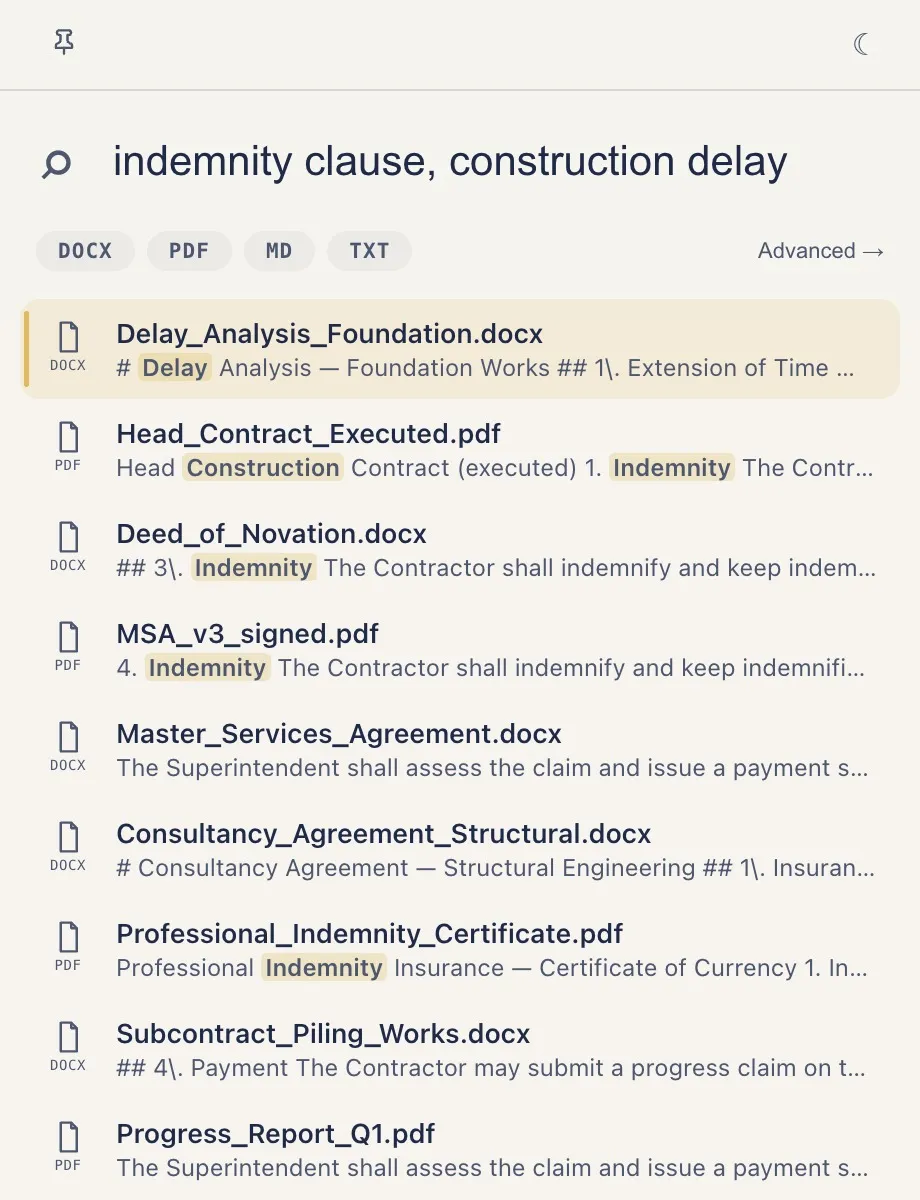
Why searching PDF files for text is harder than it should be
Most people start with the tools already on their computer. On Windows, File Explorer and the Start menu mostly match filenames, and content indexing for PDFs is inconsistent. On Mac, Spotlight indexes some document text but surfaces it unevenly and buries it under apps and web results.
The deeper problem is that PDFs are containers. A PDF can hold real, selectable text — or it can hold nothing but a picture of text, which is common for anything scanned or faxed. To a basic search index, an image-only PDF is invisible.
That leaves the manual approach: open each file and press Ctrl+F. It works for one document, but it does not scale. If you are trying to locate a phrase that might live in any of 800 reports, opening them one at a time is not a search strategy. For a broader look at the options, see how to search inside PDFs on Windows and the Spotlight alternative for document contents on Mac.
Exact-match text search vs. searching by meaning
There are two ways to search PDF files for text, and knowing the difference saves a lot of frustration.
Full-text (keyword) search looks for the exact characters you type. If you search for indemnification, it finds pages containing that string. This is precise and fast, but it fails when you remember the idea rather than the words — or when the document used a synonym like hold harmless.
Semantic search matches on meaning. You type what you remember — "the clause about who pays if a third party sues us" — and it surfaces the relevant passage even if those exact words never appear. This is the difference between remembering a filename and remembering a concept.
Neither is strictly better; they answer different questions. We compare them in detail in full-text search vs. semantic search for a folder and semantic search vs. keyword search for documents. In practice, the most useful tools let you lean on meaning when you are fuzzy on the wording.
Don't forget scanned PDFs: OCR makes image text searchable
A large share of real-world PDFs are scans — signed contracts, filed receipts, older records that predate digital originals. These files look like documents but contain no searchable text layer. No amount of Ctrl+F will find a word inside them.
The fix is OCR (optical character recognition), which reads the pixels and reconstructs the underlying text so it can be indexed and searched. The important detail for confidential work is where the OCR runs. Many online converters and search services perform OCR in the cloud, which means uploading the very documents you were trying to keep private.
An on-device tool runs OCR locally, so scanned files become searchable without leaving your machine. If your collection is scan-heavy, read how to search scanned PDFs and images locally with OCR.
How to set up an offline PDF text search workflow
Here is a repeatable approach that keeps everything on your own device:
- Gather your PDFs into folders you control. They can stay where they are — nested project folders, an external drive, a synced folder you keep locally. You do not need to reorganize anything.
- Index the collection once. A desktop search tool reads each PDF, extracts its text (running OCR on scanned pages), and builds a local index. This is a one-time cost per file; new and changed files get picked up afterward.
- Search by phrase or by meaning. Type the exact wording when you know it, or describe the passage when you don't.
- Open the result in place. Jump straight to the document rather than a converted copy.
The key requirement is that indexing, OCR, and search all happen on-device. That is what separates a private workflow from one that quietly ships your files to a server. For the underlying idea, see offline document search and how to search across thousands of files at once.
Using Fossick to search PDF files for text — entirely on-device
Fossick is a desktop app for Windows and Mac that searches your local documents by meaning, entirely offline. You point it at your folders, it indexes them on your machine, and then you can search PDF files for text the way you actually remember them — a phrase, a topic, a rough description — and it surfaces the right document.
A few things worth being precise about:
- It is search, not chat. Fossick finds and ranks your documents. It does not summarize them, answer questions, or generate text — there is no chatbot and no generative AI.
- Nothing is uploaded. Indexing, embedding, and search run on-device. You can disconnect from Wi-Fi and it still works; only licensing touches the internet.
- It handles more than clean PDFs. Word documents, text files, and images are covered too, and scanned PDFs are OCR'd automatically so their contents become searchable.
This makes it a practical fit for lawyers searching case files, accountants finding records, and anyone who cannot risk confidential PDFs leaving their machine. You can download Fossick and try it during the beta.
What to look for when choosing a PDF search tool
If you are evaluating options, a short checklist keeps you honest:
- *Does it search text inside PDFs, or just filenames?* This is the baseline requirement.
- Does it OCR scanned documents? Without it, a chunk of your files stays invisible.
- Where does processing happen? "Private" only means something if indexing and search run locally, not on a remote server.
- Can it match on meaning, not just exact strings? Useful when you remember the gist but not the phrasing.
- Does it scale to your real collection? Searching ten PDFs is easy; searching several thousand quickly is the actual test.
Fossick is free to try during the beta, and every paid plan includes the full app and all updates; you can review the pricing options when you are ready. For a deeper walkthrough of private PDF search, see how to search PDF files privately and offline.
Frequently asked questions
How do I search multiple PDF files for text at once?
You need a tool that indexes the contents of every PDF in your folders, rather than opening each one manually. Once indexed, you can search the whole collection in one query. A desktop app like Fossick does this locally so you can search thousands of PDFs at once without uploading them.
Can I search text inside scanned PDFs?
Only if the file has been through OCR, which converts the image of the text into actual searchable characters. Scanned PDFs contain no text layer by default, so plain search finds nothing. Fossick runs OCR on-device automatically, so scanned pages become searchable without leaving your machine.
Is it safe to search confidential PDFs without uploading them?
Yes, if the tool processes everything locally. Cloud search services require uploading your files, which creates exposure. An on-device app like Fossick indexes and searches PDFs on your own computer and never transmits them — it works with the Wi-Fi unplugged. See do you have to upload files to search them with AI.
What's the difference between keyword search and semantic search for PDFs?
Keyword search matches the exact characters you type, which is precise but misses synonyms and paraphrases. Semantic search matches on meaning, so you can describe a passage and still find it. Fossick emphasizes meaning-based search while still letting you find specific phrases.
Does Fossick answer questions about my PDFs?
No. Fossick is search, not chat — it finds and ranks the documents that match your query. It does not summarize, answer questions, or generate text, and there is no chatbot or cloud account for your files.