How to Search Word Documents by Their Content, Not Filename
Free to try (1 folder, 200 files) · US$14.99 to keep · Mac & Windows
You know the document exists. You wrote the paragraph, you remember the point it made — but the filename is Draft_v3_FINAL_reviewed.docx and it is one of six hundred .docx files scattered across your Documents folder, a shared drive, and last quarter's project folder. Filename search cannot help you here, and neither can trying to guess the exact words you typed months ago.
This guide explains how to search Word documents by content — by what they actually say and mean — instead of by their name. We'll cover why filename and keyword search fall short for heavy .docx users, what semantic search does differently, and how to do it all locally so your confidential drafts never leave your computer.
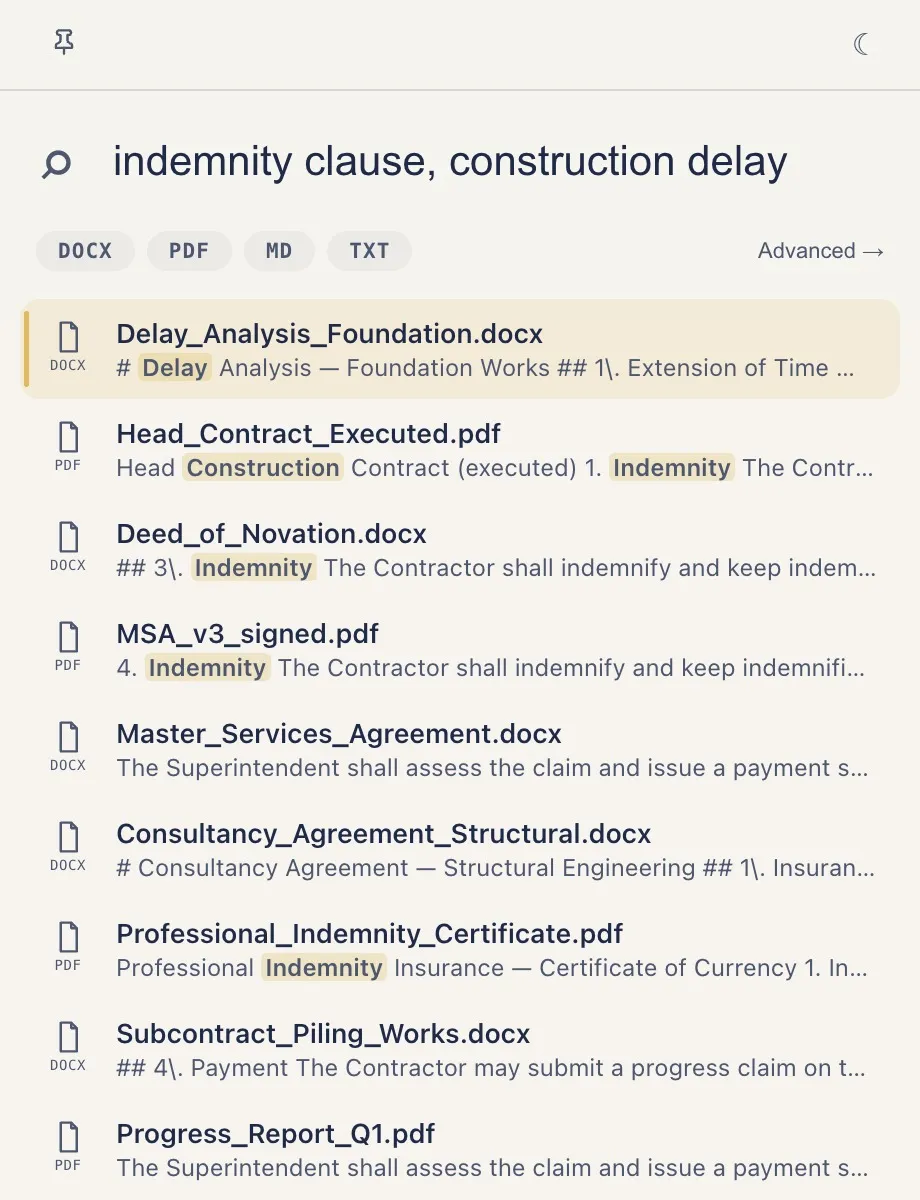
Why searching Word docs by filename fails
Filenames are a promise you make to your future self and rarely keep. By the time you need a document, the name is often useless: Notes.docx, Untitled.docx, client_final_FINAL2.docx. None of those tell you what's inside.
Heavy Word users — admins, ops teams, writers — accumulate hundreds of near-identical files. Versions, templates, meeting notes, and drafts pile up faster than any naming convention can keep pace with. When you go looking, you don't remember the name. You remember the content: the clause you added, the figure you quoted, the argument you made.
The fix is to stop searching for names and start searching for what the document says. That's what searching Word documents by content actually means — and it's a different job than filename lookup was ever built for.
Keyword search helps — until you forget the exact words
The obvious next step is full-text search: look inside the files for a specific word or phrase. This is a real improvement over filename search, and it's the right tool when you remember an exact term — a case number, a product code, a client's surname.
But keyword search is literal. It matches the characters you type, not the idea behind them. If your document says "terminate the agreement" and you search for "cancel the contract," a keyword tool returns nothing, even though both phrases mean the same thing.
That gap matters most when time has passed. You rarely recall the precise vocabulary you used six months ago. You recall the gist. For a deeper comparison of the two approaches, see full-text search vs semantic search for a folder.
Searching by meaning: what semantic search does
Semantic search matches documents by concept rather than by exact string. Instead of comparing letters, it compares meaning, so a description in your own words can surface a .docx that never contains those exact words.
In practice, that means you can type things like:
- "the memo about switching vendors after the price increase"
- "onboarding checklist for remote hires"
- "the paragraph where we pushed back on the delivery timeline"
...and get the right document back, even if it phrased everything differently. You're describing the content, not reciting it.
This is especially useful for Word files because prose varies so much. Two documents can cover the same topic with almost no shared keywords. Semantic search closes that gap. If you want the concept explained in more depth, read semantic search vs keyword search for documents or the broader guide on searching documents by meaning, not filename.
Why this should run offline, on your own machine
Many tools that promise smart search work by uploading your files to a server first. For a folder of confidential Word documents — contracts, HR records, client memos, unpublished drafts — that's a non-starter. Once a file leaves your machine, you've lost control of where it lives and who can reach it.
The alternative is to do everything locally: read the files, build the search index, and run every query on your own hardware. No account holds your documents, no server sees them, and the search works with the Wi-Fi unplugged.
This matters for anyone bound by confidentiality — legal privilege, client agreements, professional obligations. The safest document is the one that never travels. For the reasoning behind that, see private document search: find files without a data risk.
How to search Word documents by content with Fossick
Fossick is a desktop app for Windows and Mac that searches your local documents by meaning, entirely offline. It's built for exactly this problem: finding the right .docx among hundreds when you remember the content but not the name.
Here's how it works in practice:
- Point it at your folders. Add the directories where your Word files live — Documents, a project folder, a synced drive folder on disk.
- Let it index locally. Fossick reads and indexes the contents on your machine. Indexing, embedding, and search all run on-device; nothing is uploaded.
- Search in plain language. Describe what you remember — the topic, the point, the context — and Fossick ranks the documents that mean what you described.
It handles more than .docx: PDFs, plain text, and other formats too. It even runs OCR on scanned PDFs and images automatically, so a document you only have as a scan is still searchable by content.
One important thing to be clear about: Fossick is search, not chat. It doesn't summarise, answer questions, or generate text. There's no chatbot and no generative AI — it finds and ranks your real files, then you open them. That's a deliberate choice for people who need to trust the results and cite the source.
Fitting it into a heavy Word workflow
For people who live in Word all day, the win is time and certainty. Instead of opening folder after folder, or reconstructing a filename from memory, you describe the document once and open it.
A few practical habits help:
- Index broadly. Add every folder where Word files might live, including archives. Semantic search is only as good as what it can see.
- Search the way you think. Don't guess keywords — describe the content or the situation. "The revised scope after the budget cut" works better than trying to recall the heading.
- Re-index after big changes. When you add a batch of new documents, let the index catch up so recent files are findable.
Fossick is a one-time US$14.99 purchase with a 14-day money-back guarantee — you can download it here and point it at a folder of Word docs to see whether it finds what you mean. The price is a single one-time payment, so you're never forced into a subscription. If you also search across large mixed archives, the guide on searching across thousands of files at once is a useful companion.
Frequently asked questions
Can I search Word documents by content without knowing the filename?
Yes. Content-based search looks inside the documents rather than at their names, so you can find a .docx by describing what it says. With semantic search you don't even need the exact words — a plain-language description of the topic is enough to surface the right file.
Does searching my Word files require uploading them anywhere?
It doesn't have to. Fossick does all indexing and searching on your own machine, so your Word documents never leave your computer. It works fully offline — you can disconnect the internet and search still runs, which is the point for confidential files.
How is this different from the search built into Word or Windows?
Built-in search is mostly literal: it matches filenames or exact words inside a file. Semantic search matches meaning, so "cancel the contract" can find a document that says "terminate the agreement." See our Windows search alternative guide for a fuller comparison.
Does Fossick answer questions about my documents like a chatbot?
No. Fossick is search, not chat. It finds and ranks your actual files by meaning and lets you open them — it does not summarise, generate text, or answer questions. That keeps results verifiable and your files private, with no generative AI involved.
Can it search scanned Word docs or PDFs too?
Fossick automatically runs OCR on scanned PDFs and images on-device, so text inside them becomes searchable by content. Alongside .docx files, it also handles plain text and other common formats. See how to search scanned PDFs and images locally with OCR for details.