How to Search Inside a Word Document (Offline, On-Device)
You remember writing it. There was a paragraph about an indemnity clause, or a section on the migration timeline, or a note buried in a client memo. But you cannot remember which file it lived in, and Word's built-in Find only works once you already have the right document open.
This guide shows how to search a Word document — and a whole folder of them — for the text or ideas inside, without opening each one by hand and without uploading anything to the cloud. We'll cover the built-in tools, where they fall short, and how on-device semantic search finds the passage you half-remember while your files stay on your machine.
The fastest way to search inside one open Word document
If the document is already open, Word has a built-in tool that works well:
- Press Ctrl+F on Windows or Cmd+F on Mac to open the Navigation pane (Windows) or the search box (Mac).
- Type the word or phrase you're looking for.
- Use the up/down arrows to step through each match.
For more control, open Find and Replace (Ctrl+H, or the dropdown next to Find) to match whole words only, match case, or use wildcards.
This is perfect when you already know which file to open and exactly what word appears in it. The trouble starts when either of those is untrue — when you have fifty client documents and only a fuzzy memory of the wording.
How to search across many Word documents at once
When the text could be in any of dozens of files, opening each one and pressing Ctrl+F is not realistic. You have a few built-in options.
Windows
Windows Search indexes file contents, including .docx, if the folder is included in your indexing options. Open a File Explorer window, navigate to the folder, and type your term in the search box in the top-right. Matches inside documents can appear alongside filename matches.
Mac
Spotlight and Finder index the text inside Word files. Type in the Finder search bar and choose to search file contents rather than just names.
Both approaches share the same limitation: they look for the exact characters you typed. If your memo said "termination for convenience" and you search "cancel the contract early," you get nothing — even though both describe the same clause. For a deeper comparison of these built-in tools, see how to search Word docs offline on your own device.
Why keyword search misses what you actually meant
Keyword search matches strings, not ideas. That's fine when you remember exact phrasing, but confidential work rarely stores things in tidy, memorable words.
A few common failures:
- You search "budget overrun" but the document said "cost overage."
- You look for "NDA" but the file spells out "non-disclosure agreement."
- You remember the topic of a report but none of its specific terminology.
This is the gap between what you type and what you wrote. Semantic search closes it by matching on meaning: it understands that "cost overage" and "budget overrun" are close in concept, so the right file surfaces even when the wording differs. If you want the underlying explanation, we cover it in semantic search vs keyword search for documents.
Searching a Word document by meaning, on your own device
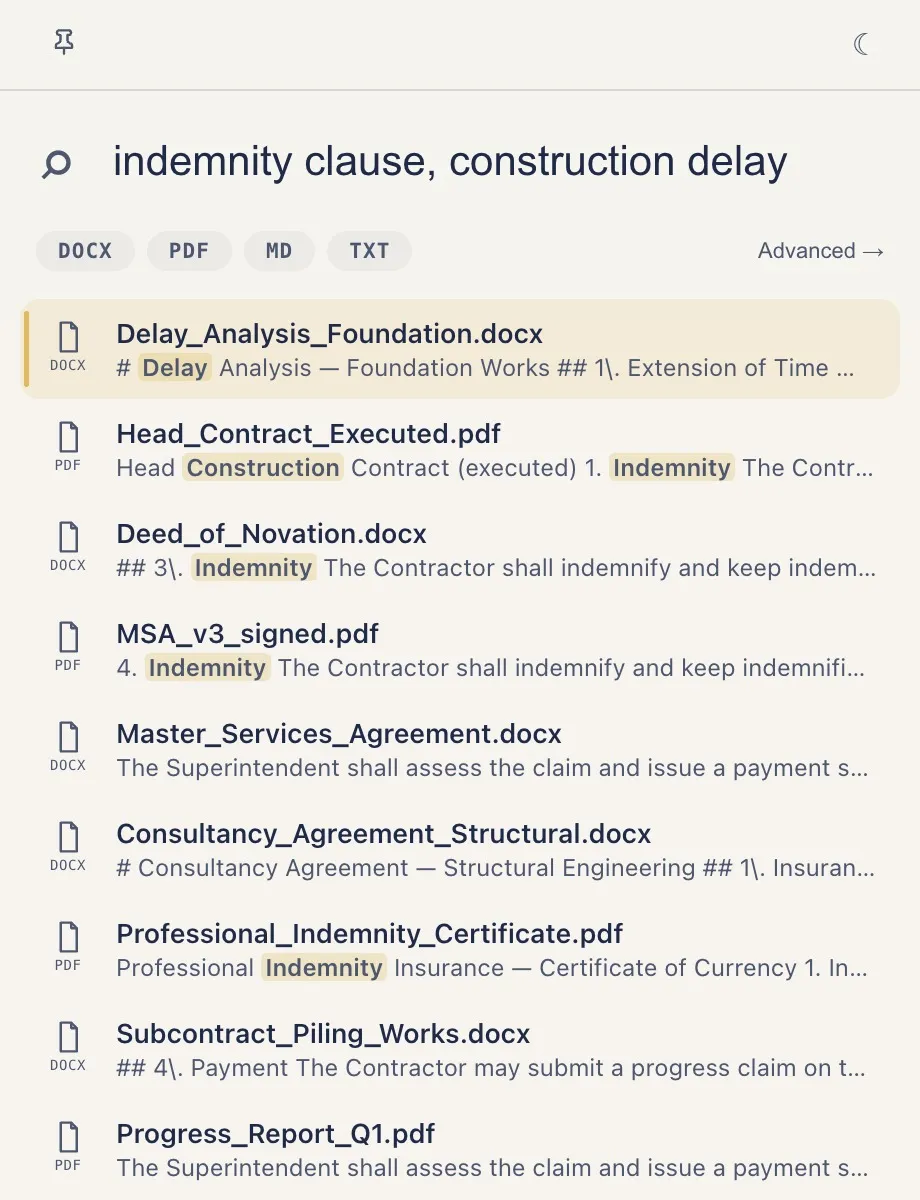
Fossick is a desktop app that searches your local documents by meaning, entirely offline. Point it at the folders where your Word files live and it builds a private index on your computer. From then on you can type what you remember — a phrase, a description, a rough recollection — and it ranks the documents that best match, not just the ones containing your exact keywords.
A few things worth being precise about:
- It is search, not chat. There is no chatbot, no generative AI, and it does not answer questions or summarise your files. It finds the document and takes you to it.
- It works across many file types, so your .doc and .docx files sit alongside PDFs, text files, and more in one searchable index.
- It reads scanned and image-based content too. If a Word file embeds a scanned page, or you also keep scanned contracts, OCR runs automatically on-device.
The result: instead of opening documents one by one, you describe the passage you need and jump straight to the file. For a broader walkthrough of content-based search, see how to search Word documents by content, not filename.
Keeping confidential Word files private while you search
Many "AI search" tools work by uploading your documents to a server first. For a lawyer, accountant, or consultant, that is often a non-starter — it can breach client confidentiality or contractual data-handling terms before you've found a single file.
Fossick takes the opposite approach. Indexing, embedding, and search all run locally. Your Word documents never leave your computer. The clearest proof is simple: unplug your Wi-Fi and it still works. The only time the app touches the internet is for licensing and billing — never for your files.
That design matters most for exactly the people who have the most to search:
- Lawyers with case files and contracts — see how lawyers search case files by meaning, offline.
- Accountants managing sensitive records — see document search for accountants.
- Anyone who needs to search confidential files without them leaving their PC.
Getting started
Setting up on-device search over your Word documents takes a few minutes:
- Download the app for Windows or Mac.
- Choose the folders that hold your .doc and .docx files (and any PDFs or images you also want searchable).
- Let it build the local index — this runs once, in the background, on your machine.
- Start typing what you remember and open the matching document.
Because every plan includes the full app and all updates, you can try it against your real files and judge the results for yourself. Pricing is available on the pricing page if you decide to keep using it beyond the trial.
Once the index exists, searching a folder of hundreds of Word documents is nearly instant — and you never trade privacy for that speed.
Frequently asked questions
How do I search inside a Word document I already have open?
Press Ctrl+F on Windows or Cmd+F on Mac to open the find tool, then type your word or phrase and step through the matches. For case-sensitive matching or wildcards, use Find and Replace (Ctrl+H). This works within a single open document; to search across many files at once you'll want a desktop search tool instead.
Can I search Word documents without opening each one?
Yes. Windows Search and Mac Spotlight can index the text inside .docx files so you can search a whole folder. They rely on exact keyword matches, though, so they miss synonyms and paraphrases. A semantic search tool like Fossick finds files by meaning across the entire folder, without opening each one.
Will my confidential Word files be uploaded anywhere?
Not with Fossick. Indexing, OCR, and search all run on your own device, and your documents are never uploaded. You can confirm this by disconnecting from the internet — search still works. Only licensing and billing ever use a network connection.
Does it work with older .doc files and scanned pages?
It handles both .doc and .docx files, alongside PDFs, plain text, and images. If a document contains scanned or image-based pages, OCR runs automatically on-device so that text becomes searchable too. Everything stays local.
Is this a chatbot that answers questions about my documents?
No. Fossick is search, not chat. It has no generative AI and does not summarise or answer questions. It finds the document that best matches what you typed and takes you straight to it, so you read the source yourself.