How to Effortlessly Retrieve Documents on Your Own Computer (Without Uploading Anything)
Short answer: To effortlessly retrieve documents on your own computer, use a local semantic search tool that indexes your files on-device and matches what you type to what documents mean, not just their filenames or exact words. You describe what you remember, it ranks the closest matches, and nothing needs to be uploaded to a cloud service.
Free to try (1 folder, 200 files) · US$14.99 to keep · Mac & Windows
You know the document exists. You remember roughly what it said, maybe who it was for, maybe the month. But it is buried somewhere in a decade of folders named "Misc", "Final", and "Final v2", and the search box keeps returning nothing useful.
This article explains why browsing folders and exact-keyword search break down as a collection grows, how semantic search lets you effortlessly retrieve documents by describing what they are about, and why doing that entirely on your own machine matters if your files are confidential. It also covers what this kind of tool is not: it is search, not a chatbot.
Why folder hunting stops working
Folder hunting fails because it relies on a filing decision you made long ago, often in a hurry, under a naming scheme you may no longer remember.
Folders work well for a few hundred files you touch every week. They work badly for everything else:
- One file, many homes. A contract amendment could reasonably live under the client, the matter, the year, or "Contracts". You picked one; your memory picked another.
- Names drift. "Proposal_final", "Proposal_final_JM", "Proposal_sent" tell you nothing about what is inside.
- Downloads and email attachments pile up. Many documents never get filed at all.
- Colleagues file differently. Shared folders inherit everyone's habits at once.
The result is the familiar ritual of opening ten files to find the one you wanted. If this is a regular frustration, our guide on finding a document you can't remember the name of goes deeper on recovery tactics.
Why exact-keyword search misses files you know exist
Keyword search misses documents because it matches the specific terms you type, not the idea you are looking for.
Built-in tools like Windows Search and Spotlight do search file contents, and they are genuinely useful when you remember a distinctive word. Under the hood, classic full-text search builds an index of terms and returns documents containing them; the SQLite FTS5 documentation is a clear example of how these term-matching indexes work.
The problem is human memory. You remember "the memo about the supplier being late on deliveries", but the document says "vendor fulfilment delays". You search "termination clause"; the contract says "either party may end this agreement". No shared keyword, no result.
Keyword search also struggles when:
- You remember the gist but none of the wording.
- The document uses jargon or abbreviations you did not use in your query.
- The text is trapped in a scanned PDF or photo with no machine-readable text layer.
For a side-by-side breakdown, see semantic search vs keyword search for documents.
How semantic search lets you effortlessly retrieve documents
Semantic search lets you effortlessly retrieve documents by converting both your query and your files into numerical representations of meaning, then returning the files whose meaning is closest.
As Wikipedia's overview of semantic search puts it, the aim is to match the intent of a query rather than its exact words. The technique most tools use is sentence embeddings: a model turns a passage of text into a vector, and passages with similar meaning end up close together. The Sentence-BERT paper describes this approach of comparing text by vector similarity.
In practice, that means a query like "supplier running late on shipments" can surface the memo about "vendor fulfilment delays", because the meaning overlaps even though the words do not.
| Method | Finds by | Works when you remember | Weak spot |
|---|---|---|---|
| Browsing folders | Location | Where you filed it | Misfiled or unfiled docs |
| Filename search | File name | The exact name | Vague or generic names |
| Keyword search | Exact terms | Specific words used | Paraphrases, synonyms |
| Semantic search | Meaning | Roughly what it said | Very short, contentless files |
Semantic and keyword search are complementary. When you know an exact case number or part code, keyword search is precise. When you only remember the idea, semantic search is what gets you there.
Why doing it on-device matters for confidential files
Running semantic search on your own computer matters because it means your documents never have to be uploaded to someone else's servers to become searchable.
Many "AI search" products work by sending your files, or extracted text from them, to a cloud service for processing. For client contracts, financial records, medical information, or unpublished research, that raises real questions: who can access the data, where it is stored, and whether you are permitted to share it with a third party at all.
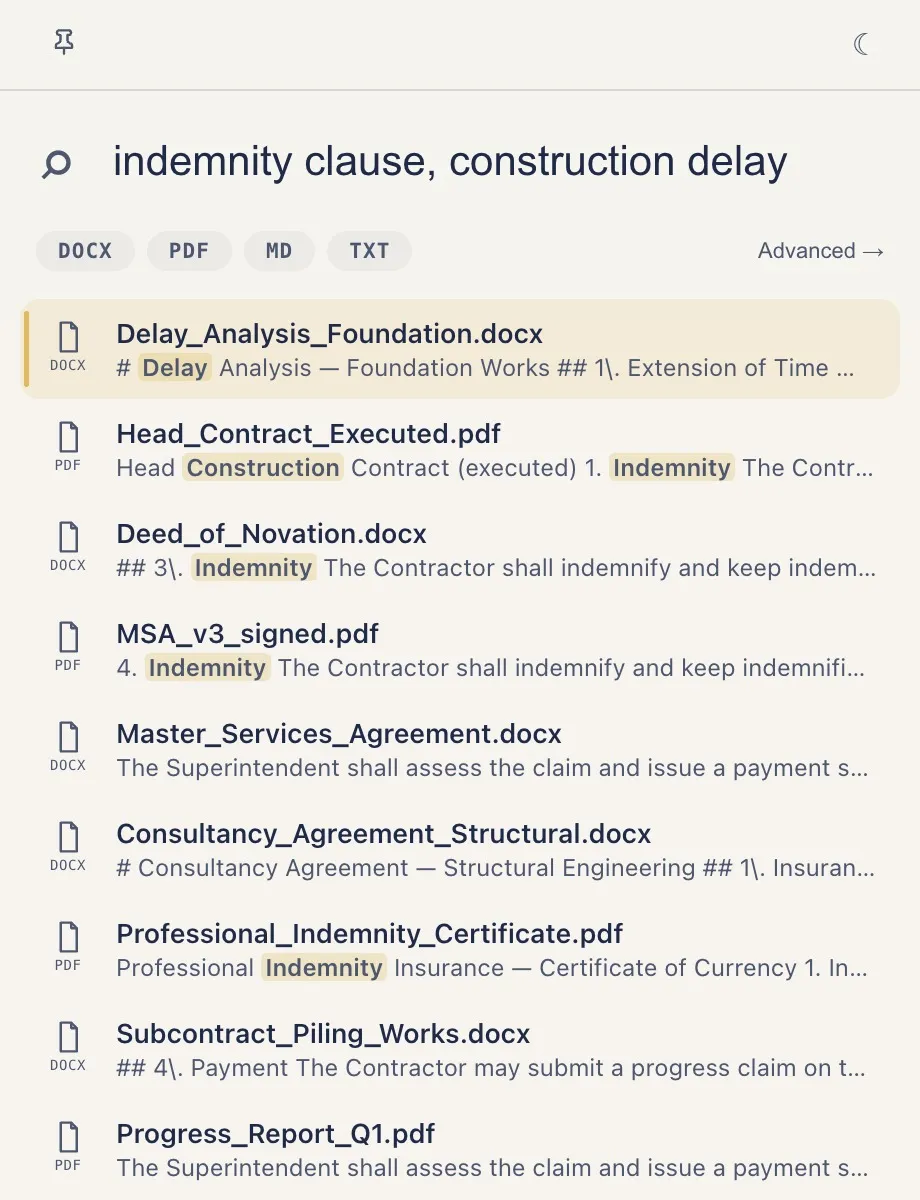
On-device search removes that question. Fossick, a desktop app for Windows and Mac that searches your local documents by meaning entirely offline, is built this way:
- Text extraction, OCR, embedding and search all run locally. Documents are never uploaded.
- It works with the Wi-Fi off. That is the simplest way to verify the claim yourself. Only licensing touches the internet.
- The embedding model is small and local. It uses the open all-MiniLM-L6-v2 model (384 dimensions, quantized, about 22 MB), running on your machine.
- Scanned files are covered. Scanned PDFs and images (PNG, JPG) are made searchable with on-device OCR.
It handles PDF, Word (.docx, .doc), Excel (.xlsx), PowerPoint (.pptx), OpenDocument text, plain text, Markdown, CSV, HTML, and email (.eml, .msg). You can read more about the approach on the Fossick homepage or in our explainer on private document search.
A practical workflow to retrieve documents effortlessly
The most reliable workflow is to point a local semantic search tool at the folders you actually use, let it index once, and then search by describing what you remember.
- Choose your folders. Start with the places documents accumulate: client folders, Downloads, an archive drive, exported email.
- Let it build the index. First-time indexing takes the longest because every file is read, OCR'd if needed, and embedded. In one measured test on an 8 GB Apple M1 MacBook, 52 mixed documents (Word, PDF including scanned pages, Excel, CSV, Markdown; 700 KB) indexed from scratch in about 81 seconds, including model load and OCR.
- Search in plain language. Type what you remember: "letter to the landlord about the water leak", "slide deck on pricing strategy for the retail client", "spec for load tolerance on the mezzanine".
- Scan the ranked results. Results are ordered by how closely their meaning matches your query. Open the file directly from the list.
- Refine with detail. If the first results are close but not right, add a detail you remember, such as the counterparty or the topic.
- Keep it current. Re-indexing is incremental, so only new or changed files are re-processed. In the same test, re-checking the unchanged 52-document folder took about 7 seconds.
If you want to try this on your own files, the app is available on the download page.
What on-device semantic search is, and what it is not
On-device semantic search is a retrieval tool: it finds and ranks your own documents, and it does not chat, summarise, or generate answers.
That distinction matters for trust. Fossick has no chatbot and no generative AI. It will not write a summary of a contract or answer a question about it; it shows you which documents are most relevant so you can read the source yourself. For professionals who need to rely on the original wording, that is usually what they want anyway.
It is also designed to stay out of the way:
- Fast queries. About 15-20 ms median per semantic search over a 52-document folder (10 queries, 3 runs, Apple M1 MacBook, 8 GB RAM).
- Small index. About 1.9 MB on disk for that same 52-document folder.
- Simple pricing. A single one-time purchase of US$14.99 includes the full app, every file type and all future updates, with a 14-day money-back guarantee; details are on the pricing page.
If you are deciding between tools more broadly, our guide to the best desktop search app lists the criteria worth checking, including where processing happens and how scanned files are handled.
Frequently asked questions
What is the easiest way to find a document on my computer if I can't remember the file name?
Use a search tool that looks at document contents, ideally one that searches by meaning. Semantic search lets you type a description of what the document was about and returns the closest matches, even if your wording differs from the file's. Keyword tools like Windows Search or Spotlight work if you remember a distinctive word.
Do I have to upload my files to use AI-powered document search?
No. Some tools send files to the cloud, but on-device semantic search builds its index and runs queries entirely on your computer. Fossick, for example, works with the Wi-Fi off, and only licensing touches the internet.
Can semantic search find text in scanned PDFs and photos?
Only if the tool runs OCR first, which converts images of text into machine-readable text. Fossick runs OCR on scanned PDFs and images (PNG, JPG) automatically and on-device, so their contents become searchable alongside your other files.
Is Fossick a chatbot like ChatGPT or Copilot?
No. Fossick is search, not chat: it finds and ranks your own documents by meaning. It has no generative AI and does not summarise documents or answer questions about them.
Can I try Fossick before buying?
Yes. It is free to try with no sign-up and no card, limited to 1 folder and up to 200 files. Buying once unlocks every folder and file.