What to Look For in a Desktop Search App in 2026
Short answer: The best desktop search app searches inside file contents, not just filenames. It understands meaning as well as exact keywords, reads scanned PDFs and images with OCR, and does all of this locally, so confidential documents never leave your computer. Test any candidate on your own real files before you commit.
Free to try (1 folder, 200 files) · US$14.99 to keep · Mac & Windows
Most people start shopping for a desktop search app after a bad afternoon. You know the document exists and roughly what it said, but you cannot find it. The built-in search came back empty, and you ended up opening folders one by one.
This guide is for choosing the best desktop search app for your situation, not someone else's. It covers the four things that separate tools: whether they read file contents, whether they understand meaning, whether they handle scans, and where your data goes. It ends with a short test you can run on your own files.
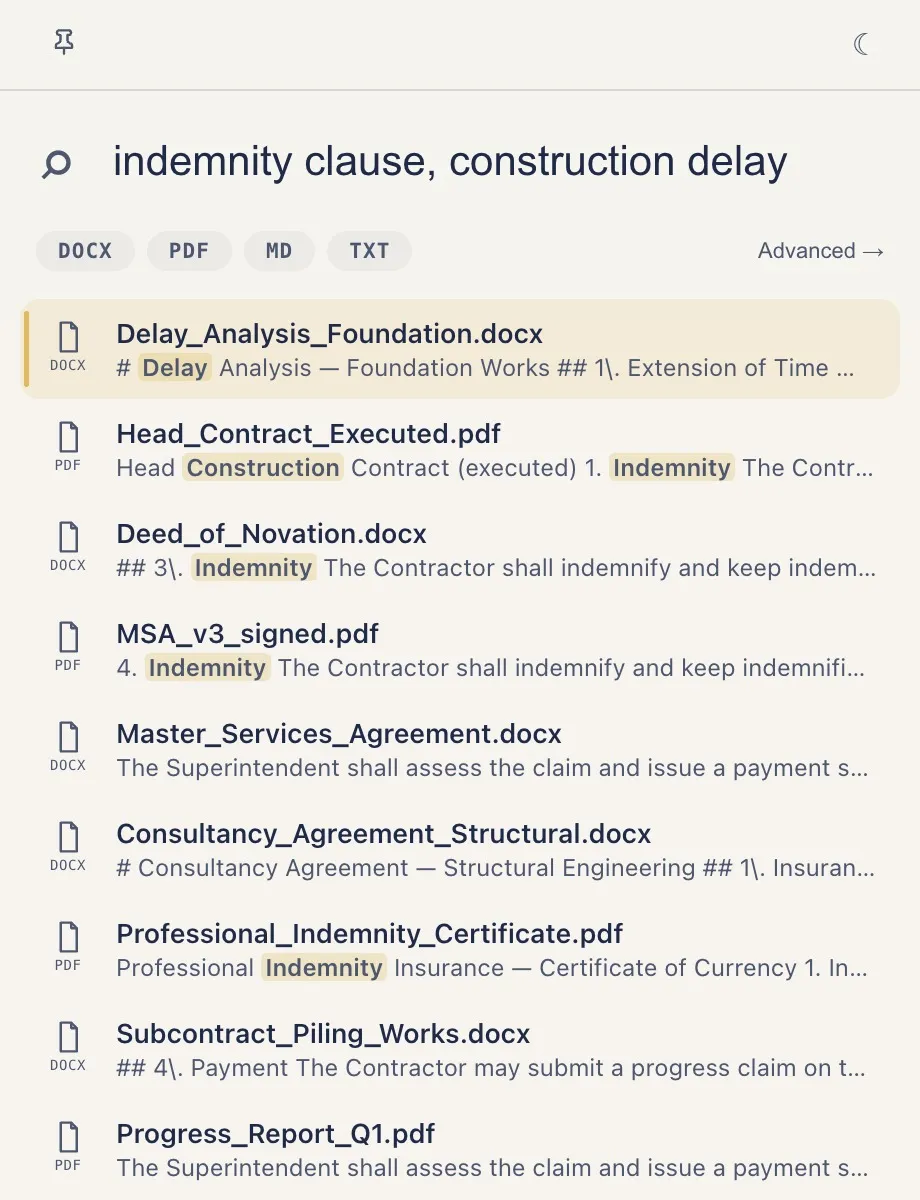
Search file contents, not just filenames
A desktop search app is only useful if it reads what is inside your files, because you usually remember a document's content long before its name.
Filename finders are excellent when you know a file is called something like Q3_final_v2.docx. They cannot help when all you remember is 'the memo about the late-delivery penalty'. Built-in tools do index some content. Windows Search relies on an index of files, their properties and contents, and Spotlight on a Mac searches content too. Coverage still depends on configuration, file type, and whether indexing has finished. If content results seem patchy, our guide to Windows Search not indexing file contents explains the common causes.
When you evaluate a tool, ask:
- Which formats does it actually read? Check for PDF, Word, Excel, PowerPoint, email (.eml, .msg), CSV, Markdown and HTML.
- Which locations does it cover? Confirm it reaches the folders you care about, including external or synced drives.
- Does it keep up with changes? It should re-process only new or edited files rather than re-scanning everything.
Semantic vs keyword search: which does the best desktop search app need?
Semantic search is what separates a modern desktop search app from a classic one, because it matches what you mean rather than the exact words you type.
Classic full-text search builds an index of terms and returns files containing those terms. It is precise and fast for case numbers, part numbers, client names and quoted phrases. It also fails quietly. If the document says 'either party may end this agreement on 30 days' notice' and you search for 'termination for convenience', a keyword engine returns nothing.
Semantic search aims to match the meaning and intent of a query rather than its exact keywords. Documents and queries are converted into numerical representations (embeddings), and the tool ranks files by how close they are in meaning. That makes it far better for vague, half-remembered queries.
Two cautions when shopping:
- Semantic search is not a chatbot. A search tool returns your documents. A chatbot generates an answer, which is a different product with different risks.
- Know when you need exact matching. For a specific contract number, a plain Ctrl+F style search inside the opened file is often the quickest confirmation.
For a deeper comparison, see semantic search vs keyword search for documents.
Privacy: where does indexing and search actually happen?
For confidential files, the most important question is whether indexing and search run on your own device or on a provider's servers.
Cloud search and AI assistants can be capable, but they work on data held in the provider's cloud. Microsoft, for example, documents how Microsoft 365 Copilot accesses and processes organisational data in the Microsoft cloud. That is not inherently wrong. It is a different trust model, involving processing agreements, retention settings and, for lawyers, questions about privileged material.
A local-only tool removes that whole category of questions, because the documents never leave the machine. Some products blur the line, though. They are labelled 'desktop' search but send content to a server for 'AI features'. Check:
- Does it require an account to index your files?
- What, exactly, connects to the internet, and why?
- The simplest proof: turn Wi-Fi off and run a search. If results still appear, processing is happening on your device.
More detail is in our guide to private document search.
OCR: can it read scanned PDFs and images?
If your archive includes scans, faxed contracts or photos of whiteboards, a desktop search app needs OCR, or those files are effectively invisible.
A scanned PDF is a picture of a page. Without optical character recognition there is no text to index, so even a perfect search engine skips it. Many offices have years of signed agreements, receipts and old reports in exactly this form.
What to check:
- Is OCR automatic? You should not have to convert files one by one first.
- Does it cover images (PNG, JPG) as well as scanned PDFs? This matters for screenshots and phone photos.
- Does OCR run on-device? Some tools send scans to a cloud OCR service, which undoes the privacy benefit.
See how to search scanned PDFs and images locally for a walkthrough.
Comparing the main types of desktop search tools
Most options fall into five groups, and the right one depends on whether you need meaning-based results and whether your files can leave your machine.
The newest group is local semantic search. One example is Fossick, a desktop app for Windows and Mac that searches your local documents by meaning, entirely offline. It handles text extraction, OCR, embedding and search on the device. It is search, not chat: there is no chatbot, no generative AI and no summaries.
| Tool type | Reads contents | Finds by meaning | OCR | Files stay local |
|---|---|---|---|---|
| Filename finders | No | No | No | Yes |
| Built-in OS search | Partly, depends on index | Limited | Varies | Yes |
| Keyword desktop search tools | Yes | No | Varies | Yes |
| Cloud drive / AI assistant search | Yes | Often | Often | No |
| Local semantic search (e.g. Fossick) | Yes | Yes | Yes, on-device | Yes |
Keyword tools remain a good fit if you mostly search exact identifiers. Cloud search suits files that already live in the cloud and are not sensitive. For confidential local files that you remember only roughly, local semantic search covers the gaps the others leave.
How to evaluate a desktop search app in an afternoon
The fastest way to choose is to test each candidate on a real folder of your own documents, using the queries you actually struggle with.
- Pick a representative folder. Include Word files, PDFs, at least one scanned document, a spreadsheet and some email.
- Write five vague queries. Describe documents the way you remember them, not by their titles.
- Write three exact queries. Use a name, a reference number and a quoted phrase.
- Search the scanned file's contents. If it does not appear, OCR is missing or not working.
- Turn Wi-Fi off and search again. This confirms what runs locally.
- Edit a file and re-index. Check that only the changed file is re-processed.
Published speed figures are only meaningful with their context, so look for the hardware and folder size behind them. As a reference point, Fossick indexed a 52-document mixed folder (Word, PDF including scanned pages, Excel, CSV, Markdown; 700 KB) from scratch in about 81 seconds, including model load and OCR. Searches then took about 15-20 ms median, the index was about 1.9 MB on disk, and re-checking the unchanged folder took about 7 seconds. All of these were measured on an Apple M1 MacBook with 8 GB RAM. It uses the small all-MiniLM-L6-v2 embedding model (about 22 MB, quantized), which runs locally.
If you want to run this test with Fossick, you can download it and try it free with no sign-up or card, on 1 folder of up to 200 files. The full app is a one-time US$14.99 purchase that covers every folder and file type and includes all future updates, with a 14-day money-back guarantee.
Frequently asked questions
Is Windows Search or Spotlight good enough for document search?
For finding files by name and for simple keyword matches, often yes. Both index some file contents, but results depend on settings and file type, and they match words rather than meaning. If you regularly search for documents you only half-remember, or need scanned files covered reliably, a dedicated tool is worth testing.
What is the difference between semantic search and an AI chatbot?
Semantic search ranks your existing documents by how closely they match the meaning of your query, then shows you the files. A chatbot generates new text in response to a question. A search-only tool does not write answers or summaries, so you always read the original document yourself.
Does a desktop search app need an internet connection?
It should not need one for search itself. A genuinely local tool extracts text, runs OCR and searches entirely on your computer. Licensing or updates may use the internet. You can verify this by disconnecting Wi-Fi and confirming that searches still return results.
Can desktop search find text in scanned PDFs and photos?
Only if the app runs OCR, which converts images of text into searchable text. Check that OCR happens automatically, covers both scanned PDFs and image files such as PNG and JPG, and runs on your device rather than through a cloud service.