How to Search for Letters or Words on a Page (Windows, Mac, Phone, PDF)
Short answer: To search letters or words on a page, press Ctrl+F on Windows or Cmd+F on Mac, type the text, and press Enter to jump between highlighted matches. On a phone, open the browser menu and choose Find in page. This works in browsers, PDF readers and Word, but only for exact text in one page or file at a time.
Free to try (1 folder, 200 files) · US$14.99 to keep · Mac & Windows
You know the word is somewhere on this page, a long article, a 40-page contract, a PDF manual, but scrolling and squinting is slow. Every major browser, document app and phone has a built-in find tool that jumps straight to the letters or words you type.
This guide explains how to search letters on a page on Windows, Mac, iPhone and Android, how to do the same inside PDFs and Word documents, a few tricks for finding partial words and phrases, and where these tools stop being useful: when you need to search many files at once, or you only remember what a document was about rather than its exact wording.
How to search letters on a page on Windows and Mac
Press Ctrl+F on Windows or Cmd+F on Mac, type what you are looking for, and the app highlights every match on the page.
This works the same way in Chrome, Edge, Firefox and Safari:
- Open the page you want to search.
- Press Ctrl+F (Windows) or Cmd+F (Mac). A small search box appears, usually at the top right or bottom of the window.
- Type the letters, word or phrase. Matches highlight as you type, often with a count such as "3 of 12".
- Press Enter (or the down arrow) to jump to the next match, and Shift+Enter (or the up arrow) to go back.
- Press Esc to close the box.
If the shortcut does nothing, look in the browser menu (the three dots or three lines) for Find or Find in page. On a Mac, Safari also has it under Edit > Find.
How to find words on a page on iPhone and Android
On a phone, the find tool lives in the browser menu rather than behind a keyboard shortcut.
Chrome (Android and iPhone)
- Tap the three-dot menu.
- Tap Find in page.
- Type your word and use the up and down arrows to move between matches.
Safari (iPhone and iPad)
- Tap the Share button and scroll down to Find on Page.
- Type your word and use the arrows to step through matches.
Alternatively, type the word into Safari's address bar and look for the On This Page result below the suggestions.
Other mobile browsers
Firefox, Edge and Samsung Internet all offer the same feature in their main menu, usually labelled Find in page. The exact position of menu items moves between versions, so if you cannot see it, scroll the menu.
How to search a PDF or Word document for a word
Inside a PDF or Word file, the same shortcut opens the app's own find tool, which often has extra options.
- Word: Ctrl+F (Cmd+F on Mac) opens the Navigation pane, which lists every match with surrounding context. Microsoft's guide to finding and replacing text in Word covers the advanced options, including match case and whole words. For more detail, see our guide on how to search a Word document.
- PDFs in a browser, Adobe Acrobat Reader or Mac Preview: Ctrl+F or Cmd+F opens a search box. Acrobat and Preview list results in a sidebar so you can jump between pages.
- Scanned PDFs and photos: If find returns nothing even though you can see the word, the page is probably an image of text. Optical character recognition is needed to convert it into searchable text first. Our article on searching scanned PDFs and images explains the options.
A quick test: try to highlight a single word with your cursor. If you can only select the whole page as a picture, there is no text layer to search.
Tips for finding exact letters, partial words and phrases
Find tools match the exact characters you type, so a few small habits make them far more effective.
- Search a fragment. Typing "contract" also finds "contractor" and "subcontract". Shorter stems catch more variations.
- Searching a single letter works, but is noisy. Typing "q" highlights every q on the page. Add neighbouring letters or a space to narrow it down.
- Case usually does not matter in browsers. Most browser find bars ignore capitals by default. Word and Acrobat let you switch on match case if you need it.
- Use whole-word matching in documents when a short word like "tax" keeps hitting "taxi" and "syntax".
- Phrases are matched as typed. Typing two words finds them only when they appear together in that order, with the same spacing.
- Watch for hyphens and line breaks. A word split across lines in a PDF, or written as "e-mail" versus "email", may not match.
- Try synonyms. If "invoice" finds nothing, the author may have written "bill" or "statement".
The limits of Ctrl+F and Find in page
Find in page is fast for one page you already have open, but it only matches exact text and only in that one place.
That creates three common dead ends:
- Exact matches only. It is classic keyword matching, the same idea behind full-text indexes like SQLite's FTS5: it matches terms, not meaning. If you remember "the clause about ending the agreement early" but the document says "termination for convenience", you get zero results.
- One page or file at a time. To check twenty PDFs you open twenty PDFs.
- No text, no result. Scans and screenshots are invisible to it.
Here is how the main options compare:
| Method | Searches | Matches | Best for |
|---|---|---|---|
| Ctrl+F / Cmd+F | One open page or file | Exact text | Finding a word you can see |
| Phone Find in page | One web page | Exact text | Quick lookups on mobile |
| Spotlight / Windows Search | Files on your computer | Names and keywords | Files you can name |
| Semantic desktop search | A folder of your documents | Meaning | Files you only half remember |
Operating-system search helps with the second problem. Apple describes how Spotlight searches files and their contents on a Mac, and Windows Search works similarly. Both are still mostly keyword-based, though, so the wording has to match.
When to search across your own files instead
If you are searching the same set of documents repeatedly, or you remember the idea but not the words, a tool that searches your whole folder by meaning saves time.
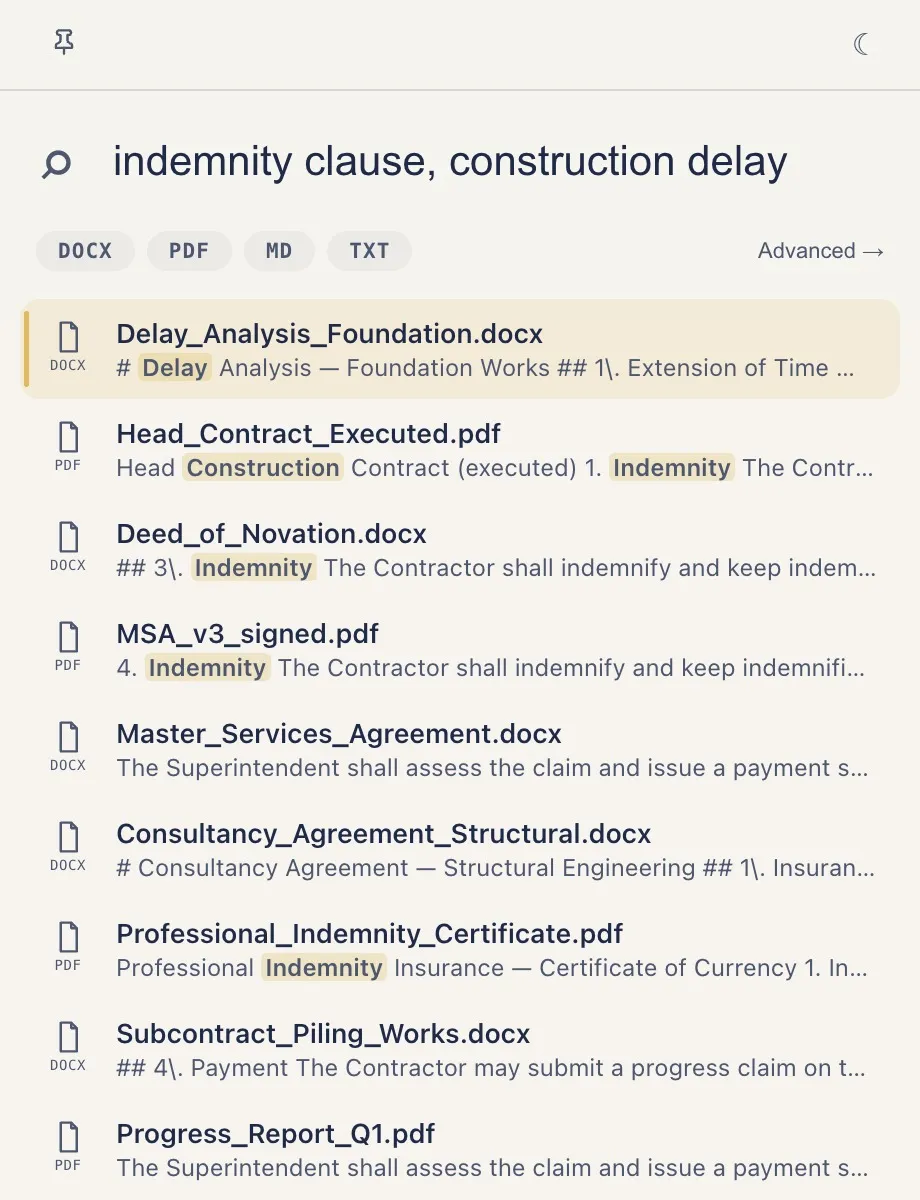
One option is Fossick, a desktop app for Windows and Mac that searches your local documents by meaning, entirely offline. You point it at a folder, it indexes the files on your computer, and you type what you remember, such as "email about the delayed site inspection", rather than guessing exact wording. Background on the approach is in our explainer on semantic search vs keyword search.
What it does, concretely:
- Searches many file types at once: PDF, Word, Excel, PowerPoint, OpenDocument text, plain text, Markdown, CSV, HTML, email (.eml, .msg) and images (PNG, JPG).
- Reads scanned pages: scanned PDFs and images are made searchable with on-device OCR.
- Stays on your machine: text extraction, OCR, embedding and search all run locally, and documents are never uploaded. It works with Wi-Fi off; only licensing touches the internet.
- Is quick once indexed: in a test on an 8 GB Apple M1 MacBook, a 52-document folder took about 81 seconds to index from scratch (including OCR), and searches then took about 15-20 ms each. Only new or changed files are re-processed afterwards.
What it is not: Fossick is search, not chat. There is no chatbot, no generative AI and no summaries; it shows you which documents match so you can open them, and then Ctrl+F is still the fastest way to find the exact line.
Fossick is free to try with one folder of up to 200 files and no sign-up or card, and the full app is a one-time purchase covered on the pricing page. You can download it for Windows or Mac or read more on the Fossick homepage.
Frequently asked questions
Why is Ctrl+F not finding a word I can see on the page?
The most common reason is that the text is actually an image, such as a scanned PDF or a screenshot, so there is nothing to match. Other causes include a hyphen or line break splitting the word, a different spelling, or the find box searching a different panel or frame than the one you are looking at. Try searching a shorter fragment of the word first.
How do I search for a single letter on a page?
Press Ctrl+F (Windows) or Cmd+F (Mac) and type the letter; every instance will highlight and the count shows how many there are. Most browsers ignore capitals, so a search for "a" also finds "A". In Word or Acrobat you can enable match case if you need only uppercase or lowercase.
Can I search multiple PDFs or documents at once?
Not with Ctrl+F, which only searches the file that is open. Adobe Acrobat has an advanced search for a folder of PDFs, and Spotlight or Windows Search can match keywords across your computer. To search a whole folder by meaning, including scanned files, a local desktop search app is the better fit; see our guide to searching across thousands of files.
How do I find a word on a page on iPhone?
In Safari, tap the Share button and choose Find on Page, or type the word into the address bar and select the On This Page result. In Chrome on iPhone, tap the three-dot menu and choose Find in Page. Use the arrows to move between matches.
Does searching my files with a desktop app upload them?
It depends on the app. Cloud services search copies of your files stored on their servers, while on-device tools index and search locally. Fossick runs extraction, OCR and search entirely on your computer and works with Wi-Fi off, so your documents are never uploaded.