A Modern dtSearch Alternative for Private Document Search
Short answer: The best dtSearch alternative depends on how you search: dtSearch excels at exact-term and boolean queries across huge datasets, while Fossick, a desktop app, finds your local documents by meaning, fully offline, for a single US$14.99 payment. Choose Fossick when you remember ideas, not keywords.
dtSearch has earned its reputation: fast, precise, boolean and phrase search across millions of files. But its interface feels dated, its licensing is built for enterprises and legal e-discovery, and it still works the way search worked twenty years ago — you have to know the exact words in the document.
This article is an honest comparison for professionals and small firms outgrowing or pricing out dtSearch. It explains what dtSearch does well, where a meaning-based tool fits better, and when you should simply stay with dtSearch.
What dtSearch does well
dtSearch is a keyword and boolean search engine that indexes text and matches exact terms, phrases, and operators across very large document sets. It is genuinely strong at what it does.
Its strengths are real:
- Precise boolean logic — AND, OR, NOT, proximity (
w/5), wildcards, and regex-style patterns for surgical queries. - Scale — it is designed to index terabytes and is widely used in legal e-discovery and litigation review.
- Exact-term recall — if you know a case number, a defined term, or an exact phrase, classic full-text indexes return every literal match.
If your work depends on that kind of deterministic, keyword-perfect retrieval, dtSearch remains an excellent tool. The trade-off is that it assumes you already know the words on the page.
Where dtSearch starts to hurt
dtSearch tends to frustrate users in three places: the interface, the licensing, and the requirement to remember exact terms. Each is a common reason people look for a dtSearch alternative.
- Dated experience. The UI and setup feel enterprise-legacy. For a solo consultant or a small firm, it can be more machinery than the job needs.
- Enterprise pricing and licensing. dtSearch is licensed for organisations and developers. If you are one person with a folder of confidential files, the cost and model rarely fit.
- You must know the keywords. Boolean search is powerful only when you recall the exact terms. When you remember the gist — "the memo about the supplier indemnity dispute" — literal matching struggles.
That last point is the real limitation. Keyword tools find strings; they do not understand that "termination for convenience" and "cancel the contract without cause" describe the same idea.
How a meaning-based alternative works
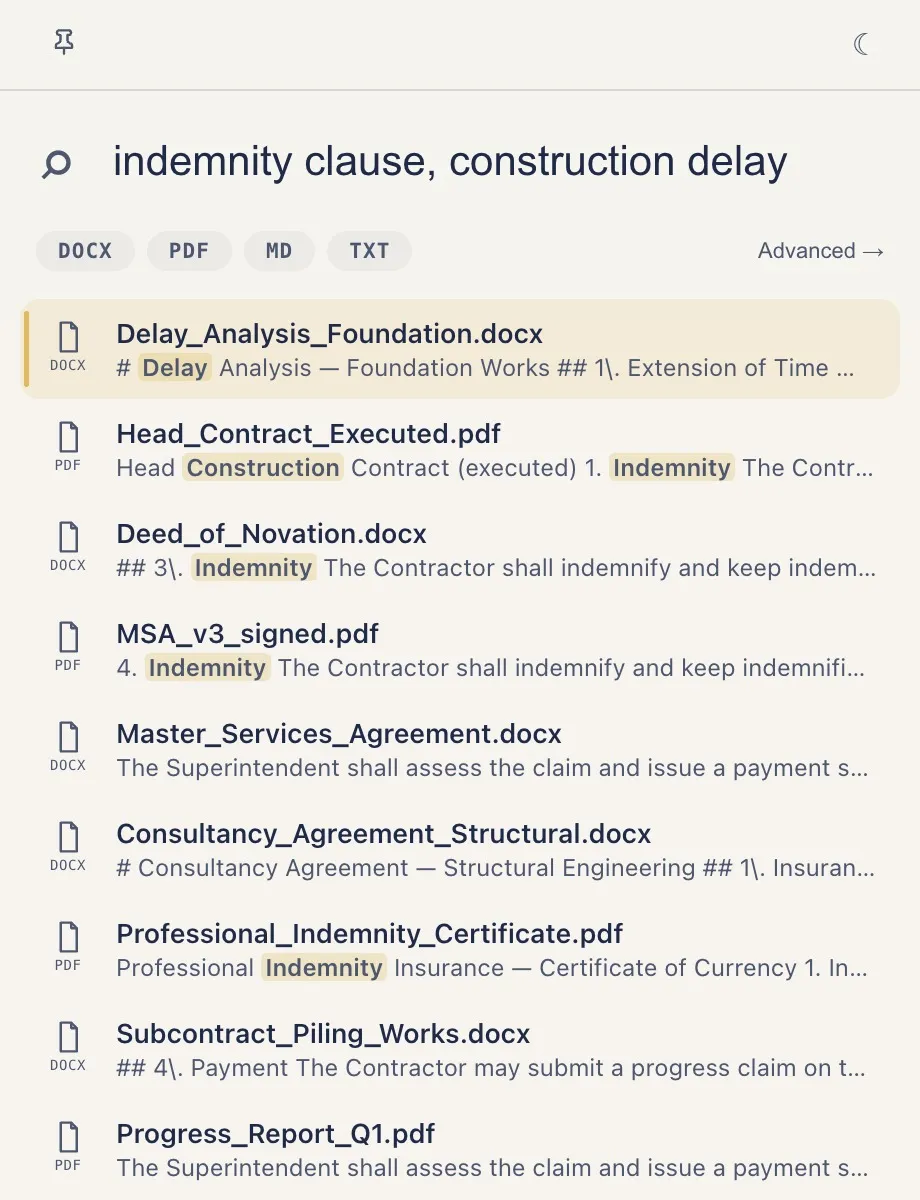
A semantic dtSearch alternative matches the intent of your query instead of its literal words. Type what you remember, and it surfaces documents that mean the same thing — even with different vocabulary.
Semantic search does this by converting text into vectors — lists of numbers that place similar meanings close together. The technique comes from sentence-embedding research: compare documents by vector similarity, not string overlap.
Fossick, a desktop app that searches your local documents by meaning, uses the small open-source all-MiniLM-L6-v2 model (384 dimensions, quantized, about 22 MB) running entirely on your own machine. You describe the document; it ranks the closest matches. If you want the deeper contrast, see semantic search vs keyword search.
Crucially, Fossick is search, not chat. There is no generative AI, no chatbot, and no summaries — it returns your actual documents, ranked by relevance.
Privacy: fully offline, on your device
Fossick performs all indexing, embedding, OCR, and search locally — your documents are never uploaded, and it keeps working with the Wi-Fi unplugged. For confidential material, that is the point.
Many "AI search" tools send file contents to a cloud service to be processed. For anyone handling privileged or regulated data, that raises obligations under frameworks like the GDPR and the interests protected by attorney–client privilege. Keeping processing on the device sidesteps a lot of that risk.
With Fossick, only licensing and billing ever touch the internet. The files themselves stay put. That is easy to verify: disconnect from the network and run a search — it still works. You can read more on the Fossick homepage or in the guide to private document search.
File types, OCR, and speed
Fossick handles common professional formats and makes scanned material searchable automatically, on-device.
It indexes PDF, Word (.docx, .doc), Excel (.xlsx), PowerPoint (.pptx), OpenDocument text (.odt), plain text, Markdown, CSV, HTML, email (.eml, .msg), and images (PNG, JPG). Scanned PDFs and photos are read with on-device OCR so image-only pages become findable.
Measured performance on an Apple M1 MacBook with 8 GB RAM (engine CLI, 2026-09-21):
- First-time indexing: 52 mixed documents (Word, PDF including scanned pages, Excel, CSV, Markdown; 700 KB) indexed from scratch in about 81 seconds, including model load and OCR.
- Search speed: about 15–20 ms median per semantic search over that 52-document folder.
- Re-checking: the same folder re-checked in about 7 seconds when nothing changed; re-indexing is incremental, so only new or changed files are reprocessed.
- Index size: about 1.9 MB on disk for that folder.
These figures describe a small folder on one machine, not a benchmark against dtSearch's terabyte-scale indexes.
dtSearch vs Fossick: which fits you
Choose based on how you search and what you handle. The short version: dtSearch for exact-term and large-scale e-discovery; Fossick for meaning-based search on your own confidential files.
| Factor | dtSearch | Fossick |
|---|---|---|
| Search type | Keyword, boolean, proximity | Semantic (by meaning) |
| Best for | Exact terms, e-discovery, scale | "I remember the gist" recall |
| Processing | Local index | 100% on-device, offline |
| Chat / AI answers | No | No (search only) |
| Pricing | Enterprise licensing | US$14.99 one-time |
Stay with dtSearch if you need boolean/proximity operators, regex-style patterns, terabyte-scale corpora, or courtroom-grade exact-match e-discovery. Those are its home turf.
Pick Fossick if you are a lawyer, consultant, engineer, accountant, or researcher who wants to find documents by what they mean, keep everything offline, and pay once. See the one-time pricing — a single US$14.99 purchase with all future updates and a 14-day money-back guarantee — or download Fossick to try it risk-free under that guarantee. Related reads: how lawyers search case files and document search for consultants.
Frequently asked questions
Is Fossick a drop-in replacement for dtSearch?
Not exactly. dtSearch specialises in exact-term, boolean, and proximity search at very large scale, often for e-discovery. Fossick specialises in meaning-based search over your own local documents. If your workflow depends on precise boolean operators and terabyte-scale indexing, dtSearch is still the better fit.
Does Fossick send my documents to the cloud like some AI search tools?
No. Indexing, embedding, OCR, and search all run on your device, and documents are never uploaded. It works with the Wi-Fi disconnected; only licensing and billing touch the internet. That makes it suitable for privileged and confidential files.
Can Fossick answer questions about my documents the way a chatbot would?
No. Fossick is search, not chat — there is no generative AI, no summaries, and no chatbot. It returns your actual documents ranked by how closely their meaning matches your query, then you open the file you need.
How much does Fossick cost compared with dtSearch licensing?
Fossick is a single US$14.99 one-time purchase that includes every supported file type and all future updates, with a 14-day money-back guarantee. There is no subscription and no per-seat enterprise licensing. dtSearch is licensed for organisations and developers, which is typically a very different cost model.
Will Fossick read my scanned PDFs and images?
Yes. Scanned PDFs and images such as PNG and JPG are made searchable automatically with on-device OCR, so text trapped in scans becomes findable by meaning. See the guide on searching scanned PDFs and images locally for details.