An X1 Search Alternative for Private, Meaning-Based Search
Free to try (1 folder, 200 files) · US$14.99 to keep · Mac & Windows
X1 Search built its reputation on fast, unified desktop and email search across large file collections. But it is fundamentally a keyword and metadata engine: it finds documents when your query matches the words inside them. If you can't recall the exact phrasing — or the term you remember never appears verbatim in the file — that model starts to strain.
This article is for X1 users who want two things at once: results based on meaning rather than literal keyword matches, and a strict guarantee that confidential files never leave the machine. We'll look at what an X1 Search alternative should offer, where semantic search changes the workflow, and how to verify that a tool is genuinely local-only before you trust it with client data.
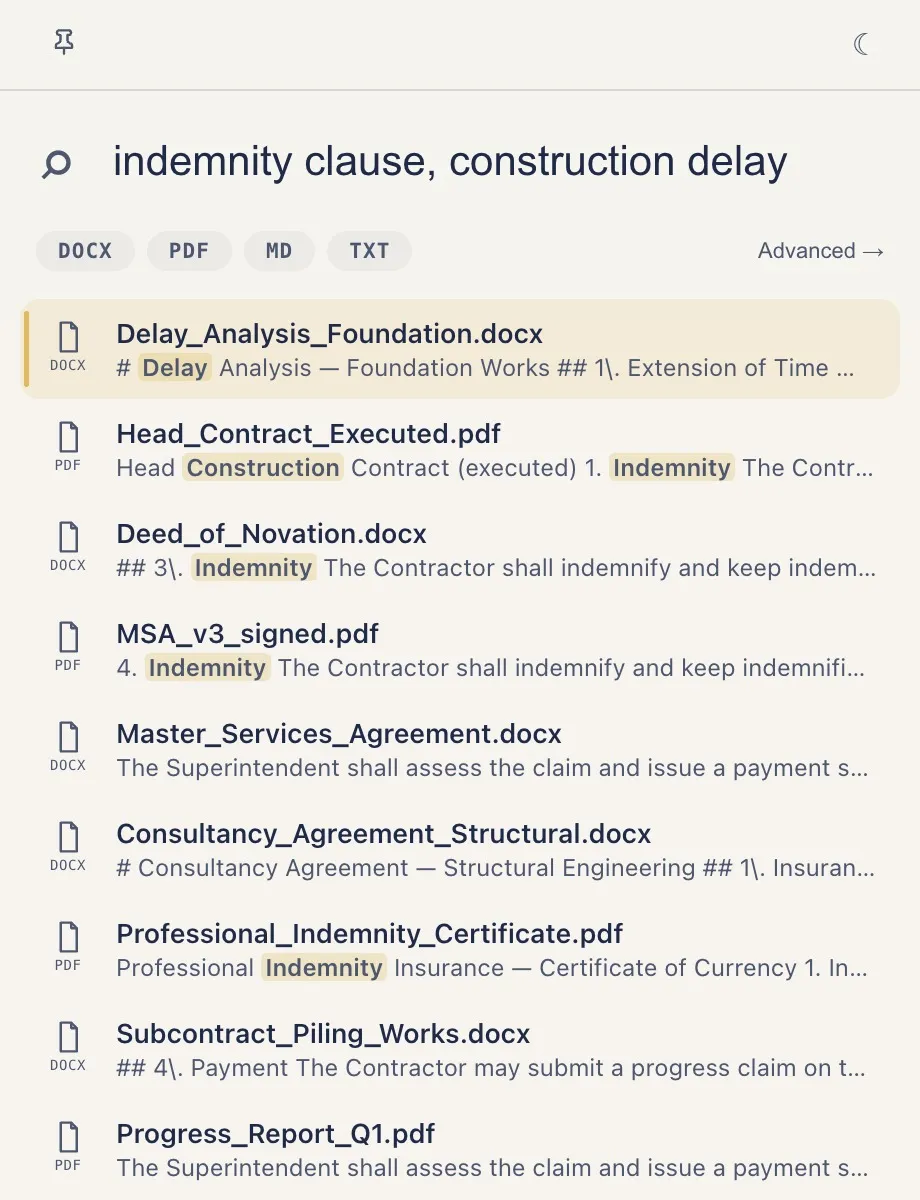
Where X1 Search leaves gaps for confidential work
X1 Search is a capable indexer, but two limitations tend to drive people to look for an alternative.
It matches words, not meaning. X1 is built around full-text and metadata queries. If you search for termination for convenience but the contract says the client may end this engagement at its discretion, a keyword engine may not connect the two. You end up guessing synonyms and re-running searches. For a deeper look at that distinction, see full-text search vs semantic search for a folder.
Trust and deployment overhead. Enterprise desktop search often assumes some level of connectors, servers, or IT configuration. For an independent lawyer, consultant, or accountant who simply wants to search their own files without any data leaving the laptop, that's more surface area than they want. The core question — does anything about my documents touch the network? — should have a simple, verifiable answer.
What a semantic X1 Search alternative should do
If you're replacing a keyword engine specifically to get meaning-based results, look for these properties:
- Semantic retrieval. You type what you remember in plain language, and the tool ranks documents by conceptual similarity — not just exact string matches.
- Strictly on-device. Indexing, embedding, and search all run locally. No upload step, no cloud account for your files.
- Broad format coverage. Real work is PDFs, Word files, plain text, and scanned images — not one tidy format.
- OCR built in. Scanned contracts and photographed documents should become searchable automatically, on the same machine.
- Predictable, one-app licensing. No per-seat server, no connector sprawl.
Fossick, a desktop app that searches your local documents by meaning and runs entirely offline, is built around exactly this shape. It's available for Windows and Mac, and it treats the files never leave your device as the central promise rather than a footnote.
Meaning-based search, in practice
The practical difference shows up the moment you can't remember the right keyword.
Say you're looking for the engagement letter where a client agreed to a phased fee structure. With a keyword tool you'd hunt for phased, then milestone, then installments, hoping one matches the drafting. Semantic search lets you describe the idea — client agreed to pay in stages tied to deliverables — and surfaces the document even if it used none of those exact words.
This is the same reason semantic search helps when you've forgotten a filename entirely. If you're used to scanning folders by hand, how to find a document you can't remember the name of walks through the shift in workflow. For the underlying concept, semantic search vs keyword search for documents covers when each approach wins.
One clarification that matters for evaluation: this is search, not chat. Fossick has no generative AI, does not answer questions, and does not summarize. It finds and ranks your actual files, then you open them and read them yourself.
Scanned PDFs and images, handled on-device
Enterprise document sets are rarely clean. You'll have scanned signature pages, photographed receipts, and screenshots dropped into folders. A keyword indexer can only find text it can read — and a scanned page is just an image until OCR turns it into text.
Fossick runs OCR automatically and locally on scanned PDFs and image files (PNG, JPG, and similar), so those documents become searchable alongside everything else without a separate step or a cloud service. If OCR is central to your use case, see how to search scanned PDFs and images locally with OCR and how to search text inside images and screenshots.
The important detail for confidential work: the OCR happens on your machine. A scanned settlement agreement is never transmitted to an external service to be read.
How to verify local-only operation yourself
With confidential files, you shouldn't take private on faith. The advantage of a truly on-device tool is that you can test the claim directly.
- Install the app and point it at a folder of documents.
- Let it finish indexing.
- Disconnect from the network — unplug Ethernet, turn off Wi-Fi.
- Run your searches.
If search keeps working with the network off, then indexing, embedding, and retrieval are genuinely happening on your device. Fossick is designed to pass this test: the only thing that touches the internet is licensing and billing, never your documents. For the broader reasoning, private document search: find files without a data risk and do you have to upload files to search them with AI? both explain why the offline test matters.
Fit by profession and how to try it
Semantic, offline search maps cleanly onto document-heavy professions:
- Lawyers searching case files and contracts by concept — see how lawyers search case files by meaning, offline.
- Consultants hunting for a past deck by the argument it made — document search for consultants.
- Engineers locating a spec by what it describes — offline search for engineers.
- Accountants finding records without exposing client data — document search for accountants.
If you're weighing the switch from X1, the low-risk path is to install it on a real folder and run your own searches, offline, before committing. You can download Fossick for Windows or Mac and try it risk-free for 14 days. Everything — the full app and all updates — is included; the pricing page lays out the one-time US$14.99 price.
Frequently asked questions
Is Fossick a direct replacement for X1 Search?
It covers the core need — fast search across your local documents — but with a different engine. X1 is keyword and metadata driven; Fossick ranks results by meaning. If your main reason for switching is semantic retrieval plus strict local-only operation, it's a strong fit. If you rely heavily on X1's email-client integrations specifically, evaluate whether document search alone covers your workflow.
Does Fossick send my documents to the cloud like some search tools?
No. Indexing, embedding, OCR, and search all run on your device. Your files are never uploaded. You can confirm this by disconnecting from the network and searching — it keeps working. Only licensing and billing use the internet.
Can Fossick answer questions about my files the way an AI chatbot does?
No. Fossick is search, not chat. It has no generative AI and does not summarize or answer questions. It finds and ranks your actual documents by meaning, and you open them to read them yourself. See on-device AI search, explained for how that works.
Does it handle scanned PDFs and images?
Yes. Fossick runs OCR automatically and on-device for scanned PDFs and image files such as PNG and JPG, so those become searchable alongside your regular documents. Nothing is sent to an external OCR service.
How much does Fossick cost and can I try it first?
You can download it and try it risk-free for 14 days. It is a single one-time purchase of US$14.99 that includes the full app and all updates; details are on the pricing page. There is no subscription to cancel.