An Offline Alternative to Copilot for Searching Your Own Files
Free to try (1 folder, 200 files) · US$14.99 to keep · Mac & Windows
Microsoft Copilot can be genuinely useful for drafting and summarizing, but it comes with a trade-off many professionals are uneasy about: to work across your files, it relies on your documents being indexed and processed in Microsoft's cloud. If you handle confidential material — client files, case documents, financial records — that trade-off is worth questioning.
This article is for Microsoft 365 users who want Copilot-like findability across their own documents without sending anything to the cloud. We'll look at what Copilot actually does with your files, why an offline alternative to Microsoft Copilot for files appeals to privacy-conscious professionals, and how a local, search-only tool fills the gap.
What Copilot actually does with your files
Microsoft Copilot's value across your documents comes from Microsoft Graph and the semantic index that sits behind Microsoft 365. To reason over your emails, SharePoint sites, and OneDrive files, Copilot needs those files indexed and accessible in Microsoft's cloud services.
For many teams that's fine — the data already lives in Microsoft 365. But it means:
- Your file contents are processed by cloud services, not just stored there.
- Copilot's usefulness depends on your documents being in the Microsoft ecosystem and indexed.
- Governance, retention, and tenant settings determine what is and isn't in scope.
Copilot is also fundamentally a generative tool. It drafts, summarizes, and answers. That's powerful, but it's a different job from simply locating the right document quickly — and it's the generative, cloud-connected part that raises the most eyebrows in regulated professions.
Why cloud indexing worries confidential-document professionals
If you're a lawyer, accountant, consultant, or engineer, the concern isn't usually that Microsoft is careless. It's that any copy of a privileged or sensitive file leaving your device widens the surface area you're responsible for.
- Duty of confidentiality. Privilege and client agreements often assume documents stay under your direct control.
- Data residency and retention. Cloud indexes create additional locations where content is processed and cached.
- Scope creep. It can be hard to know exactly which files an AI service can see across a tenant.
We wrote more about this trade-off in is it safe to search documents with AI. The short version: for the find my file task, you can get most of what you want without any of the cloud exposure.
You may want findability, not a chatbot
It's worth separating two needs that Copilot bundles together:
- Generation — drafting an email, summarizing a report, answering a question.
- Findability — locating the one contract, spec, or memo you half-remember among thousands of files.
Most of the daily frustration is findability. You remember the idea — "the settlement clause about early termination penalties" — but not the filename, folder, or exact words. Keyword search fails here because it matches strings, not meaning.
That's where semantic search helps: it matches on what a document is about. If you want the deeper comparison, see semantic search vs keyword search. The key insight is that semantic search doesn't require a generative model or the cloud — it can run entirely on your own machine.
Fossick: a private, offline alternative for finding your files
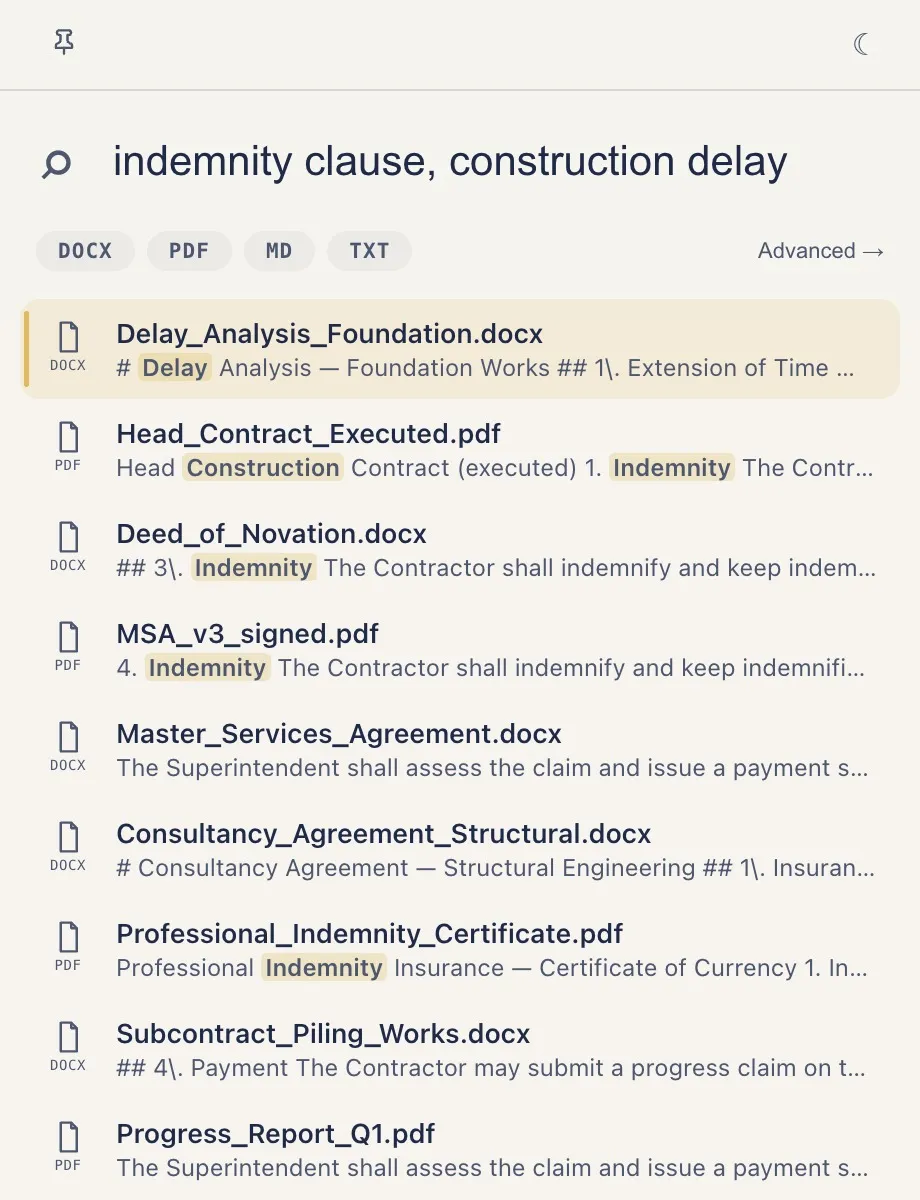
Fossick is a desktop app for Windows and Mac that searches your local documents by meaning, entirely offline. You point it at your folders, it builds a searchable index on your device, and then you type what you remember in plain language.
What makes it a genuine offline alternative to Microsoft Copilot for files:
- Nothing is uploaded. Indexing, embedding, and search all run on-device. You can verify this by pulling the Wi-Fi plug — search still works.
- No cloud account for your documents. Only licensing touches the internet; your files never do.
- Semantic matching. Describe the content, not the filename, and Fossick surfaces the right file.
- Broad format support. PDFs, Word documents, text files, and more — with automatic on-device OCR for scanned PDFs and images.
Because it's local, it doesn't depend on your files living in a particular ecosystem. It works across whatever folders you keep, whether that's a synced OneDrive folder, a network share, or an archive on an external drive.
What Fossick is not
Being accurate matters more than sounding impressive, so here's the honest boundary:
- Fossick is search, not chat. There is no LLM answering questions and no generative AI.
- It does not summarize documents, draft text, or answer questions about your files.
- It won't replace Copilot's writing features — that's not its job.
What it does is take you from "I know this document exists somewhere" to the actual file, fast, without anything leaving your computer. If you also work with confidential material and have wondered about generative tools specifically, ChatGPT alternative for confidential documents covers that angle.
Think of it as the findability half of Copilot, kept entirely on your machine.
Using it alongside Microsoft 365
You don't have to choose one tool for everything. A practical setup for many professionals looks like this:
- Keep using Microsoft 365 for authoring, collaboration, and storage.
- Use Copilot where you're comfortable with cloud processing — general drafting, non-sensitive material.
- Use an offline tool for searching confidential files so nothing sensitive is indexed in the cloud.
Because Fossick reads the same local folders your OneDrive syncs to, you can search that content without triggering any additional cloud processing of the contents. For a broader look at keeping search local, see our guide to offline document search.
Fossick is a one-time US$14.99 purchase with a 14-day money-back guarantee, and its pricing is a single one-time licence — there is no subscription. You can download it and point it at a single folder to see how semantic, offline search feels before trusting it with everything.
Frequently asked questions
Does Microsoft Copilot upload my files to the cloud?
Copilot's file features rely on the Microsoft 365 semantic index and Microsoft Graph, which means your document contents are processed in Microsoft's cloud services, not just stored there. The exact scope depends on your tenant configuration. If you need certainty that contents never leave your device, an on-device tool is a better fit.
Can I search my documents by meaning without any cloud service?
Yes. Semantic search only requires a model to run the matching, and that model can run locally. Fossick performs indexing, embedding, and search entirely on your machine, so you can find files by meaning with the Wi-Fi unplugged and nothing uploaded.
Is Fossick a replacement for everything Copilot does?
No. Fossick replaces the findability part — locating the right file by meaning — not the generative part. It is search, not chat: it does not draft, summarize, or answer questions. Many people keep Microsoft 365 for authoring and use Fossick for private search over confidential files.
Does it work with scanned PDFs and images?
Yes. Fossick runs OCR automatically and on-device for scanned PDFs and image files like PNG and JPG, so text inside those documents becomes searchable. None of that processing requires an internet connection.
How do I try it before committing?
You can download the desktop app and point it at a single folder to test semantic, offline search. It's a one-time US$14.99 purchase with a 14-day money-back guarantee, and the pricing page confirms the single one-time price.