Stop Organizing Folders — Just Search Your Documents by Meaning
Free to try (1 folder, 200 files) · US$14.99 to keep · Mac & Windows
Most of us were taught that good organization means good folders: a tidy tree of nested directories where every file has a home. But if you have thousands of documents, that tree is where things go to disappear. You save a contract under Clients, then wonder later whether it should have gone under Projects, 2024, or Legal. Six months on, you can't remember which choice you made — so you can't find the file.
This article makes a simple argument: you don't need perfect folders. You need a way to find a document by what it says, not by where you filed it. Below is how to organize and find documents without folders using meaning-based search, and why a search-first approach is more forgiving than any filing system you'll ever maintain.
Why folders quietly fail at scale
Folders are not wrong — they're just fragile. The problems compound as your document count grows:
- One file, one place. A signed NDA might reasonably live under the client, the matter, the year, or Contracts. It can only sit in one folder, so the other three searches come up empty.
- Your future self forgets the rule. The taxonomy that felt obvious in January is a mystery by August. You end up opening folders one by one, hoping to recognize the right name.
- Filenames lie.
Draft_v3_FINAL_updated.docxtells you nothing about what's inside. Neither doesscan_0421.pdf. - Everyone files differently. On a shared drive, three people invent three structures, and none of them match how you think.
The deeper issue is that folders index files by location, but you remember them by content. You recall a phrase, a topic, a client's problem — not the path you clicked eighteen months ago.
The shift: from filing to finding
A search-first approach flips the burden. Instead of investing effort up front to file every document perfectly, you invest nothing — and let search do the recall work later, on demand.
The key is how you search. Ordinary desktop search matches exact keywords: if you don't type a word that appears verbatim in the file, you get nothing. That's why keyword search feels brittle for documents you half-remember.
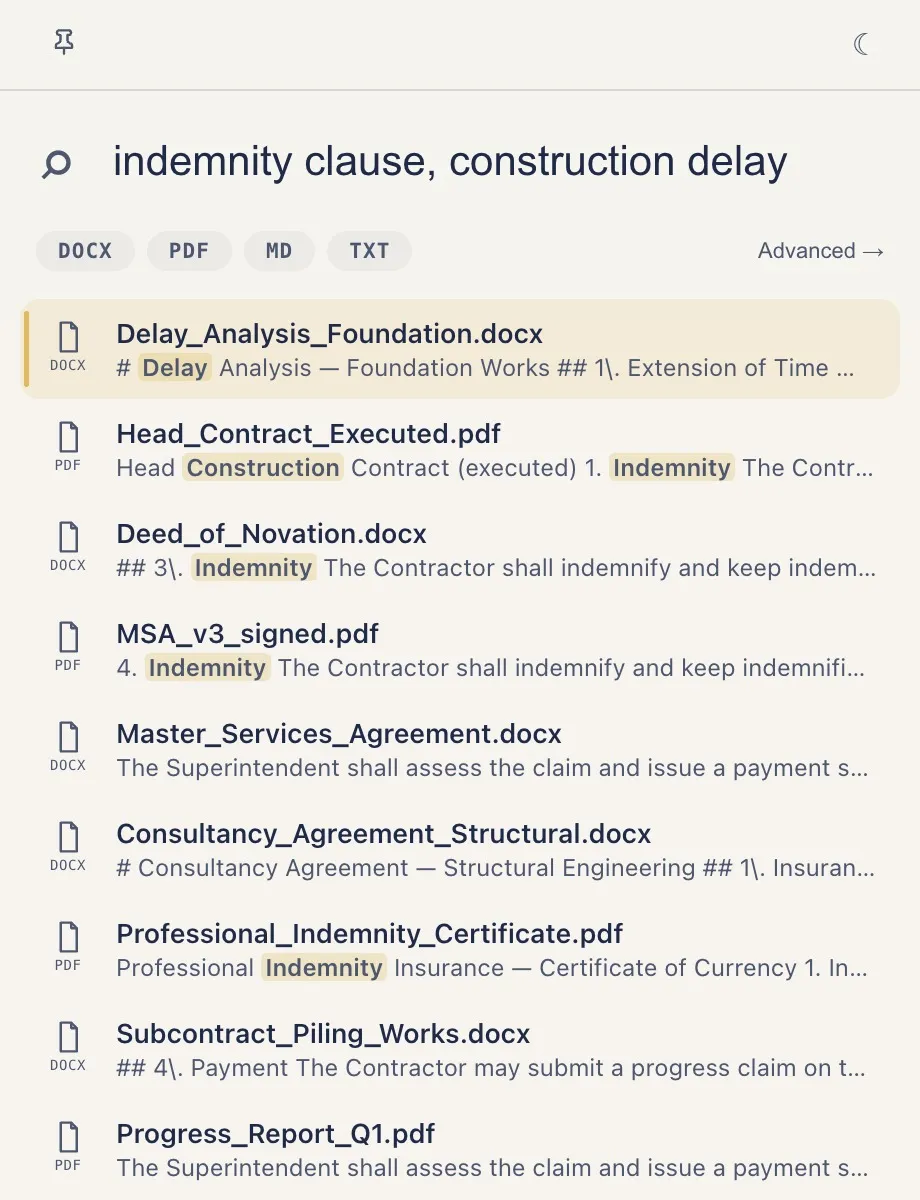
Semantic search works differently. It matches on meaning, so a query like "agreement about not sharing confidential information" can surface a document titled Mutual Non-Disclosure Agreement even though none of your search words appear in it. You describe the idea; the search finds the file. We compare the two approaches in more depth in semantic search vs keyword search for documents.
When search understands meaning, the folder structure stops mattering. A flat pile of files is just as findable as a perfectly curated tree — because you're no longer relying on where things sit.
How meaning-based search actually finds your files
Here's what happens under the hood, without the jargon:
- The tool reads the contents of each document — the actual text, not just the filename.
- It builds a mathematical representation of what each passage is about.
- When you type a query, it compares the meaning of your words to the meaning of every document and ranks the closest matches.
Because it reads contents, it also handles the documents folders hide worst: scanned PDFs and photographed pages. A tool that runs OCR on-device can pull the text out of a scanned contract or a screenshot and make it just as searchable as a typed file — see how to search scanned PDFs and images locally with OCR.
The practical result: you can type what you remember — "the report where we recommended delaying the launch" — and get the document, even if it's buried twelve folders deep with a meaningless name. This is the core idea behind finding a document you can't remember the name of.
Doing this privately, without uploading anything
There's an obvious catch with "search by meaning": many tools that offer it send your documents to a cloud server to be processed. For anyone handling confidential material — client files, case documents, financial records — that's a non-starter.
Fossick is a desktop app for Windows and Mac that searches your local documents by meaning, entirely offline. Indexing, reading, OCR, and search all run on your own machine. Your files are never uploaded and there's no cloud account holding them. You can unplug your Wi-Fi, run a search, and it still works — which is the simplest proof that nothing is leaving your device.
One important distinction: Fossick is search, not chat. There's no chatbot, no generative AI, and it does not summarize or answer questions. It finds and ranks your actual documents so you can open the real thing. If you've been weighing AI tools, is it safe to search documents with AI explains the on-device versus cloud tradeoff.
A practical workflow to stop over-organizing
You don't have to tear down your existing folders. Search-first just removes the pressure to maintain them perfectly.
Keep it simple
- Save where it's easiest. Drop files into a small number of broad folders — or one big one. Don't agonize over the right subfolder.
- Point your search tool at the top level. Index the whole tree once. Everything below becomes findable regardless of structure.
- Search by description, not filename. Type the topic, the phrase you recall, the problem the document addressed.
- Let recent additions get picked up automatically. A good local index keeps up as you add files, so new documents are searchable without re-filing.
Stop doing the busywork
- No more renaming files to make them findable later.
- No more debating which folder a document "belongs" in.
- No more maintaining parallel structures that only you understand.
The folders can stay as loose bins. Search becomes the thing you actually rely on to get a document back into your hands.
When folders still help — and when to let go
Search-first doesn't mean anti-folder. A few coarse folders are genuinely useful:
- Access control and sharing — keeping a client's files together for permissions or handover.
- Backups and archiving — moving finished matters out of the way.
- Physical separation — work versus personal, or one drive versus another.
What you can let go of is the fine-grained filing: the deep nesting, the elaborate naming conventions, the mental energy spent deciding where each file lives so you can find it again. That job is what search does better.
The test is simple. If you're creating a folder to organize, keep it only if it helps someone other than search. If you're creating it purely so you can find the file later, you probably don't need it — a meaning-based search will find that file no matter where it sits. If you want to see how this feels on your own documents, you can download Fossick and point it at a messy folder to test it directly.
Frequently asked questions
Can I really find documents without organizing them into folders?
Yes — if your search tool reads document contents and matches by meaning rather than filename. You describe what you remember about a file, and the tool ranks the closest matches wherever they're stored. The folder structure becomes optional rather than essential.
Do I have to delete my existing folders to use search-first?
No. Keep whatever folders help with sharing, access, or backups. Search-first simply removes the pressure to file every document perfectly, because you'll find things by content instead of by location. Your current structure can stay exactly as it is.
Is meaning-based search the same as an AI chatbot for my files?
No. Fossick is search, not chat — it has no generative AI and does not summarize or answer questions. It finds and ranks your real documents so you can open the original, rather than producing an AI-written response about them.
Does searching by meaning require uploading my documents to the cloud?
Not with an on-device tool. Fossick indexes, runs OCR, and searches entirely on your own Windows or Mac machine, so files are never uploaded. It works with the internet disconnected, which is the clearest proof nothing leaves your device.
How much does Fossick cost to try?
Fossick is a one-time US$14.99 purchase with a 14-day money-back guarantee, so you can index a folder and test meaning-based search on your own documents first. If you decide to keep it, the one-time US$14.99 price is listed on the pricing page.