How to Search a Shared Drive of Contracts by Meaning
Free to try (1 folder, 200 files) · US$14.99 to keep · Mac & Windows
A shared drive of contracts is easy to build and painful to search. You know the indemnity clause exists somewhere across a few hundred agreements, but you can't remember which counterparty, which year, or what the file was named. Keyword search only helps if you type the exact words the drafter used — and contracts almost never use the same words twice.
This guide covers a better way to search a shared drive of contracts: finding the right agreement or clause by meaning, across the whole folder, without uploading a single confidential file to the cloud. It's written for legal ops, procurement, and operations teams who need answers fast but can't afford a data risk.
Why searching a contract drive is so hard
Most contract repositories are just folders — a shared network drive, a synced cloud folder mirrored locally, or a departmental archive that has grown for years. The problem isn't storage. It's retrieval.
Contracts resist keyword search for a few specific reasons:
- Vocabulary drift. One agreement says limitation of liability, another says liability cap, a third buries the same concept inside a paragraph titled General Provisions. A keyword for one misses the others.
- Uninformative filenames. Files are named
MSA_final_v3.pdf,Acme_signed.pdf, orContract (2).docx. The name tells you nothing about what's inside. - Scanned signatures. The executed version is often a scan or photo with no selectable text at all, so full-text tools skip it entirely.
- Volume. A mature drive holds thousands of agreements, amendments, and NDAs. Opening files one by one is not a search strategy.
The result is familiar: you remember the idea of the clause, but the tools only understand the letters you type.
Keyword search vs searching by meaning
Traditional search matches character strings. If you search for auto-renewal and the contract says this Agreement shall renew for successive terms unless either party gives notice, keyword search returns nothing — even though that paragraph is exactly what you wanted.
Semantic search works differently. It represents the meaning of your query and the meaning of each passage, then matches them by concept. You type what you remember in plain language — "clause about renewing automatically each year" — and it surfaces the paragraphs that express that idea, regardless of the exact words used.
For contracts, this is the difference between guessing the drafter's vocabulary and describing what you're looking for. If you want the full breakdown, see semantic search vs keyword search for documents and full-text search vs semantic search for a folder.
Semantic search doesn't replace keyword search — sometimes you do know the exact counterparty name or contract number, and an exact match is faster. The point is having both, so you're not stuck when you only remember the gist.
The privacy problem with most contract search tools
The obvious modern answer — upload everything to a cloud AI search service — is a non-starter for confidential agreements. Contracts contain pricing, counterparty terms, personal data, and negotiation history. Sending them to a third-party server means:
- Copies of privileged or commercially sensitive documents leave your control.
- You inherit the vendor's breach risk and data-retention policies.
- You may violate confidentiality clauses in the very contracts you're indexing.
Procurement and legal ops teams live with obligations — NDAs, DPAs, client confidentiality — that a cloud upload can quietly breach. The safest architecture is simple: keep the documents where they already are and do the searching on the device.
That means indexing, reading, and matching all happen locally. Nothing is transmitted. You can confirm it yourself by unplugging the network and watching search still work. More on that principle in private document search and search confidential files without them leaving your PC.
How to search a shared drive of contracts offline
Here is a practical workflow that keeps everything local while giving you meaning-based search across the whole drive.
- Point a local tool at the folder. If your shared drive is mapped or synced to a local path, an on-device search app can index it directly — no copying required.
- Let it index and OCR. The tool reads each contract's contents and runs OCR on scanned PDFs and image files, so signed and photographed agreements become searchable text.
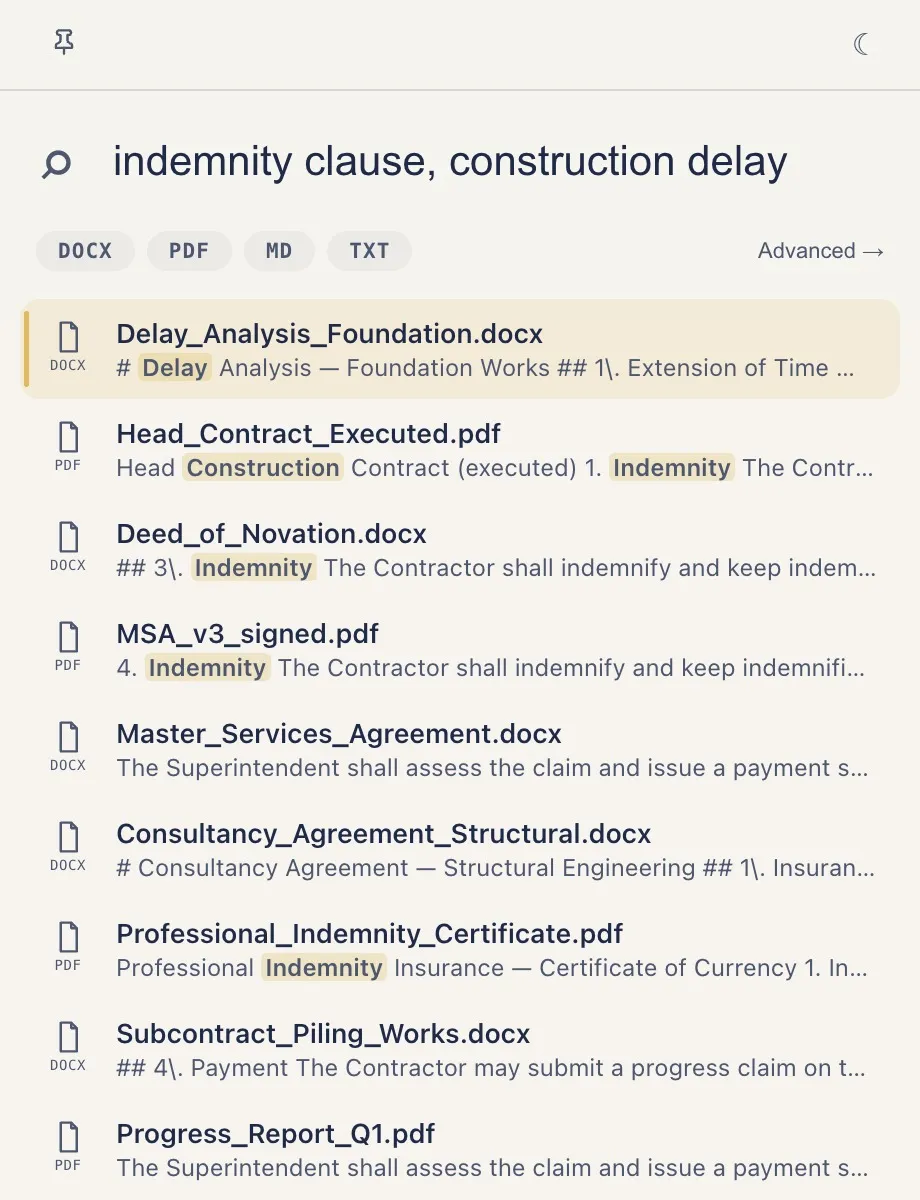
- Search by description. Instead of guessing keywords, type the concept: "payment terms net 60", "governing law New York", or "clause limiting liability to fees paid."
- Open the match in place. Results point back to the original file on the drive, so you review the real document, not a copy.
This is exactly what Fossick, a desktop app that searches your local documents by meaning entirely offline, is built to do. It indexes PDFs, Word files, text, and more; runs OCR automatically on scans and images; and never uploads anything. It's search, not chat — there's no chatbot answering questions or summarising terms for you. It finds the right document and clause; a human still reads and decides.
For drives with thousands of agreements, see how to search across thousands of files at once.
What semantic search finds that you'd otherwise miss
Once a contract drive is indexed by meaning, the everyday retrieval tasks that used to eat an afternoon become quick:
- Find a clause type across all agreements. "Termination for convenience" surfaces the relevant sections wherever they live, however they're worded.
- Locate an agreement you half-remember. You recall a consulting deal with an unusual IP-ownership term but not the vendor — describe the term and let the search find the file. This is the same problem covered in how to find a document you can't remember the name of.
- Pull scanned, signed originals. Because OCR runs on-device, executed copies that are pure images become findable. See how to search scanned PDFs and images locally with OCR.
- Compare terms during renewals or audits. Search the concept — "data processing obligations" — and review how it's handled across every active contract.
The common thread: you stop needing to know where something is or exactly how it was phrased. You describe what you need and let the meaning do the matching.
Getting started without risk
You don't have to reorganise your drive or migrate anything. Keep the contracts where they are, index them locally, and search.
A sensible first test:
- Install the app on the machine that already has access to the shared drive (Windows or Mac).
- Point it at one contract folder to start — a single client or vendor set.
- Unplug your network and run a few searches by meaning. Confirming that it works offline is the trust proof: if search still returns results with Wi-Fi off, nothing is being uploaded.
- Once you trust it, index the full drive.
Fossick is free to download, and at a one-time US$14.99 with a 14-day money-back guarantee you can validate the workflow on real agreements before committing. If you decide to keep it, the pricing page confirms the one-time US$14.99 price. For legal-specific context, how lawyers search case files by meaning, offline walks through a related workflow.
Frequently asked questions
Can I search a shared drive of contracts without uploading them anywhere?
Yes. An on-device tool like Fossick indexes and searches the files locally, so nothing is transmitted to a server. You can verify this by disconnecting from the network — search still works with the Wi-Fi unplugged, which means your contracts never leave the machine.
Does it work on scanned or signed PDF contracts?
Yes. Fossick runs OCR automatically on scanned PDFs and image files (PNG, JPG, and similar) on your device, turning them into searchable text. That means executed, signed originals become findable alongside your editable drafts.
Is this an AI chatbot that answers questions about my contracts?
No. Fossick is semantic search, not chat. It finds the right documents and clauses by meaning, but it does not summarise, draft, or answer questions — there's no generative AI involved. A person still reads the actual contract and makes the call.
How is searching by meaning different from Ctrl+F or keyword search?
Keyword search only matches the exact words you type, so it misses clauses that express the same idea in different language. Semantic search matches concepts, so a query like "clause about automatic annual renewal" finds the relevant paragraph even if the contract never uses those words.
Will it slow down my computer or the shared drive?
Indexing happens once up front and then updates as files change; day-to-day searches are fast because the index is already built locally. Because it reads files rather than modifying them, it doesn't alter your contracts or the drive's structure.