Search a Document for a Word: Exact and Meaning-Based Techniques
You remember a document mentioned something specific — a clause, a term, a name — but Ctrl+F keeps coming up empty because you're not typing the exact word the file uses. Searching a document for a word sounds simple, and for literal matches it is. The harder problem is finding the passage you mean when your memory and the document's phrasing don't line up.
This guide covers both: how to search a document for a specific word using the tools already on your computer, and how offline semantic search finds related passages beyond the literal string. The goal is a search that works whether you know the exact term or only the idea behind it.
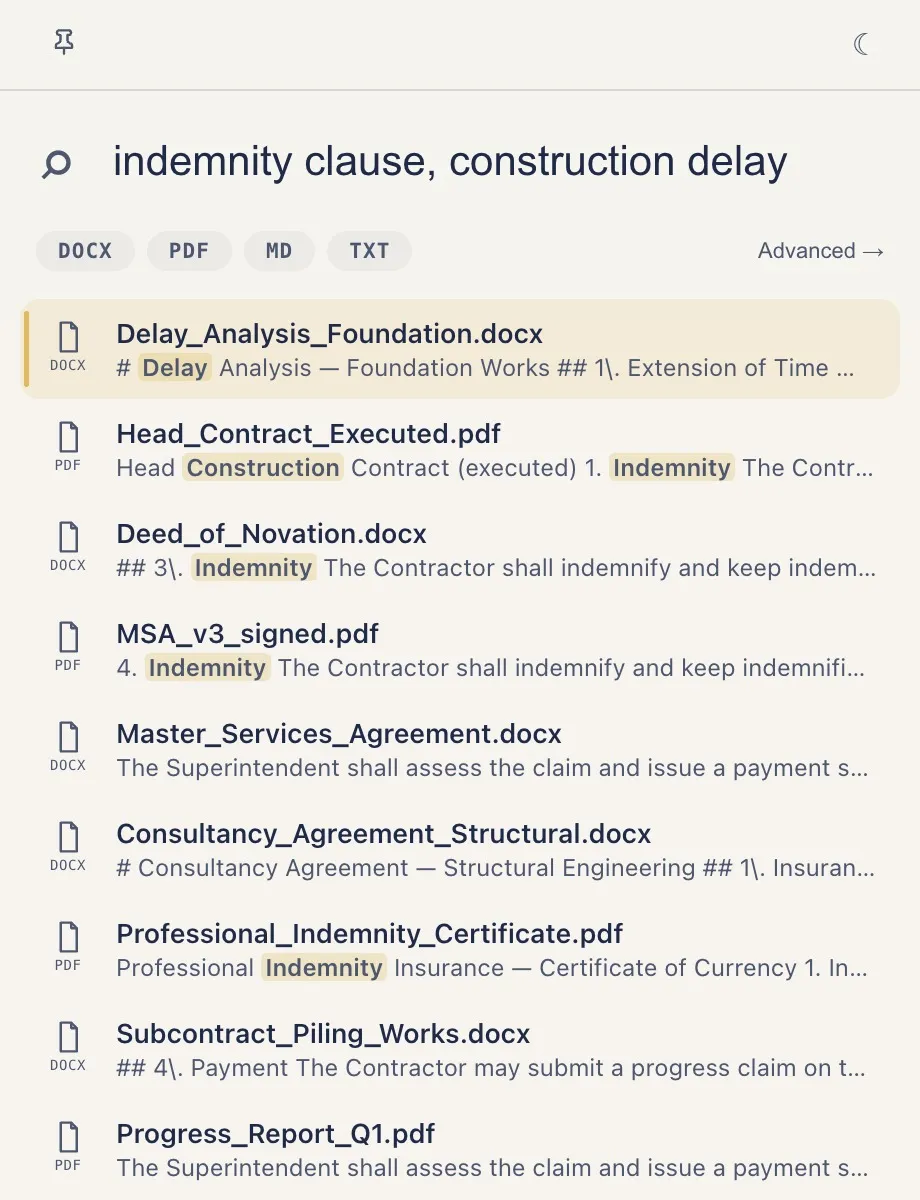
The quick way: exact word search inside one document
When you have a file open and know the exact word, the fastest route is your app's built-in find function.
- Microsoft Word: Press Ctrl+F (Windows) or Cmd+F (Mac) to open the Navigation pane, then type the word. Word highlights every match and lets you jump between them.
- PDF readers (Adobe Acrobat, Preview, browsers): Same shortcut — Ctrl+F or Cmd+F — searches the visible text of the PDF.
- Plain text and code editors: Ctrl+F works almost universally.
This is exact, literal matching. It looks for the character string you typed and nothing else. That's ideal when you know precisely what you're after — a party's name in a contract, a part number in a spec, a defined term in a report.
For a deeper walkthrough of Word specifically, see how to search a Word document. For PDFs, how to search in a PDF covers the same ground.
Where exact word search breaks down
Literal search is precise but brittle. It only helps when the word in your head matches the word on the page, character for character. In real documents that assumption fails often:
- You remember the idea, not the term. You search a report for "layoffs" but the author wrote "workforce reduction" — zero matches, even though the passage exists.
- Synonyms and jargon. Indemnity vs. hold harmless; revenue vs. turnover; deprecated vs. end-of-life. Different words, same meaning.
- The word lives in an image or scan. A scanned contract or a screenshot has no selectable text, so Ctrl+F finds nothing at all.
- You need to search across many files. Find works inside one open document. It won't scan a folder of hundreds of PDFs and Word files at once.
The result is a familiar frustration: you know the document says what you're looking for, but the search box insists it doesn't. The problem isn't the file — it's that literal matching can't bridge the gap between your wording and the author's.
Searching by meaning, not just by the word
Semantic search closes that gap. Instead of matching characters, it matches meaning. It represents both your query and the text of your documents as mathematical fingerprints of meaning, then finds passages that sit close together — even when they share no words.
So a search for "remote work policy" can surface a paragraph titled "telecommuting arrangements". A search for "cancellation terms" can find a clause about "termination for convenience". You describe what you remember, in your own words, and the search finds the document that means the same thing.
This doesn't replace exact search — it complements it. When you know the precise term, literal matching is perfect. When you only recall the gist, semantic search takes over. The two together cover far more of how people actually remember their own documents. For a fuller comparison, see semantic search vs keyword search.
Don't forget scanned pages and images
A large share of confidential documents aren't typed text at all — they're scans. A signed agreement, a filed form, a photographed whiteboard, a screenshot of an email. To the computer these are pictures, and no amount of Ctrl+F will search the words inside them.
OCR (optical character recognition) solves this by reading the text out of the image so it becomes searchable. Good desktop search runs OCR automatically on scanned PDFs and image files (PNG, JPG, and similar), so a word buried in a scan is just as findable as one typed in Word.
If most of your archive is scanned, how to search scanned PDFs and images with OCR explains how this works locally, without sending pages to a cloud service.
Doing all of this offline with Fossick
Fossick is a desktop app that searches your local documents by meaning, entirely offline. You point it at your folders once; it indexes the contents — PDFs, Word files, text, and scanned pages via built-in OCR — and then you search across everything at once, by exact word or by meaning.
A few things worth being precise about:
- It is search, not chat. Fossick finds and ranks the documents and passages that match. There is no chatbot, no generative AI, and it never writes summaries or answers questions for you. It points you to the source; you read it.
- It is genuinely offline. Indexing, OCR, and search all run on your own device. Your documents are never uploaded — you can unplug the Wi-Fi and it still works. Only licensing touches the internet.
- It searches your whole collection, not one open file, which matters when the word could be in any of thousands of documents.
That combination — private, on-device, and meaning-aware — is aimed at people who can't paste confidential files into a web tool: lawyers, accountants, consultants, engineers, and researchers. You can download Fossick and see how it works.
Choosing the right method for the job
A simple way to decide:
- You know the exact word and the file is open. Use Ctrl+F / Cmd+F. Nothing beats it for speed on a single document.
- You know the exact word but not which file. Use a desktop search tool that scans folders and reads inside files — see the fastest way to search a folder of documents.
- You only remember the idea, not the term. Use semantic search so synonyms and paraphrases still surface the right passage.
- The word might be in a scan or screenshot. Make sure your tool runs OCR, or the text is invisible to search.
Most real searches are a blend — you start with a word, come up empty, and realize you're not sure the document used that word at all. Having both exact and meaning-based search in one private, offline place means you don't have to guess which one you'll need.
Frequently asked questions
What's the fastest way to search a document for a specific word?
For a single open document, press Ctrl+F on Windows or Cmd+F on Mac and type the word. This works in Microsoft Word, PDF readers, browsers, and most text editors, highlighting every literal match. It only finds the exact string you type, so it's best when you know the precise word.
Why can't Ctrl+F find a word I know is in the document?
Usually one of three reasons: the document uses a different word for the same idea, the text lives inside a scanned image and isn't selectable, or you have a small typo. Exact search matches characters, not meaning, so any mismatch returns nothing. Semantic search and OCR address the first two cases.
How can I search for a word by meaning instead of exact match?
Semantic search compares the meaning of your query to the meaning of the text, so a search for one term surfaces passages that express the same idea with different words. Fossick does this on-device across all your files, so "cancellation terms" can find a clause about "termination for convenience" even with no shared words.
Can I search words inside scanned PDFs and images?
Yes, but only if the text has been extracted with OCR first. Fossick runs OCR automatically on scanned PDFs and image files locally, turning the pictured text into searchable content. After that, a word inside a scan is as findable as one typed directly.
Are my documents uploaded when I search them with Fossick?
No. Fossick indexes, runs OCR, and searches entirely on your own device, and your documents are never uploaded — it works with the Wi-Fi unplugged. Only licensing and billing use the internet, never your files.