How to Search in a PDF: Find Text Inside PDFs Without the Cloud
You know the document exists. You just can't remember which of the thousand PDFs on your drive it lives in. Maybe it was a contract clause, a paragraph in a report, or a figure buried in a scanned invoice. The ability to search in a PDF — and across every PDF at once — is the difference between finding it in seconds and losing an afternoon.
This guide covers the practical ways to search inside PDFs: the built-in tools you already have, their limits, and how to search by meaning rather than exact words — all while keeping confidential files on your own machine and off the internet.
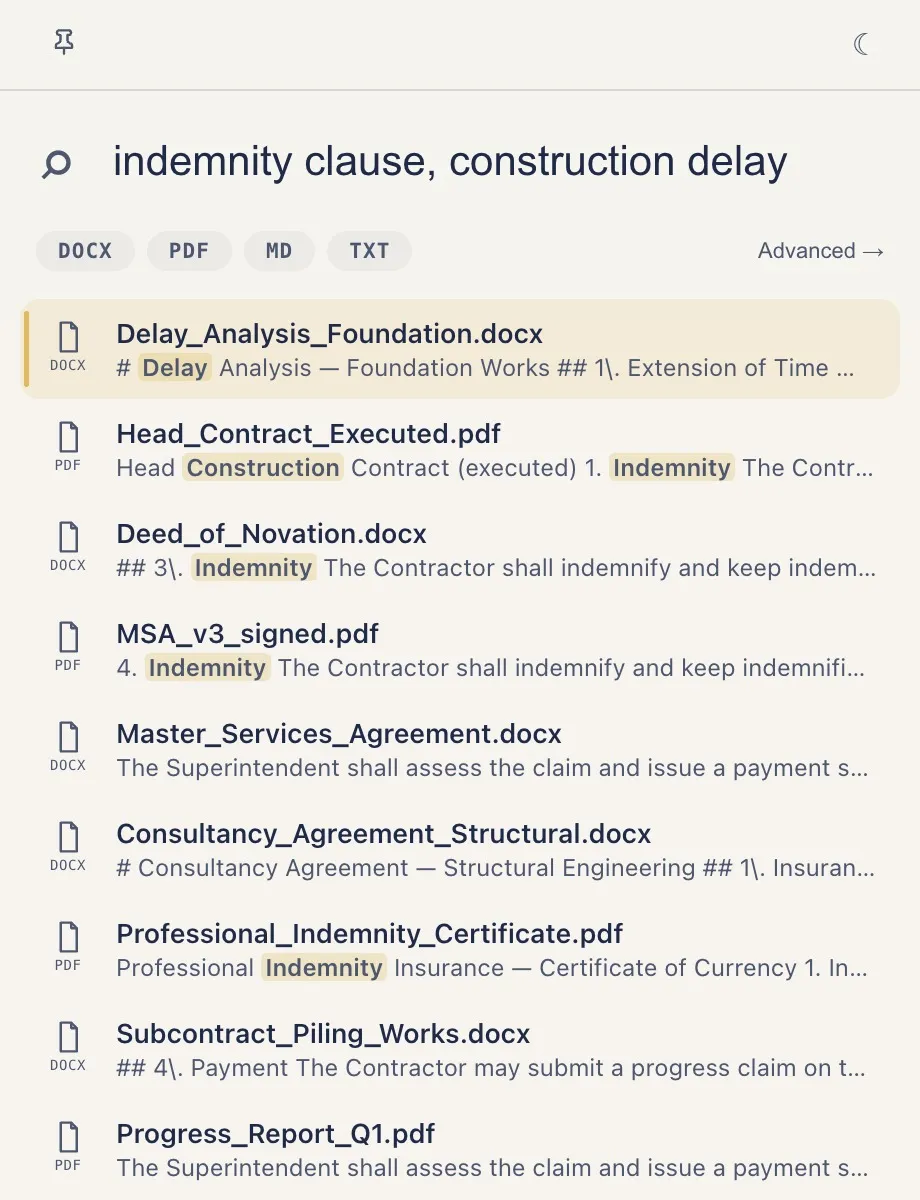
The quick way: search inside a single open PDF
Every major PDF reader lets you search the file you're currently looking at.
- Adobe Acrobat / Reader: Press
Ctrl+F(Windows) orCmd+F(Mac), type your term, and step through matches. For more control,Shift+Ctrl+Fopens an advanced search with whole-word and case options. - Preview (Mac): Press
Cmd+Fand type in the search box; results are highlighted and listed in the sidebar. - Web browsers: Open the PDF in Chrome, Edge, or Firefox and use
Ctrl+F/Cmd+Fthe same way.
This works well when you already have the right file open and you know the exact word or phrase on the page. It breaks down in two common situations: when the PDF is a scan with no text layer, and when you don't know which file to open in the first place.
Why scanned PDFs won't search (and how OCR fixes it)
A PDF can contain real, selectable text — or it can be nothing more than a photo of a page. Contracts you signed and scanned, receipts, and older archives are usually the second kind. Press Ctrl+F on one of these and you'll get zero results, even though you can clearly read the words on screen.
The fix is OCR — optical character recognition — which reads the pixels and reconstructs a searchable text layer. Acrobat can run OCR on a single file, but doing it manually across hundreds of scans is tedious.
A better approach is a tool that runs OCR automatically as it indexes. If you regularly deal with scanned paperwork, our guide to searching scanned PDFs and images locally with OCR walks through how this works on-device, without sending images to a server.
Searching across every PDF at once
The single-file search falls apart the moment you have a folder — or a whole drive — of PDFs and you don't remember which one holds the answer. You need to search inside many files simultaneously.
Desktop-wide tools attempt this, but with caveats:
- Windows Search indexes file contents in some locations, but coverage is uneven and it often misses PDFs or scanned pages entirely. (See our Windows search alternative comparison.)
- Spotlight on Mac indexes text-based PDFs but ignores scans without a text layer.
Both rely on matching the exact words you type. If the document phrased something differently than you remember, the file simply won't appear — even though it's sitting right there.
Search by meaning, not just keywords
Keyword search asks: which files contain this exact string? Semantic search asks a more useful question: which files are about this idea?
Type "penalty for late delivery" and a semantic engine can surface a contract that actually says "liquidated damages for delayed shipment" — no shared keyword required. That's the practical value when you remember the gist of a document but not its wording.
Fossick is a desktop app that searches your local documents by meaning, entirely offline. You describe what you're looking for in plain language, and it ranks the PDFs (and Word files, text files, and images) that match the concept. It's worth being precise about what it is: this is search, not chat. There's no chatbot, no generative AI, and nothing that writes summaries or answers questions — it points you to the right document and the passage inside it. If you want the deeper comparison, see semantic search vs keyword search for documents.
Keeping confidential PDFs private and offline
Many online "search your PDF" tools work by uploading your file to a server first. For a lawyer, accountant, consultant, or engineer, that's often a non-starter — client contracts, financial records, and specifications shouldn't leave the building to be indexed.
The safer model is on-device search, where indexing, OCR, and the search itself all run on your own computer. With Fossick, your documents are never uploaded. You can pull the network cable out, keep working, and searching still functions — that offline-by-default behaviour is the simplest proof that your files aren't going anywhere. (Only licensing and updates ever touch the internet; your file contents don't.)
If privacy is your main concern, these are worth reading:
- Search PDFs without uploading: a local, private guide
- How to search confidential files without them leaving your PC
A simple workflow for searching PDFs on your device
Here's a practical setup that scales from a handful of files to thousands:
- Point the tool at your folders. Choose the directories where your PDFs live — a case folder, a project archive, a downloads dump.
- Let it index locally. Text PDFs are read directly; scanned ones get OCR automatically, on your machine.
- Search by phrase or idea. Type what you remember — a clause, a topic, a client detail — not just a filename.
- Open straight to the match. Jump to the file and the relevant passage instead of scrolling page by page.
This is how professionals handle large archives without a cloud account. For a broader view, see the fastest way to search a folder of documents and how to search across thousands of files at once.
Fossick is a one-time purchase of US$14.99 — the full app, every file type, and all future updates, with a 14-day money-back guarantee. There's no subscription and no recurring charge; you can review the details on the pricing page or download it to try it on your own files.
Frequently asked questions
How do I search for text inside a PDF?
For a single open PDF, press Ctrl+F (Windows) or Cmd+F (Mac) in your PDF reader or browser and type your term. To search across many PDFs at once, use a desktop search tool that indexes file contents, so you can find text without opening each file individually.
Why can't I search a scanned PDF?
A scanned PDF is essentially an image of a page with no underlying text, so a normal search finds nothing. You need OCR (optical character recognition) to create a searchable text layer. Tools like Fossick run OCR automatically on-device as they index, so scanned files become searchable without manual conversion.
Can I search inside PDFs without uploading them to the cloud?
Yes. On-device tools index and search your PDFs locally, so the files never leave your computer. Fossick works entirely offline — you can disconnect from the internet and searching still functions — which keeps confidential documents private.
What's the difference between keyword search and semantic search in a PDF?
Keyword search matches the exact words you type, so it fails if a document phrases things differently. Semantic search matches meaning, so a query like "late delivery penalty" can surface a file that says "liquidated damages for delayed shipment." It's more forgiving when you remember the idea but not the exact wording.
Does Fossick answer questions about my PDFs?
No. Fossick is search, not chat — it has no generative AI and does not summarise documents or answer questions. It finds the right PDFs and the relevant passage inside them, then you read the source yourself.