How to Look Up a Word in a Document: Fast, Private, Offline Methods
You know the word is in there somewhere. Maybe it's a client name, a clause, a part number, or a phrase you highlighted months ago. The question is how to look up a word in a document quickly—without scrolling page by page.
This guide covers the built-in Find tools every computer already has, their limits, and what to do when you remember the idea but not the exact word. Everything here works offline, so your confidential files never have to leave your machine.
The fastest way: use Find inside an open document
If the document is already open, looking up a word takes two keystrokes.
- Windows: press
Ctrl+F - Mac: press
Cmd+F
A small Find bar appears—usually at the top or bottom of the window. Type the word, press Enter, and the app jumps to the first match and highlights it. Press Enter again (or the arrow buttons) to step through every other occurrence.
This works in Microsoft Word, Adobe Acrobat and most PDF readers, web browsers, Notepad, and nearly every text editor. In Word, you can also open the Navigation pane (Ctrl + F) to see every match listed together, which is handy for long reports.
Most Find bars also offer options like Match case and Whole words only if you need to narrow results. For a deeper walkthrough of finding text inside a specific document, see how to search within a document.
Where built-in Find falls short
The Find bar is excellent for one open file. It runs into trouble the moment your search gets bigger or fuzzier.
- It only searches the open document. If you don't know which of a hundred files contains the word, Find can't help—you'd have to open each one and search it individually.
- It needs the exact spelling. Search for agreement and you'll miss agreements, contract, or a British/American spelling variant.
- It can't read scanned pages. A PDF made from a scanner or photo is just an image of text. Find finds nothing because there is no selectable text underneath.
- It ignores meaning. If you remember the concept but not the wording the author used, exact-match Find leaves you stuck.
These gaps are why looking up a single word often turns into a half-hour of opening files one by one.
Looking up a word across many files at once
When the word could be in any of thousands of documents, you need search that spans a whole folder or drive—not a single file.
Windows and Mac both ship with system search (File Explorer and Spotlight), and they can look inside file contents in some cases. In practice, results are often incomplete, slow to index, or limited to certain file types and locations. Many people find these tools reliably match filenames but miss text buried inside documents.
A dedicated desktop search tool indexes the contents of every file in the folders you choose, so a single query checks them all at once. If you regularly hunt for a word across a large collection, this is the difference between two keystrokes and an afternoon of manual opening. See the fastest way to search a folder of documents for a practical comparison.
When you don't remember the exact word
Often the real problem isn't where the word is—it's that you can't recall the precise word at all. You remember what the document was about: "the memo about the delayed shipment penalty," "the report where we recommended switching vendors."
Exact-match Find is useless here, because you're guessing at wording the author may never have used. This is where semantic search helps. Instead of matching letters, it matches meaning: you describe what you remember in plain language, and it surfaces the documents that are about that idea—even if they use entirely different words.
Semantic search and keyword search solve different problems, and the best workflow uses both. We break down the trade-offs in semantic search vs keyword search for documents.
Doing it privately, offline, on your own device
If your documents are confidential—client files, case notes, financials, engineering specs—the how matters as much as the what. Many search and "AI" tools work by uploading your files to a server. That's a data-exposure decision you may not want to make just to find a word.
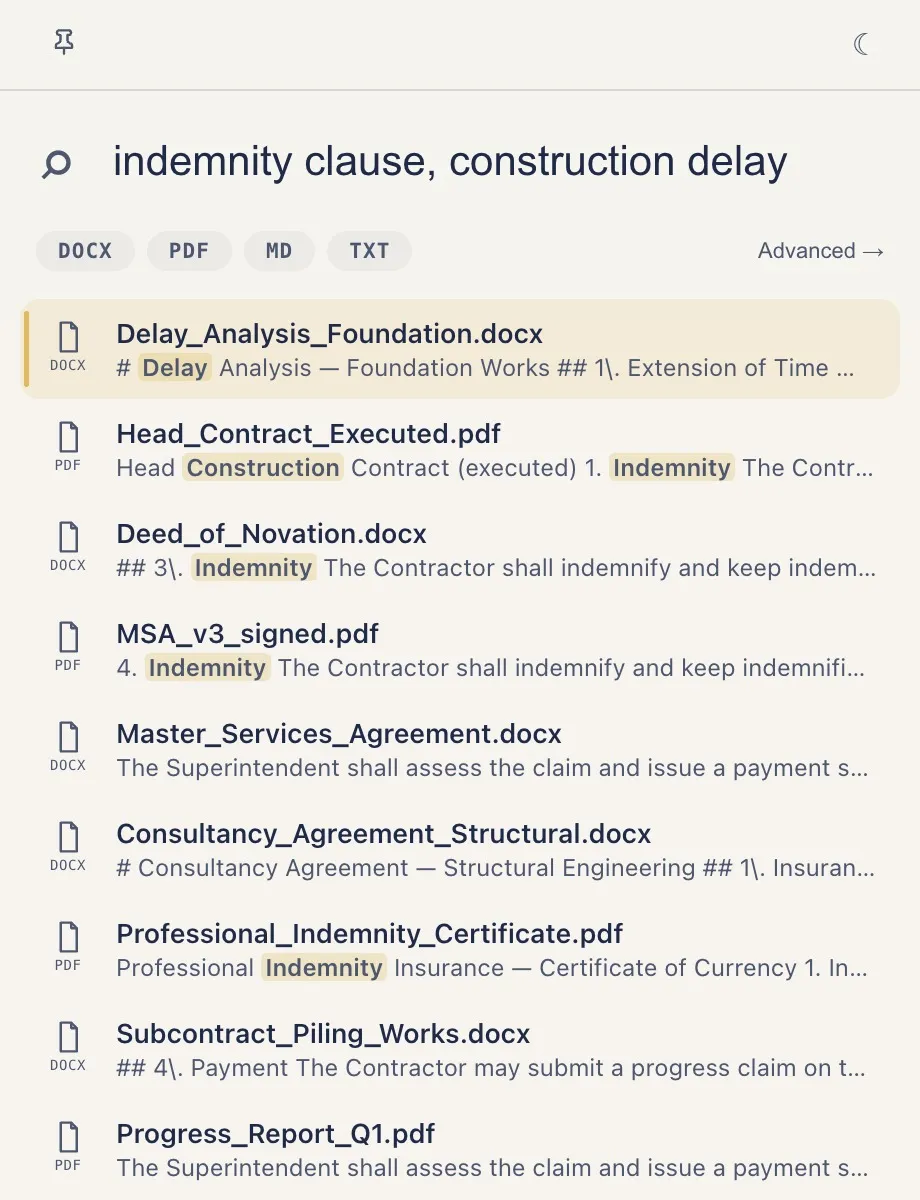
Fossick is a desktop app that searches your local documents by meaning, entirely offline. Indexing, text extraction, and search all run on your own machine—nothing is uploaded. You can literally unplug the Wi-Fi and it still works, which is the simplest proof that your files stay put.
A few things worth being clear about:
- It handles PDFs, Word documents, text files, and more, and it runs OCR automatically on scanned PDFs and images—so the word inside a scanned contract or a screenshot becomes findable.
- It is search, not chat. There's no chatbot, no generated answers, no summaries. It points you to the right document and lets you read it yourself.
- It searches by both exact words and meaning, so it covers the everyday "look up this word" case and the harder "I only remember the gist" case.
You can download Fossick for Windows or Mac and point it at a folder to try it on your own files.
A practical workflow
Putting it together, here's a reliable approach to looking up a word in your documents:
- Document already open? Use
Ctrl+F/Cmd+Fand type the word. Done in seconds. - Don't know which file it's in? Use a desktop search tool that indexes file contents across your folders, so one query checks every file.
- Can't recall the exact word? Describe the idea and let semantic search surface documents by meaning.
- Word is inside a scan or image? Make sure OCR has run, or use a tool that does OCR on-device automatically.
- Files are confidential? Keep the whole process offline so nothing is uploaded.
For the specific case of tracking down a file you can't name, how to find a document you can't remember the name of goes deeper.
Frequently asked questions
What is the keyboard shortcut to look up a word in a document?
On Windows, press Ctrl + F; on Mac, press Cmd + F. This opens a Find bar in almost every app—Word, PDF readers, browsers, and text editors—where you type the word and step through each match.
How do I find a word if I don't know which file it's in?
The single-document Find bar can't help there. You need a desktop search tool that indexes the contents of a whole folder or drive, so one query checks every file at once. Semantic tools also let you search by meaning when you can't recall the exact word.
Why can't I find a word in my scanned PDF?
A scanned PDF is an image of text, so there's no selectable text for Find to match. You need OCR (optical character recognition) to convert the image into searchable text first. Some tools, including Fossick, run OCR automatically and on-device.
Can I search my documents without uploading them to the cloud?
Yes. Fossick indexes and searches your files entirely on your own machine—nothing is uploaded, and it works with the internet disconnected. That keeps confidential documents private while you look up words across them.
Does Fossick answer questions about my documents?
No. Fossick is search, not chat—there is no chatbot, no generated answers, and no summaries. It finds and points you to the right document so you can read the original yourself.