Everything Finds Filenames — Here's What Finds What's Inside Your Files
Short answer: Everything (voidtools) is the fastest way to find files by name on Windows, but it doesn't read document contents. To search what's inside your files, pair it with a content-aware tool like Fossick, a desktop app that searches your local documents by meaning, entirely offline, without uploading anything.
If you use Everything, you already know the feeling: type a few letters and the matching filenames appear instantly. Nothing beats it for locating a file when you remember what it was called.
But Everything indexes filenames and paths, not the words inside your PDFs, Word files, or scanned contracts. The moment you remember what a document said rather than what it was named, filename search runs out of road. This article explains that gap and shows how to fill it with an offline search that understands file contents by meaning.
What Everything does well — and where it stops
Everything is a filename search engine: it builds a near-instant index of file and folder names on your NTFS drives, so results appear as you type. For locating a known file quickly, it is excellent and lightweight.
The limit is deliberate. Everything indexes names and paths, not the words inside each document. It belongs to the broader family of desktop search tools, but it optimises for speed over content. So these searches fall outside its scope:
- Finding a report because it discusses indemnity clauses, when the filename is
Final_v3.docx - Locating a scanned invoice by the vendor named inside the image
- Recalling a spec by the concept it covered, not the code it was saved under
If you can't remember the name, Everything can't help — because the thing you remember lives in the contents.
Why filename search and content search are different jobs
Filename search matches the label on the file; content search reads what the file says. They solve different problems, and most people need both.
Windows Search can index file contents to a degree — Microsoft documents how its index stores file properties and contents — but it still relies on matching literal keywords. Classic full-text engines work the same way: they tokenise words and match terms, as with SQLite's FTS5 full-text index. If your query words don't appear verbatim in the document, you get nothing.
That's the second gap. Even a content-aware keyword search fails when you remember the idea of a document but not its exact phrasing. For a fuller comparison, see full-text search vs semantic search for a folder.
An Everything search alternative for file contents: search by meaning
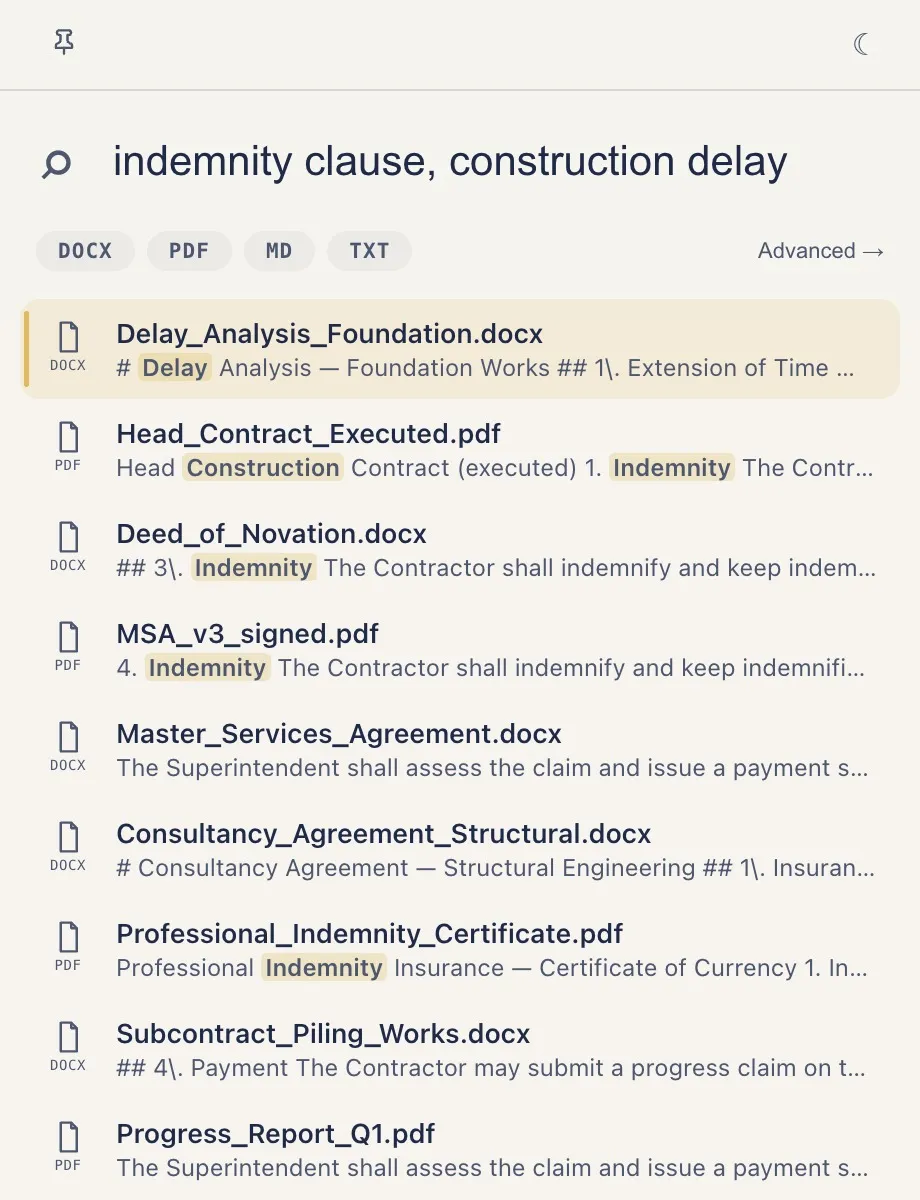
The best complement to Everything for file contents is semantic search, which matches meaning rather than exact keywords. Instead of requiring the same words, semantic search understands intent, so "agreement about who owns the code" can surface an IP-assignment clause even if those exact words never appear.
Under the hood, this works by turning text into vectors and comparing them — the technique introduced in Sentence-BERT. Fossick, a desktop app that searches your local documents by meaning, does exactly this on your own machine.
- It reads inside PDFs, Word, Excel, PowerPoint, ODT, text, Markdown, CSV, HTML, and email files.
- It runs OCR on scanned PDFs and images so their text becomes searchable too.
- You type what you remember; it ranks the documents that mean the same thing.
Crucially, Fossick is search, not chat. There is no chatbot, no generative AI, and no summaries — just a ranked list of your own files. If you want to search by content instead of names, that's the job it's built for; see search documents by meaning, not filename.
Everything vs content search vs Fossick: which for what
Use the tool that matches the question you're asking. Here's how the three approaches line up for a Windows power user.
| Task | Everything | Windows content search | Fossick |
|---|---|---|---|
| Find a known filename fast | Excellent | OK | Not its focus |
| Match exact words in text | No | Yes | Yes (by meaning) |
| Find by idea / paraphrase | No | No | Yes |
| Read scanned PDFs & images | No | Limited | Yes (on-device OCR) |
| Fully offline | Yes | Yes | Yes |
Many people keep Everything for instant name lookups and add Fossick for content. They aren't rivals — Everything answers "where's that file called X," and Fossick answers "which file talked about Y." If you're weighing broader options, the Windows Search alternative guide covers the same ground for the built-in tool.
How the offline part actually works
Everything you index and search with Fossick stays on your device — indexing, text extraction, OCR, embedding, and search all run locally, and documents are never uploaded. Only licensing touches the internet, so you can literally unplug the Wi-Fi and it keeps working. That is the trust proof for anyone handling confidential files.
Fossick uses the open all-MiniLM-L6-v2 sentence-embedding model — 384 dimensions, quantized, about 22 MB — running on your own hardware. For scans, it applies optical character recognition before indexing, so photographed and scanned pages become searchable.
Some measured figures, all on an Apple M1 MacBook with 8 GB RAM over a 52-document mixed folder (about 700 KB):
- First-time indexing from scratch: about 81 seconds, including model load and OCR.
- Re-checking the same folder when nothing changed: about 7 seconds — re-indexing is incremental, so only new or changed files are reprocessed.
- Median semantic search: about 15-20 ms per query.
- Index size on disk: about 1.9 MB.
Because processing is local, this approach suits regulated work — the kind of setup NIST's guide to storage encryption for end-user devices assumes, where data doesn't leave the laptop. Lawyers guarding privileged communications, accountants, and engineers get content search without a cloud dependency.
Setting up both without conflict
You can run Everything and Fossick side by side; they don't compete for the same index. A practical workflow on Windows:
- Keep Everything open for instant filename and path lookups — the thing it does best.
- Point Fossick at the folders where your real documents live (contracts, reports, research, scans).
- Let Fossick build its local index once; after that, re-checks are quick because only changed files are reprocessed.
- Search by name in Everything; search by meaning or content in Fossick.
Fossick is a Windows and Mac desktop app you can download and install like any other. It's a one-time purchase of US$14.99 that includes every file type and all future updates, with a 14-day money-back guarantee — no subscription and no trial. You can try it risk-free under that guarantee, and read more about the approach on the Fossick homepage.
Frequently asked questions
Does Everything search inside file contents?
No. Everything indexes filenames and paths for instant results, not the text inside documents. To search what a file says — including PDFs, Word files, and scans — you need a content-indexing tool alongside it.
Can I use Everything and Fossick together?
Yes. They serve different jobs and don't conflict. Keep Everything for instant filename lookups and add Fossick for searching contents by meaning, including scanned PDFs and images via on-device OCR.
Does Fossick upload my documents to search them?
No. Indexing, text extraction, OCR, embedding, and search all run locally on your Windows or Mac device, and documents are never uploaded. It works with the Wi-Fi off; only licensing touches the internet.
Is Fossick a chatbot or AI assistant?
No. Fossick is search, not chat. There's no generative AI, no summaries, and no question-answering — you type what you remember and it returns a ranked list of your own matching documents.
How much does Fossick cost?
Fossick is a single one-time purchase of US$14.99, which includes every file type and all future updates, with a 14-day money-back guarantee. There's no subscription, no trial, and no recurring charge. See the pricing page for details.