How Do I Search a Document for a Word? A Complete Guide
If you have ever stared at a long report wondering how do I search a document for a word, you are not alone. Most files hide the one line you need somewhere in dozens of pages, and scrolling by eye wastes time you do not have.
This guide walks through the quick, reliable ways to find any word inside a document — from the keyboard shortcut you already have to the meaning-based search that finds a passage even when you cannot recall the exact wording. Everything here works on your own computer, with no uploads required.
The fastest answer: use Find (Ctrl+F or Cmd+F)
When a single document is already open, the quickest way to find a word is the built-in Find command.
- Open the document.
- Press Ctrl+F on Windows or Cmd+F on Mac.
- Type the word you are looking for.
- Press Enter to jump to the first match, then keep pressing it to cycle through the rest.
This shortcut works in web browsers, Notepad, TextEdit, and most other apps. The find box usually shows a running count — 3 of 12 — so you know how many times the word appears before you start clicking through them.
Searching inside a Word document
Microsoft Word gives you more than a simple find box. Pressing Ctrl+F opens the Navigation Pane, which lists every match in a scrollable sidebar so you can see the surrounding text at a glance.
For finer control, press Ctrl+H to open Find and Replace. Under More options you can:
- Match case (find Contract but not contract).
- Find whole words only, so art does not match start.
- Use wildcards for patterns.
If you routinely dig through .docx files, our guides on how to search a Word document and searching Word documents by content cover these steps in more detail.
Finding a word inside a PDF
PDFs work much the same way. In Adobe Acrobat Reader, Preview on Mac, or a browser, press Ctrl+F or Cmd+F and type your word. Acrobat also offers an advanced search (Shift+Ctrl+F) that returns a full list of matches across a long document.
There is one catch. A PDF only responds to text search if it actually contains selectable text. Scanned PDFs and photographed pages are just images, so Find returns nothing even when the word is clearly visible on screen.
The fix is OCR (optical character recognition), which reads the text out of the image. If you often work with scans, see how to search a PDF and searching scanned PDFs and images locally with OCR.
When exact-match search lets you down
The built-in Find command is fast, but it only matches the exact characters you type. That breaks down in common situations:
- You misremember the wording. You search for cancellation but the document says rescind.
- The author used a synonym. Deadline versus due date, client versus customer.
- You have no idea which file it is in. Find only searches the document that is open, not your whole folder.
- The text is inside an image or scan with no OCR layer.
In each case the word — or the idea behind it — is really there, but a literal search cannot see it. This is the gap between looking for exact characters and looking for meaning, explained further in semantic search vs keyword search.
Searching by meaning, not just the exact word
Semantic search solves the misremembered-wording problem. Instead of matching characters, it understands what a passage is about, so a search for ended the agreement can surface a document that says terminated the contract — no exact word in common.
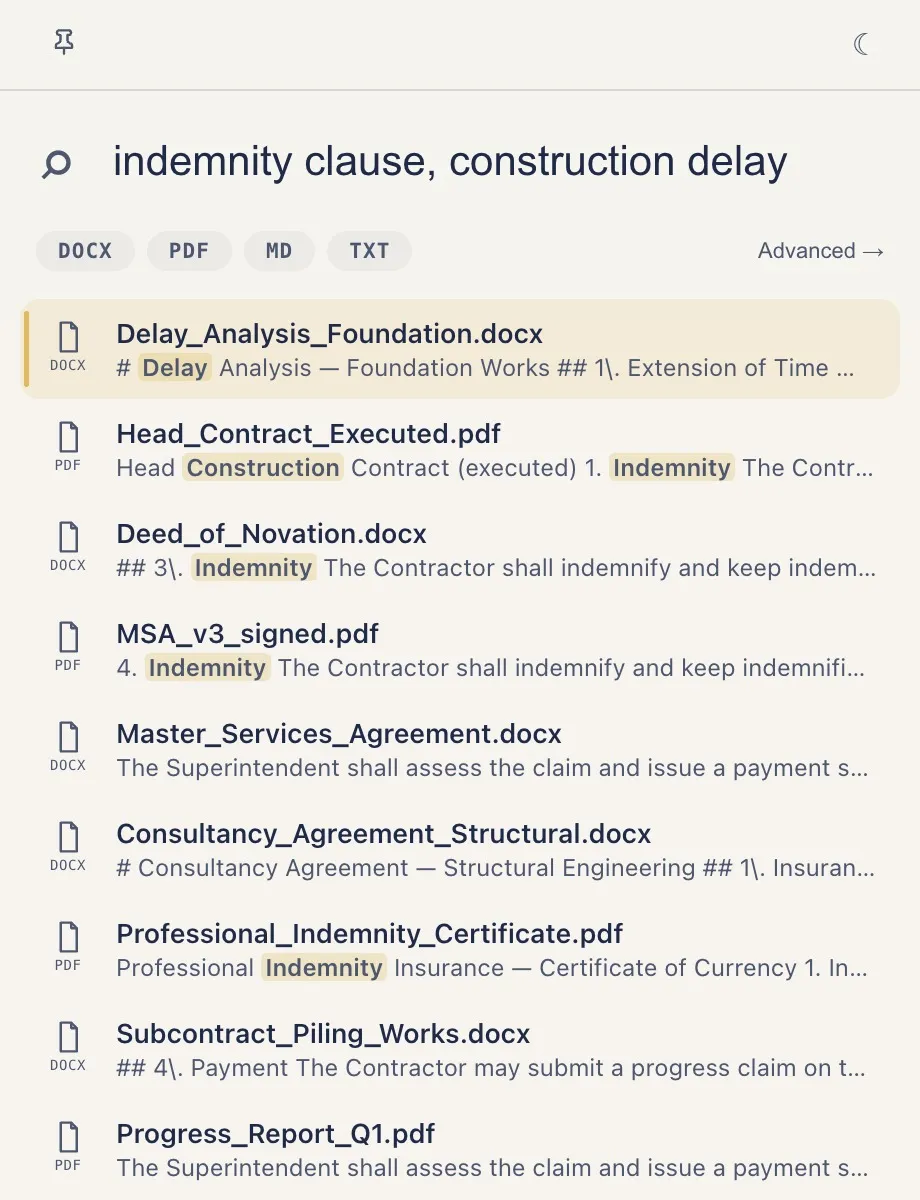
This is where Fossick, a desktop app that searches your local documents by meaning and runs entirely offline, fits in. You point it at your folders once; it indexes the contents — including running OCR on scanned PDFs and images automatically — and then you can search across thousands of files at once by typing what you remember.
A few things worth being clear about:
- Fossick is search, not chat. There is no chatbot, no generated answers, and no summaries. It finds the real documents and shows you where the match is.
- It handles both styles. If you know the exact word, it finds it; if you only remember the gist, meaning-based search fills the gap.
- It works across your whole document set, not just the file that happens to be open.
If your usual problem is not remembering a word but not remembering which file holds it, how to find a document you can't remember the name of is a good companion read.
Keeping confidential documents private while you search
For anyone handling sensitive material — contracts, client records, case files, financial statements — where the search happens matters as much as how well it works.
Many cloud search and AI tools require you to upload your files to a server before you can search them. For confidential work, that is often a non-starter.
Fossick takes the opposite approach. Indexing, text extraction, OCR, and search all run on your own device. Your documents are never uploaded — the app keeps working with the Wi-Fi unplugged, which is the simplest proof that nothing is leaving your machine. Only licensing touches the internet. You can download it and install it on Windows or Mac.
It is a one-time purchase of US$14.99 — no subscription and no recurring charge — with a 14-day money-back guarantee, and details are on the pricing page. For the wider case for keeping search local, see private document search.
Frequently asked questions
What is the keyboard shortcut to search a document for a word?
Press Ctrl+F on Windows or Cmd+F on Mac to open the Find box in almost any app or browser. Type the word, press Enter to jump to the first match, and keep pressing Enter to move through the rest.
Why can't I find a word I can see in a PDF?
The PDF is probably a scan or photo, which stores the page as an image with no selectable text. Regular Find has nothing to match. Running OCR extracts the text so you can search it; tools like Fossick do this automatically on your device.
How do I search for a word across many documents at once?
The built-in Find command only searches the file that is open. To search a whole folder or drive, use a desktop search tool that indexes your documents. Fossick searches across thousands of local files at once and can match by exact word or by meaning.
What if I can't remember the exact word in the document?
Exact-match search fails when you misremember the wording or the author used a synonym. Semantic search understands meaning, so a search for one phrase can surface a document that expresses the same idea in different words.
Do I have to upload my documents to search them?
No. Built-in Find works offline, and on-device tools like Fossick index and search entirely on your own computer, so your files are never uploaded. That keeps confidential documents private while you search.