How to Word Search a Document: Fast Ways to Find Any Word or Phrase
You know a specific word or phrase is buried somewhere in a document, but scrolling through pages to find it wastes minutes you don't have. The good news: every major document app has a built-in way to word search a document in seconds — and there are faster methods when you need to search across dozens or hundreds of files at once.
This guide covers the basic find tools in Word, PDF readers, and browsers, then shows how to go beyond exact matches so you can locate a word and the ideas around it, even when you don't remember which file it lives in.
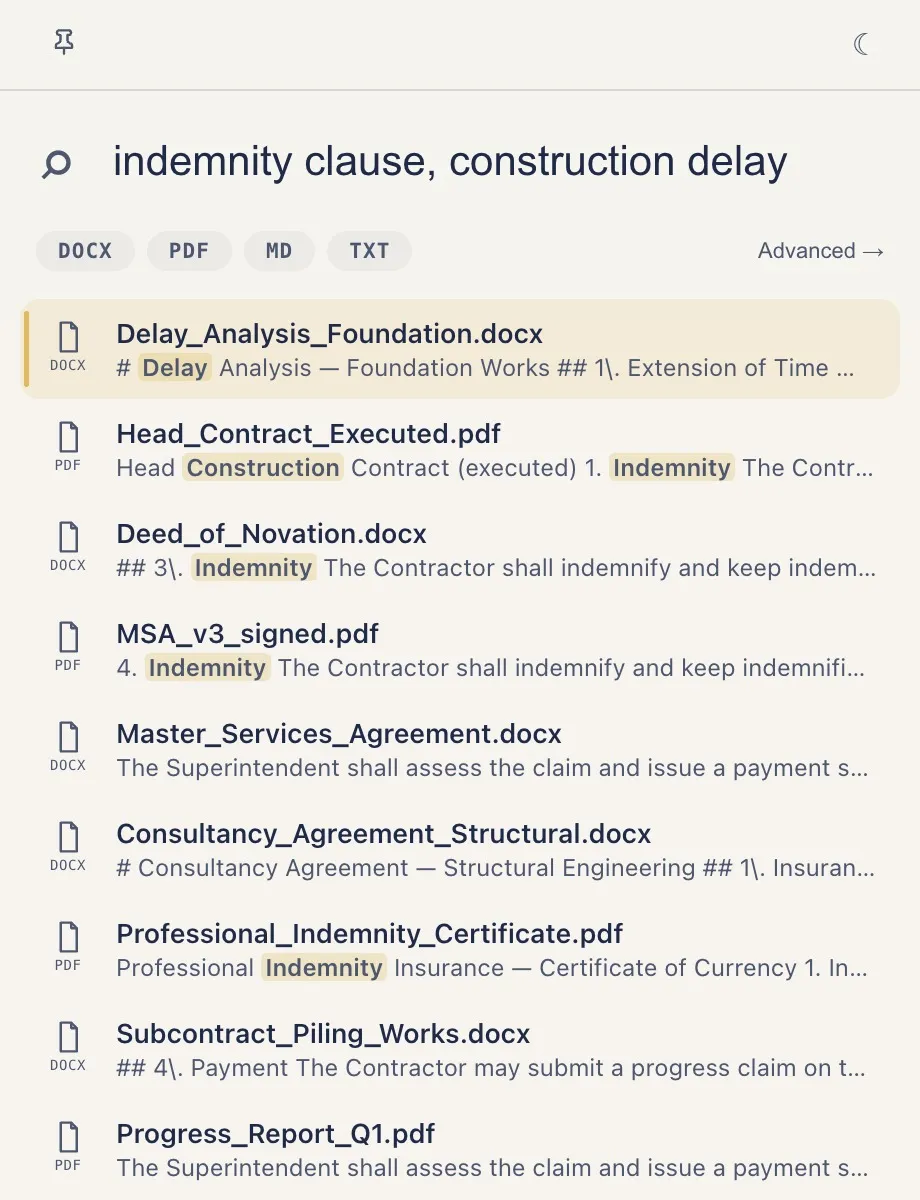
The fastest way to word search a single document
When the word you want is inside one open file, the built-in Find tool is all you need. It highlights every match and lets you jump between them.
In Microsoft Word
- Press Ctrl+F (Windows) or Cmd+F (Mac) to open the Navigation pane.
- Type the word or phrase.
- Word lists every match and highlights it in the document; use the arrows to step through results.
For more control — matching whole words only, or matching case — open Find and Replace with Ctrl+H and expand the search options. Our guide to searching a Word document covers these settings in detail.
In a PDF reader
Adobe Acrobat, Preview on Mac, and most browsers use the same shortcut. Press Ctrl+F / Cmd+F, type your term, and press Enter to move between hits. For a full walkthrough, see how to search in a PDF.
In a web page or browser
Any page open in Chrome, Edge, Safari, or Firefox responds to Ctrl+F / Cmd+F with an inline find bar that counts matches as you type.
Where basic word search falls short
The built-in Find tool is excellent for one document, but it has real limits the moment your search gets bigger or fuzzier.
- It only searches the open file. If you don't know which of your documents contains the word, Find can't help — you'd have to open each file and search it one at a time.
- It matches characters, not meaning. Searching for termination won't surface a document that says ending the agreement or notice to quit, even though they cover the same thing.
- It ignores scanned pages. A PDF that is really a photo of a page has no selectable text, so Find returns nothing — the words are locked inside an image.
- Spelling and phrasing have to match. Type organisation and you may miss organization; type an exact phrase and a slightly different wording slips through.
For a single, well-formatted file these limits rarely bite. For a folder of contracts, a research library, or years of client records, they turn a quick lookup into a slow manual hunt.
How to word search across many documents at once
When the word could be in any of hundreds of files, you need a tool that indexes the contents of every document up front, so a search checks all of them instantly.
Desktop search tools do this by building an index — a map of which words appear in which files. Once indexed, searching a whole folder is as fast as searching one page. This is the difference between opening 200 PDFs by hand and getting a ranked list in under a second.
The catch with older desktop search tools is that many only do exact keyword matching, and some quietly send your queries or files to the cloud. If you handle confidential material, that trade-off matters. Our piece on searching across thousands of files goes deeper on scaling search beyond a single document.
Finding a word AND its meaning: semantic search
Exact word search answers where does this literal word appear? Semantic search answers a more useful question: which documents are about this idea, however they phrase it?
Semantic search represents the meaning of your query and your documents as numbers, then finds the closest matches. In practice that means:
- Searching remote work policy also surfaces a file titled work-from-home guidelines.
- Searching late payment penalty finds a contract clause worded interest on overdue invoices.
- You can type what you remember about a document rather than the exact word it uses.
This doesn't replace exact word search — sometimes you truly need that one literal term. The best approach combines both: match the exact word when you know it, and fall back on meaning when you don't. We compare the two approaches in semantic search vs keyword search.
Searching words inside scanned PDFs and images
A large share of real-world documents — signed contracts, receipts, older records, screenshots — are images, not text. A normal word search finds nothing in them because there are no characters to match, only pixels.
The fix is OCR (optical character recognition), which reads the text out of an image so it becomes searchable. A capable desktop search tool runs OCR automatically as it indexes, so scanned PDFs and image files (PNG, JPG, and more) become just as searchable as a typed document.
That means a word search can reach a term printed inside a scanned page or captured in a screenshot. For the specifics, see how to search scanned PDFs and images with OCR and how to search text inside images.
Doing all of this privately, on your own device
Many search and AI tools require uploading your files to a server before they can search them. For anyone handling privileged, regulated, or commercially sensitive documents, that is a non-starter.
Fossick is a desktop app for Windows and Mac that searches your local documents by both exact words and meaning — entirely offline. Indexing, OCR, and search all run on your own machine. Your files are never uploaded; you can pull the Wi-Fi plug and it still works.
A few things worth being clear about:
- It is search, not chat. Fossick finds and ranks your documents. It does not use generative AI, does not summarise, and does not answer questions in prose — it points you to the right file.
- It handles the formats you actually use. PDFs, Word documents, plain text, and more, including scanned PDFs and images via on-device OCR.
- It searches every file at once. Type what you remember and Fossick returns the matching documents across your whole indexed library, ranked by relevance.
You can download Fossick and try it during the beta. When you're ready to keep it, it's a single one-time purchase of US$14.99 — no subscription and no recurring charge — with a 14-day money-back guarantee, detailed on the pricing page.
Frequently asked questions
What is the keyboard shortcut to word search a document?
Press Ctrl+F on Windows or Cmd+F on Mac. This opens the find bar in Word, PDF readers, browsers, and most text editors, letting you type a word and jump between every match.
How do I search for a specific word across many documents at once?
The built-in Find tool only searches the file that's open. To search many files at once you need a desktop search tool that indexes document contents ahead of time. A tool like Fossick indexes a whole folder so a single query checks every file instantly, offline.
Why can't I find a word inside a scanned PDF?
A scanned PDF is usually an image of a page, so it contains no selectable text for a normal word search to match. You need OCR to read the text out of the image first. Fossick runs OCR automatically as it indexes, making scanned PDFs and images searchable.
What's the difference between word search and semantic search?
Word search finds the exact characters you type, so it misses synonyms and different phrasing. Semantic search finds documents by meaning, so a search for one term also surfaces files that express the same idea in other words. Combining both lets you match an exact word when you know it and search by meaning when you don't.
Does searching my documents mean uploading them to the cloud?
Not with an on-device tool. Fossick performs indexing, OCR, and search entirely on your own computer, so your documents never leave your device. It works with the internet disconnected, which matters for confidential or regulated files.