How to Search Inside a Document: A Complete Guide to Finding Text Fast
Everyone hits the same wall eventually: you know the information is somewhere in a document, but scrolling through pages to find it wastes minutes you don't have. Knowing how to search in a document properly turns that hunt into a two-second task.
This guide walks through the practical methods, from the built-in Find box in Word and your PDF reader to searching across a whole folder at once. It also covers a newer approach—searching by meaning—for the times you remember what a document said but not the exact words it used.
The fastest way: Find (Ctrl+F / Cmd+F)
For a single document that's already open, the built-in Find feature is the quickest option and it's identical almost everywhere.
- Open the document in its usual app (Word, your browser, a PDF reader, Notepad).
- Press Ctrl+F on Windows or Cmd+F on a Mac.
- Type the word or phrase you're looking for.
- Use the arrows or press Enter to jump between matches; the total count is usually shown.
This works in Microsoft Word, Google Docs, Adobe Acrobat, Preview on Mac, and every major web browser. It's ideal when you know roughly what the text says and you only need to look inside one file.
For a step-by-step walkthrough of specific apps, see our guides on how to search a Word document and how to search in a PDF.
Searching a PDF—including scanned pages
Text-based PDFs behave just like Word documents: Ctrl+F or Cmd+F finds any word or phrase instantly.
The trouble starts with scanned PDFs and photographed pages. A scan is really an image of text, so there are no characters for Find to match. Pressing Ctrl+F returns nothing even though the words are plainly visible on screen.
The fix is OCR (optical character recognition), which reads the picture and converts it into searchable text. Some PDF editors offer OCR as a manual step. If you regularly deal with scanned contracts, receipts, or old reports, an automatic approach saves a lot of time—our guide on searching scanned PDFs and images with OCR explains how this works locally.
When one document isn't enough: searching across files
The Find box only looks inside the document that's open. But most real questions span many files: Which of my 400 PDFs mentioned the indemnity clause? Where did I write down that pricing figure?
Opening each file and pressing Ctrl+F is not a plan. You need a tool that indexes a whole folder and searches every document at once.
- Windows Search and Mac Spotlight can index file contents, but results are often patchy and they struggle with document bodies rather than filenames.
- Dedicated desktop search apps build a proper index of your files and return matches across the entire collection.
If you've been frustrated by the built-in options, our comparisons of a Windows Search alternative and a Spotlight alternative for document contents cover what to expect, and the fastest way to search a folder of documents shows the workflow.
The limit of keyword search: it matches letters, not meaning
Every method above shares one weakness: it matches exact characters. Search for "terminate" and you won't find "cancel," "end the agreement," or "wind down." Search for "revenue" and you'll miss "turnover" and "top-line."
That's a problem because we rarely remember documents word-for-word. We remember the gist—the topic, the decision, the idea. Keyword search forces you to guess the precise phrasing the author used, then guess again when the first guess fails.
This is the gap between keyword search and semantic search. Keyword search asks "which files contain these exact letters?" Semantic search asks "which files are about this?" Our explainer on semantic search vs keyword search breaks down when each one wins.
Searching by meaning: type what you remember
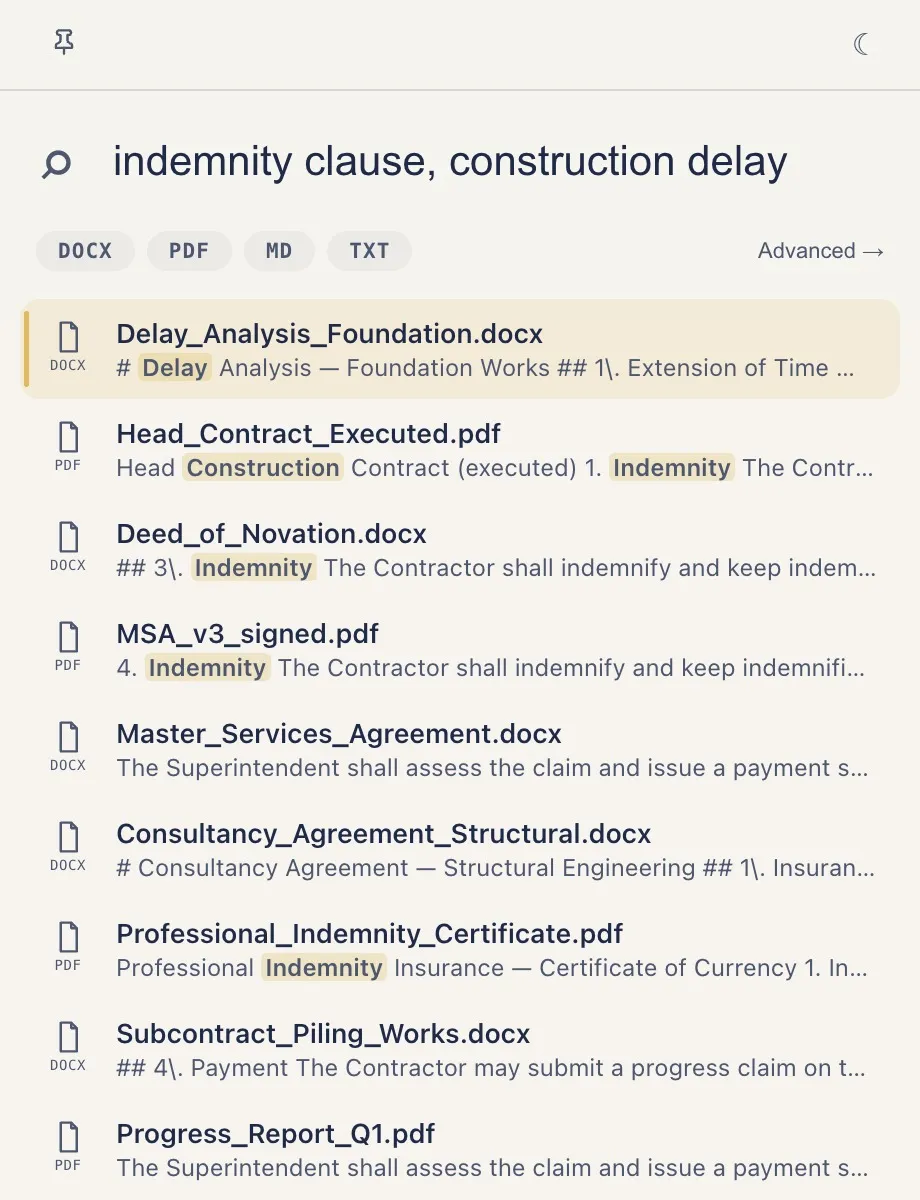
Semantic search works by understanding the concepts in your documents rather than just their spelling. Type a plain-language description of what you're after—"the memo about delaying the product launch"—and it surfaces the right file even if none of those exact words appear in it.
This is what Fossick does: it's a desktop app for Windows and Mac that searches your local documents by meaning, entirely offline. You point it at your folders, it indexes PDFs, Word files, text files, and more—running OCR on scanned pages and images automatically—and then you search with everyday phrasing.
A few things worth being clear about:
- It is search, not chat. Fossick finds and ranks your actual documents. There's no chatbot, no generated answers, and no summarising—it points you to the source so you read the real text.
- It runs 100% on your device. Indexing, the meaning analysis, and search all happen locally. Your files are never uploaded; only licensing checks touch the internet.
- You can still search by exact word when you want to—meaning-based search is an addition, not a replacement.
If you often find documents by topic long after you wrote them, our piece on searching documents by meaning, not filename goes deeper.
Why offline matters for confidential documents
If your documents are ordinary, uploading them to a cloud search or AI service is a convenience question. If they're client files, case notes, financial records, or engineering specs, it's a confidentiality question—and often a contractual or regulatory one.
Many cloud tools require you to upload the very files you're trying to protect. On-device search removes that risk entirely: the documents never leave your machine. The simplest proof is that a fully offline tool keeps working with the Wi-Fi unplugged.
That's the standard Fossick is built to. It's a one-time purchase of US$14.99 for the full app—every supported file type and future updates included, no subscription and no recurring charge, with a 14-day money-back guarantee. You can review the pricing details or download it and index a folder to see how meaning-based search feels on your own files.
For more on the privacy angle, see private document search and do you have to upload files to search them with AI?
Frequently asked questions
What is the keyboard shortcut to search in a document?
Press Ctrl+F on Windows or Cmd+F on a Mac to open the Find box in almost any app—Word, PDF readers, browsers, and text editors. Type your word or phrase and use the arrows or Enter to jump between matches. This searches only the document you currently have open.
Why can't I search text in my scanned PDF?
A scanned PDF is an image of a page, so there are no characters for Find to match—which is why Ctrl+F returns nothing. You need OCR (optical character recognition) to convert the picture into searchable text first. Tools that run OCR automatically, on-device, let you search scanned pages and photographed documents without a manual conversion step.
How do I search across many documents at once?
The Find box only looks inside one open file, so for a whole folder you need a desktop search tool that indexes your files. Windows Search and Mac Spotlight can do a basic job, while dedicated apps index the full text and return matches across your entire collection. A meaning-based tool goes further by finding relevant files even when they don't contain your exact words.
What's the difference between keyword search and semantic search?
Keyword search matches exact characters, so it only finds the literal words you type and misses synonyms or paraphrases. Semantic search understands concepts, so you can describe what a document is about and find it even if the wording differs. Semantic search is especially useful when you remember the idea but not the precise phrasing.
Is it safe to search confidential documents with search software?
It depends entirely on where the search happens. Cloud services often require you to upload your files, which may breach confidentiality obligations. An on-device tool like Fossick keeps everything local—indexing and search run on your machine and documents are never uploaded—so the files stay private, even offline.