A Simpler Recoll Alternative for Windows (and Mac)
Short answer: A good Recoll alternative for Windows is a desktop search tool that indexes your documents locally but needs less setup. Fossick is one option: it installs like a normal Windows or Mac app, runs OCR on scans automatically, and finds files by meaning rather than exact keywords, entirely offline. Recoll remains free and more configurable.
Free to try (1 folder, 200 files) · US$14.99 to keep · Mac & Windows
Recoll has a loyal following for good reason. It is free, open source, runs locally, and its keyword search is powerful once you have it tuned. But many people who try it on Windows or a Mac find the experience rougher than on Linux, where it originated: more configuration, more helper programs for certain file types, and a query style that rewards knowing the exact words in the document.
If you are searching for a Recoll alternative for Windows, this article explains what Recoll does well, where it tends to be fiddly, and how a meaning-based tool like Fossick compares. It is an honest comparison: for some readers, Recoll is still the right choice.
What Recoll does well
Recoll is a mature, free desktop search engine that builds a local full-text index of your files and lets you query it with a rich keyword syntax.
It belongs to the long tradition of desktop search tools that index files on your own computer, and it has real strengths:
- Free and open source. You can inspect it, modify it and use it without paying.
- Local indexing. Your index lives on your machine, not in someone's cloud.
- Powerful queries. Boolean operators, phrase search, field filters and wildcard-style matching give experienced users precise control.
- Broad format support, often extended through external helper programs.
For a technical user who knows exactly which terms appear in a document and enjoys tuning a tool, Recoll is hard to beat on price and flexibility.
Why Recoll can feel fiddly on Windows and Mac
The main friction with Recoll outside Linux is setup: getting every file type, OCR and indexing preferences working often takes manual configuration.
Recoll grew up on Linux, and its Windows and macOS versions carry some of that heritage. Common friction points people report include:
- Helper programs. Some document formats are handled by external filters that may need to be present and working before those files index properly.
- OCR is not automatic by default. Making scanned PDFs searchable typically means installing and configuring an OCR engine such as Tesseract, an open-source OCR engine, then enabling it.
- Configuration files and options. Choosing folders, skipped paths and indexing behaviour can involve settings that are more technical than a typical Windows or Mac user expects.
- Keyword-first results. Even when everything works, you need to guess the words the document actually uses.
None of this makes Recoll bad. It just means the total cost is measured in time rather than money, and for busy professionals that time is often the deciding factor.
Keyword search vs semantic search: the bigger difference
The deeper difference between Recoll and a semantic tool is not setup; it is that Recoll matches words while semantic search matches meaning.
Classic full-text engines work by building an inverted index of terms. As the SQLite FTS5 documentation describes, a query finds documents containing the matching tokens. Recoll's engine is more sophisticated than a basic index, with stemming and phrase handling, but the principle is the same: if you search for "termination notice" and the contract says "right to end the agreement on 30 days' written notice", a keyword search may miss it or bury it.
Semantic search aims to match the meaning and intent of a query rather than exact keywords. Text is converted into numeric vectors (embeddings), and documents whose vectors sit close to your query's vector are returned, even when they share few words.
In practice:
- Keyword search is ideal when you know an exact phrase, a case number, or a product code.
- Semantic search is ideal when you remember roughly what a document was about but not its filename or wording.
For a longer explanation, see semantic search vs keyword search for documents.
Fossick as a Recoll alternative for Windows and Mac
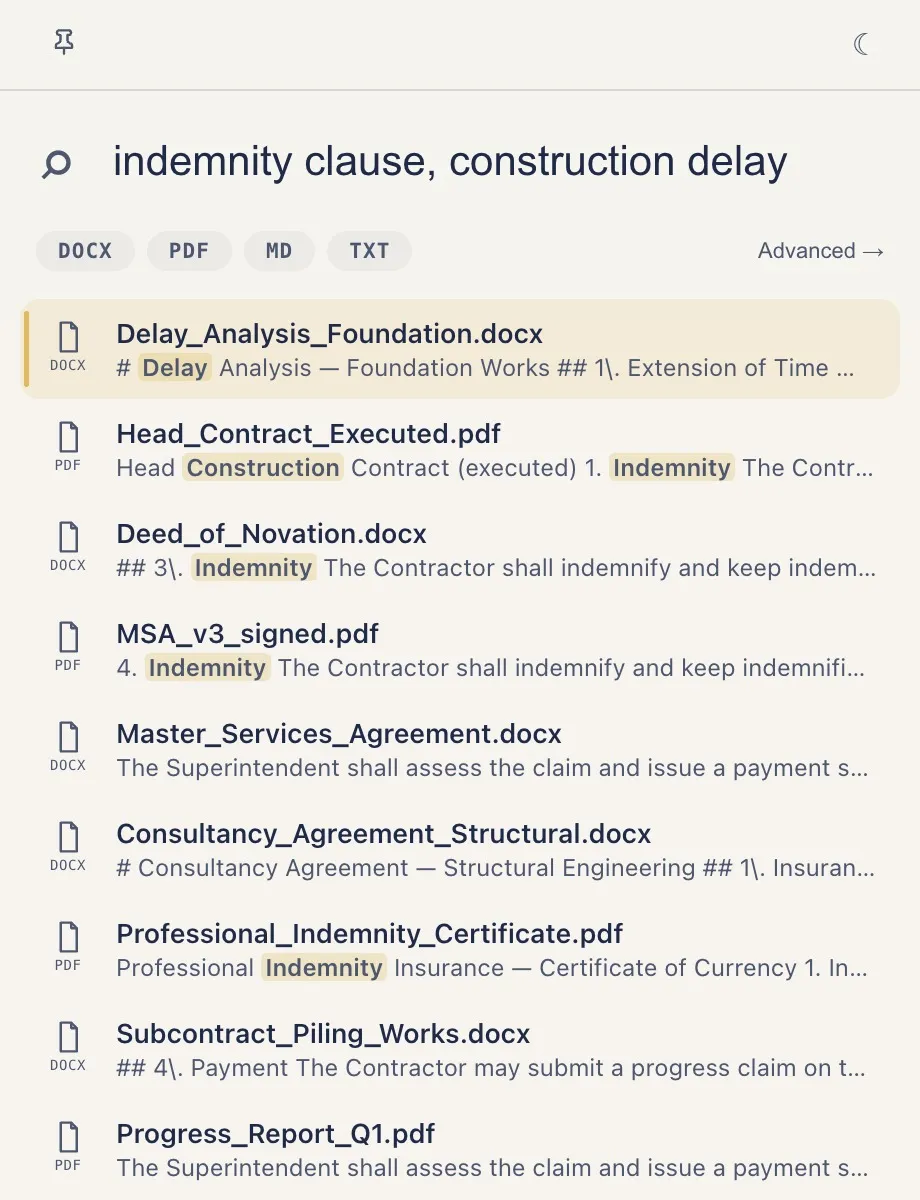
Fossick, a desktop app that searches your local documents by meaning entirely offline, is designed for people who want local search without the configuration work.
Here is what it does:
- Installs like a normal app on Windows or Mac. You download it, point it at your folders, and it builds an index.
- Searches by meaning. Type what you remember ("email about delaying the site inspection") and it finds the document.
- OCR is built in. Scanned PDFs and images (PNG, JPG) are made searchable automatically, on-device, with nothing extra to install.
- Wide file coverage: PDF, Word (.docx, .doc), Excel (.xlsx), PowerPoint (.pptx), OpenDocument text (.odt), plain text, Markdown, CSV, HTML, and email (.eml, .msg).
- Incremental re-indexing. Only new or changed files are re-processed.
Under the hood it uses the open all-MiniLM-L6-v2 sentence-embedding model: 384 dimensions, quantized, about 22 MB, running locally.
What Fossick is not
Fossick is search, not chat. There is no chatbot, no generative AI and no summaries. It shows you the documents; you read them. It also does not offer Recoll's advanced Boolean query language, so if that is central to your workflow, keep that in mind.
Privacy: both stay local, with different trade-offs
Recoll and Fossick both keep your documents on your own machine, which is why both appeal to people handling confidential files.
With Fossick, text extraction, OCR, embedding and search all run on the device. Documents are never uploaded, and it works with the Wi-Fi turned off; only licensing touches the internet. That makes it a very different proposition from cloud assistants or cloud drive search, where files are processed on a provider's servers.
Recoll's advantage here is that it is open source, so its behaviour can be audited directly. Fossick's advantage is that the offline behaviour is easy to verify without reading code: unplug the network and search still works.
For lawyers, accountants, consultants and engineers, either approach avoids sending client material to a third party. For more on this, see how to search confidential files without them leaving your PC.
Recoll vs Fossick vs Windows Search at a glance
The quickest way to choose is to match the tool to how you search and how much setup you will tolerate.
| Recoll | Fossick | Windows Search | |
|---|---|---|---|
| Cost | Free, open source | One-time purchase | Built into Windows |
| Search type | Keyword, advanced syntax | Semantic (by meaning) | Keyword and filenames |
| OCR for scans | Via configured OCR engine | Built in, on-device | Limited |
| Setup effort | Moderate to high | Low | Low |
| Runs offline | Yes | Yes | Yes |
On speed, measured figures for Fossick on an Apple M1 MacBook with 8 GB RAM (engine CLI, 2026-09-21): a 52-document mixed folder of about 700 KB, including scanned pages, indexed from scratch in about 81 seconds including model load and OCR; the resulting index was about 1.9 MB; re-checking the unchanged folder took about 7 seconds; and a semantic search took about 15-20 ms median.
On price, Fossick is a single one-time purchase of US$14.99 with all future updates and a 14-day money-back guarantee. There is no subscription. If you are also weighing Windows' built-in tool, see a Windows Search alternative that actually finds docs.
Which should you choose?
Stay with Recoll if you want free, open-source, highly configurable keyword search; choose Fossick if you want local search that works out of the box and finds documents by meaning.
Recoll is likely the better fit if:
- You want a free tool and are comfortable configuring it.
- You rely on Boolean queries, field filters or exact-phrase precision.
- Open-source auditability matters more to you than convenience.
Fossick is likely the better fit if:
- You often remember the idea of a document but not its wording or filename.
- You have scanned PDFs or images and want OCR without extra setup.
- You want a standard Windows or Mac app that stays fully offline.
Some people use both: keyword search for exact identifiers, semantic search for everything they only half remember. You can read more about the approach on the Fossick homepage.
Frequently asked questions
Is Recoll available for Windows?
Yes. Recoll has Windows and macOS versions as well as its original Linux version. Many users find setup on Windows and Mac more involved, particularly for OCR and certain file types that rely on helper programs.
Is there a free Recoll alternative for Windows?
Windows Search is built into Windows and can index file contents, though it is keyword-based and limited for scanned documents. Fossick has a free trial (1 folder, up to 200 files, no sign-up), and the full version is a one-time US$14.99 purchase with a 14-day money-back guarantee.
Does Fossick upload my documents to search them?
No. Text extraction, OCR, embedding and search all run on your device, and it works with Wi-Fi turned off. Only licensing touches the internet.
Can Fossick answer questions about my documents like a chatbot?
No. Fossick is search, not chat. It finds the documents that match what you mean and shows them to you; it has no generative AI and does not write summaries or answers.
Can Fossick search scanned PDFs the way Recoll does with Tesseract?
Yes, and without separate setup. Fossick runs OCR on scanned PDFs and images (PNG, JPG) automatically and on-device, so their text becomes searchable by meaning alongside your other files.