An Agent Ransack Alternative That Searches by Meaning
Short answer: If you need an Agent Ransack alternative that finds documents by meaning rather than exact text, use a local semantic search tool such as Fossick. Agent Ransack excels at exact strings and regular expressions. Semantic search matches paraphrases and synonyms instead, so you find a clause even when you cannot remember its wording.
Agent Ransack, and its paid sibling FileLocator, have earned a loyal following among Windows users. You type a string or a regular expression, point it at a folder, and it shows every line that matches. For log files, code and known phrases, that approach is hard to beat.
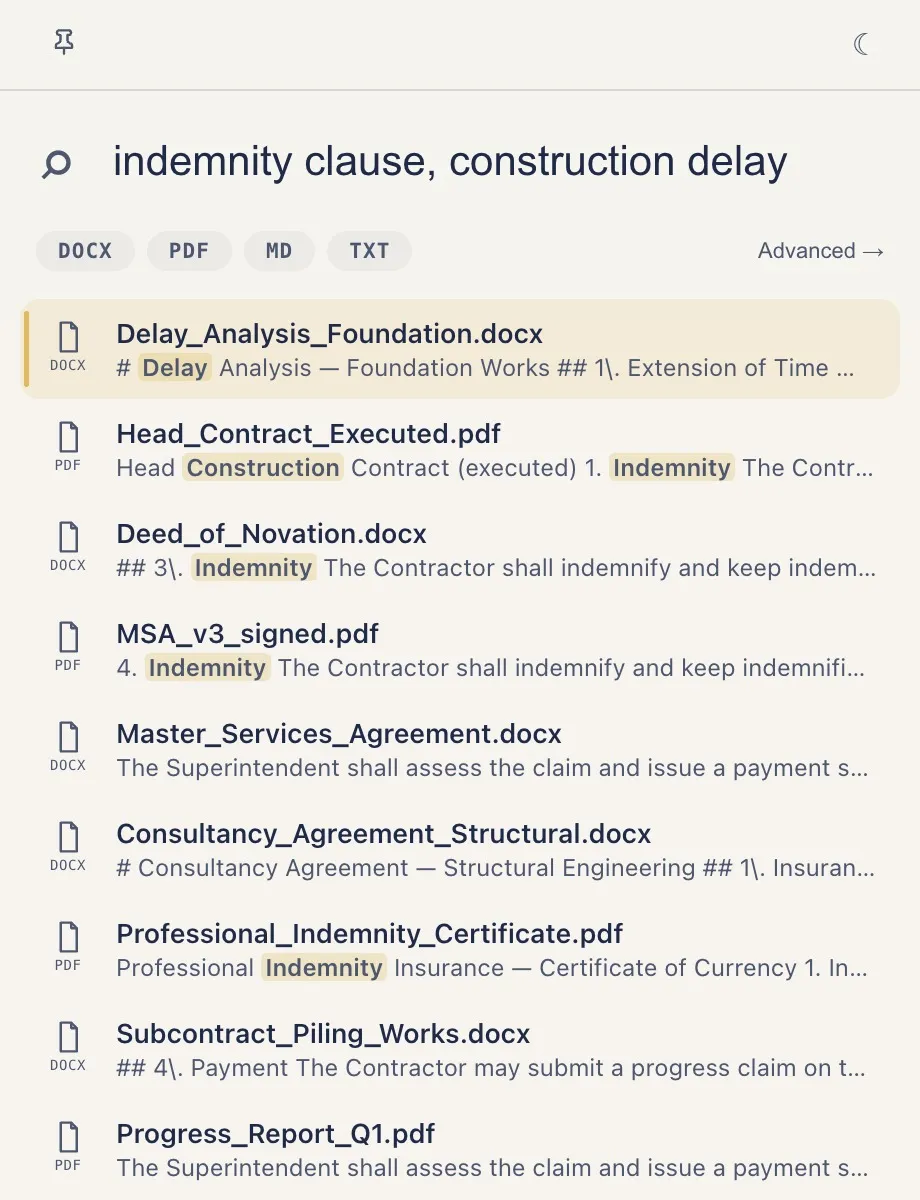
The trouble starts when you do not remember the exact words. A contract might say "either party may end this agreement on 30 days' written notice" while you search for "termination clause". This article covers what Agent Ransack does well, where exact matching breaks down, and when an Agent Ransack alternative such as Fossick fits better. Fossick is a desktop app for Windows and Mac that searches your local documents by meaning, entirely offline.
What Agent Ransack does well
Agent Ransack is a strong tool for finding exact text and patterns inside files on Windows, and it deserves credit for that.
It belongs to a long line of desktop search tools built to look inside files rather than only at filenames. Its main strengths:
- Regular expressions. You can search for invoice numbers, email addresses, date formats or error codes with a single pattern.
- Boolean and literal queries. Combine terms, exclude others, and match exact phrases.
- Line-level results. You see the matching line in context, which is ideal for logs, configuration files and source code.
- No setup. You point it at a folder and search, with no index to build first.
If you know the exact string you want, such as a part number or a defined term, a grep-style tool is precise and predictable. It either finds the string or it does not. Nothing about semantic search replaces that.
Where exact matching fails: synonyms and paraphrased clauses
Exact matching fails when the document uses different words from the ones in your memory, which happens often in professional writing.
Classic full-text engines, including the kind described in the SQLite FTS5 documentation, work by matching terms. Regex tools go further with patterns, but the principle is the same: the characters must be there. Some common cases where that breaks:
- Legal drafting. You search "non-compete". The agreement says "shall not engage in any competing business within the territory".
- Consulting decks. You remember "the pricing recommendation for the retail client". The slide says "proposed tariff restructure, consumer segment".
- Engineering specs. You search "maximum operating temperature". The spec says "rated for continuous use up to 85 °C".
- Research notes. You remember the idea of a finding but not the author's terminology.
With Agent Ransack you can work around this by guessing synonyms and chaining them with OR or regex alternation. That works when you can predict the vocabulary. It gets slow when you can't, and it can't help when you only remember the gist. For more on this distinction, see semantic search vs keyword search.
How semantic search finds what grep misses
Semantic search turns both your query and your documents into numerical representations of meaning, then returns the passages closest in meaning. It does not look for matching characters.
Semantic search aims to match intent rather than exact keywords. The technique behind most modern implementations is sentence embeddings, described in the Sentence-BERT paper. Text with similar meaning ends up close together in vector space, so "end this agreement on notice" sits near "termination clause" even though they share no words.
Fossick applies this to your own files, on your own machine:
- It uses the all-MiniLM-L6-v2 sentence-embedding model (384 dimensions, quantized, about 22 MB), which runs locally.
- Text extraction, OCR, embedding and search all happen on the device. It works with the Wi-Fi off. Only licensing touches the internet.
- It handles PDF, Word (.docx, .doc), Excel (.xlsx), PowerPoint (.pptx), .odt, plain text, Markdown, CSV, HTML, email (.eml, .msg) and images (PNG, JPG).
- Scanned PDFs and images are made searchable with on-device OCR.
It is important to be clear about what Fossick is not. It has no chatbot, no generative AI and no summaries. You type what you remember, and it shows you the documents and passages that match. You then open the file and read it yourself.
Agent Ransack vs Fossick at a glance
The short answer is that Agent Ransack matches text and Fossick matches meaning. Which one suits you depends on what you remember.
| Agent Ransack / FileLocator | Fossick | |
|---|---|---|
| Search type | Exact text, wildcards, regex | Semantic (by meaning) |
| Best query | A known string or pattern | What you remember, in your own words |
| Platforms | Windows | Windows and Mac |
| Scanned PDFs/images | Depends on edition and setup | On-device OCR, automatic |
| Where it runs | Locally | 100% locally, works offline |
On speed, the two work differently. A grep-style tool reads files at search time. Fossick builds an index first and then queries it. In a measured test on an Apple M1 MacBook with 8 GB RAM (engine CLI, September 2026), a 52-document mixed folder of Word, PDF including scanned pages, Excel, CSV and Markdown was indexed from scratch in about 81 seconds, including model load and OCR. Semantic searches then took about 15-20 ms median each. Re-checking the unchanged folder took about 7 seconds, because re-indexing is incremental and only new or changed files are processed. The index for that folder was about 1.9 MB on disk.
Privacy: both stay on your machine
Both Agent Ransack and Fossick search files locally, so neither requires uploading documents to a cloud service. That matters when you handle client or confidential material.
This matters because many "AI search" options do rely on the cloud. Cloud tools index your files on a provider's servers. For lawyers, accountants and consultants, that can raise questions about confidentiality, privilege and data-processing obligations.
Fossick was designed so that the semantic part, the embedding model, also runs on-device. You get meaning-based search without sending document text anywhere. You can check this yourself: disconnect from the network and search still works. For more detail, see how to search confidential files without them leaving your PC and on-device AI search, explained.
Which to use when, and why many people keep both
Use Agent Ransack when you know the exact string or pattern. Use semantic search when you only remember the idea. The two tools complement each other more than they compete.
Reach for a grep-style tool when
- You need a regex, such as all files containing a specific reference format.
- You are searching logs, code or configuration files.
- You must confirm that an exact phrase appears, or does not appear, anywhere.
Reach for semantic search when
- You remember what a document said but not how it was worded.
- Colleagues or counterparties use different terminology from yours.
- The file is a scan or photo, and you want it searchable without extra steps.
- You are on a Mac, or you move between Windows and Mac.
Fossick is a one-time purchase of US$14.99 that includes all future updates and a 14-day money-back guarantee. Details are on the pricing section. If you want to test it against your own "I know it's in here somewhere" folder, you can download Fossick and run the same query you would have tried in Agent Ransack.
Frequently asked questions
Is there an Agent Ransack alternative for Mac?
Agent Ransack is a Windows tool. Fossick runs on both Windows and Mac and searches document contents by meaning, entirely offline. On a Mac you can also use Spotlight for basic content search, though it is keyword-based.
Does Fossick support regular expressions like Agent Ransack?
Fossick is built for meaning-based semantic search, not regex pattern matching. If you need regular expressions for codes, logs or exact formats, a grep-style tool like Agent Ransack remains the right choice. Many people use both side by side.
Does Fossick upload my documents to find them by meaning?
No. Text extraction, OCR, embedding and search all run on your device, and documents are never uploaded. It works with Wi-Fi turned off. Only licensing touches the internet.
Can semantic search find scanned PDFs that grep tools miss?
A scanned PDF is an image, so it has no text to match until OCR converts it. Fossick runs OCR on scanned PDFs and images (PNG, JPG) automatically on-device, which makes them searchable by meaning alongside your other files.
Is Fossick an AI chatbot for my files?
No. Fossick is search, not chat. It has no generative AI, does not answer questions and does not summarise. It finds the documents and passages that match what you describe, and you read them yourself.