How to Search Encrypted or Sensitive Folders Without Exposing Them to the Cloud
Short answer: To search encrypted or sensitive folders without exposing them, use a search tool that indexes and searches entirely on your own device, and keep both the folder and its search index on an encrypted disk. Unlock the volume as usual and let the local tool read it. Nothing is uploaded to a cloud service for indexing or search.
Free to try (1 folder, 200 files) · US$14.99 to keep · Mac & Windows
Sensitive folders tend to be the hardest ones to search. Client files, HR records, audit workpapers and privileged correspondence are exactly what you need to find quickly, yet they are also what you are least willing to hand to a cloud indexer or an AI assistant.
This article explains how to search encrypted or sensitive folders while keeping them local. It covers the real data-flow difference between cloud and on-device tools, a practical setup that works with disk encryption, what a search index actually contains, and a short checklist for vetting any tool before it touches confidential material.
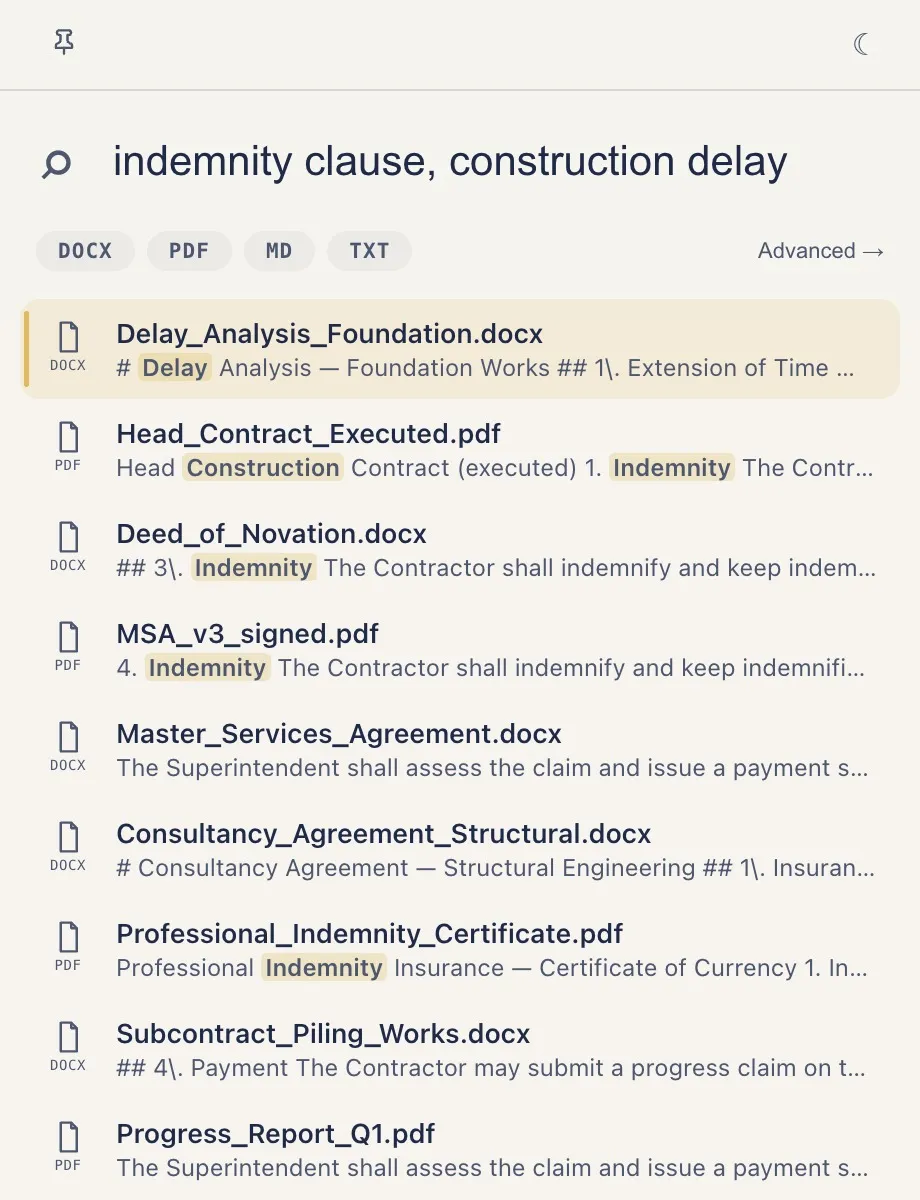
Why searching sensitive folders is a data-flow question
Whether a search tool is safe for sensitive folders depends mainly on where your document contents travel and where they are processed. Interface, speed and features matter less than that.
To make anything searchable, a tool has to read your files, extract their text, and build an index. Each of those steps either happens on your computer or on someone else's server. For a compliance-minded professional, that one distinction decides whether you are simply using software or sharing data with a third-party processor. Sharing with a processor can bring contractual, regulatory and professional-conduct obligations with it.
So before asking "how good is the search?", ask three questions:
- Where are the files stored while they are being searched?
- Where does text extraction and indexing run, including OCR on scanned pages?
- Where does the index live, and who else can read it?
If all three answers are "on my device", the search tool adds very little new exposure. If any answer is "in the provider's cloud", you need to treat the tool like any other vendor that handles client data.
Cloud vs local search: where your documents actually go
Cloud search tools process your document contents on the provider's infrastructure. Local tools do that work on your own hardware.
With a cloud drive, files are stored on the provider's servers and searched there. Google Drive's own help pages describe search over files held in your Drive account. AI assistants built into office suites work in a similar way. Microsoft's documentation on how Microsoft 365 Copilot processes organisational data describes access to and processing of content within the Microsoft cloud. Neither approach is inherently careless, but each puts your contents inside someone else's processing chain.
| Approach | Where files live | Where processing runs | Finds by meaning |
|---|---|---|---|
| Cloud drive search | Provider's servers | Provider's servers | Varies |
| Cloud AI assistant | Provider's cloud | Provider's cloud | Yes |
| Built-in OS search | Your device | Your device | No, keywords |
| Local semantic search | Your device | Your device | Yes |
Built-in OS search, such as Windows Search or Spotlight, is local, but it matches words rather than meaning, and its coverage of file contents depends on how indexing is configured. Local semantic search aims to combine the privacy of the third row with the recall of the second. For a deeper comparison, see Is It Safe to Search Documents With AI? On-Device vs Cloud.
How to search encrypted or sensitive folders locally, step by step
The reliable pattern has two parts: keep the data encrypted at rest, then search it with a tool that never sends contents off the machine.
- Encrypt the disk or volume. Full-disk encryption (BitLocker on Windows, FileVault on Mac) or an encrypted container protects the folder if a laptop is lost or stolen. NIST's guide to storage encryption for end-user devices is a good reference for choosing an approach.
- Unlock it the normal way. When you are signed in and the volume is mounted, the operating system decrypts files transparently for authorised apps. A local search tool reads them the same way your word processor does.
- Point a local search tool at the folder. For example, Fossick is a desktop app for Windows and Mac that searches your local documents by meaning, entirely offline. Text extraction, OCR, embedding and search all run on the device, and documents are never uploaded. Only licensing touches the internet.
- Keep the index on encrypted storage too. The index is derived from your documents. It belongs on the same protected disk as the files themselves (more on this below).
- Verify offline behaviour yourself. Disconnect Wi-Fi and run a search. If results still come back, contents are not being sent anywhere to compute them.
One caveat: individually password-protected files, such as a locked PDF or an encrypted ZIP, cannot be read by an indexer that does not have the password. Do not assume any search tool will cover them. Test with a sample file first.
What a local search index contains, and how to protect it
A search index is a compact, derived copy of what is in your documents, so treat it as sensitive data in its own right.
Classic keyword indexes, such as the SQLite FTS5 full-text engine, store terms and where they appear. Semantic indexes store numeric vectors (embeddings) that represent the meaning of passages, and often extracted text as well, so that results can be shown. Either way, someone who obtains the index can learn something about your files.
Practical safeguards:
- Store it on an encrypted disk. If your system drive uses full-disk encryption, an index on that drive is covered by it.
- Avoid synced locations. Do not let a cloud-sync client upload the index folder. That would undo the point of local search.
- Include it in retention decisions. When a matter closes and files are deleted, remove the folder from the search tool so its index entries go too.
Local indexes are usually small. In one measurement, Fossick's index for a 52-document mixed folder was about 1.9 MB on disk (measured 2026-09-21). That makes them easy to keep inside the same encrypted boundary as the source files.
Why meaning-based search matters most in sensitive archives
In confidential archives you usually remember what a document was about, not its exact words. Searching by meaning closes that gap without exposing the files.
You might recall "the letter where the client agreed to cap our liability", but the document actually says "aggregate exposure shall not exceed the fees paid". A keyword search for "liability cap" can miss it entirely. Semantic search converts both your query and each passage into vectors and compares them by similarity, so related wording still matches.
Fossick runs a small sentence-embedding model, all-MiniLM-L6-v2 (384 dimensions, quantized, about 22 MB), locally for this. Scanned PDFs and images are made searchable with on-device OCR, which matters because older sensitive records are often scans. Supported files include PDF, Word, Excel, PowerPoint, OpenDocument text, plain text, Markdown, CSV, HTML, email (.eml, .msg) and PNG/JPG images.
To be clear about scope, this is search, not chat. Fossick has no chatbot and no generative AI, and it does not write summaries. It returns the documents and passages that match what you typed, and you read them yourself. For many compliance teams that is a feature: there are no generated answers to verify and no model writing text about client matters.
A compliance checklist before trusting any search tool
Before pointing any search tool at sensitive folders, confirm where processing happens, what leaves the device, and how you would prove it.
- Processing location: Does indexing, OCR and querying run on the device, or is content sent to a server? Get this in writing from the vendor's documentation.
- Network test: Does the tool work fully with networking disabled? This is the simplest independent check you can run.
- Account requirements: Does it require a cloud account linked to your files? Local tools should not need one for searching.
- Index location: Where is the index stored, and is that location covered by disk encryption and excluded from sync?
- Scope control: Can you choose exactly which folders are indexed, and remove them later?
- Re-indexing behaviour: Incremental re-indexing (processing only new or changed files) keeps a large sensitive archive current without long rescans.
- Regulatory fit: Map the data flow against your obligations, such as GDPR processor rules, client confidentiality terms, or health-data safeguards, with your privacy or risk lead.
If you want to run this checklist against Fossick, you can download it for Windows or Mac and run the Wi-Fi-off test on a non-sensitive sample folder first. The free trial covers 1 folder of up to 200 files with no sign-up or card. The full app is a single one-time purchase, detailed on the pricing page.
Frequently asked questions
Can I search a BitLocker or FileVault encrypted folder?
Yes. When you are signed in and the encrypted volume is unlocked, the operating system decrypts files transparently for applications, so a local search tool can read and index them like any other folder. The protection still applies when the device is off or locked. Keep the search index on the same encrypted disk.
Is it safe to use cloud AI to search confidential documents?
It depends on your contracts, regulations and the provider's terms. Cloud AI tools process file contents on the provider's servers, which makes the provider part of your data chain. If you want to avoid that entirely, use an on-device tool where indexing and search run locally. See Do You Have to Upload Files to Search Them With AI? for more.
How can I confirm a search tool is really offline?
Turn off Wi-Fi and unplug any network cable, then index a test folder and run several searches. If indexing and results work normally, the tool is not relying on a server to process your documents. Fossick is designed to work this way; only licensing touches the internet.
Can a search tool read password-protected PDFs or encrypted ZIP files?
Generally not without the password, because the contents cannot be decrypted. Do not assume any indexer covers individually locked files. Test with a sample, and if those files need to be searchable, store them unlocked inside an encrypted volume instead.
Does Fossick summarise or answer questions about my files?
No. Fossick is semantic search, not chat. It finds the documents and passages that match the meaning of your query. It has no chatbot, no generative AI and no summaries, so you always read the source document yourself.