How to Search a Document for a Word: The Complete Offline Guide
You remember writing about something, but you can't find it. Maybe it was a clause in a contract, a figure in a report, or a paragraph you swear you saved somewhere. So how do you search a document for a word? The good news is that every major program has a built-in way to do it, and there are faster options when a single-file search isn't enough.
This guide covers the practical methods — from the humble keyboard shortcut to searching entire folders — and explains a newer approach: finding a document by what it means, not just the exact word you typed, entirely on your own machine.
The fastest way: Find within an open document
If the document is already open on screen, the quickest answer is the Find feature, built into nearly every program.
- Windows: press
Ctrl+F - Mac: press
Cmd+F
A small search box appears, usually in a corner. Type the word, press Enter, and the program jumps to the first match and highlights it. Press Enter again (or click the arrows) to move to the next occurrence.
This works in Microsoft Word, most PDF readers, web browsers, text editors, and email apps. In Word you can open a wider Navigation pane with Ctrl + F that lists every match in context. For a step-by-step walkthrough, see how to search a Word document.
Searching a PDF for a word
PDFs work the same way in most readers: open the file, press Ctrl + F or Cmd + F, and type the word. Adobe Acrobat, Preview on Mac, and Edge's built-in PDF viewer all support this.
There is one common catch. A PDF made from a photo or a scan is really just an image of text — there are no actual characters for the search to match. Press Find and you'll get zero results even though you can clearly see the word on the page.
The fix is OCR (optical character recognition), which reads the image and turns it into searchable text. Once a scan has been through OCR, Find works normally. More detail is in our guides to searching inside a PDF and searching scanned PDFs with OCR.
When Ctrl+F isn't enough
Find is perfect for one open document. It falls apart the moment you don't know which file the word is in.
If the word could be in any of hundreds of files across a folder, you'd have to open each one and search it individually. That's where built-in Find stops helping.
A few other limits show up quickly:
- Exact spelling only. Find matches the letters you type. Search for agreement and you'll miss agreements, contract, or terms.
- No sense of meaning. It can't connect car to vehicle or invoice to billing.
- One file at a time. No way to rank results across a whole document library.
When you need to search everything at once, you need a tool built for searching a folder of documents rather than a single file.
Searching many documents at once
To find a word across a whole folder, drive, or archive, you have two broad options.
Built-in desktop search
Windows Search and macOS Spotlight can index file contents and return matches from many files. They're free and already installed. In practice, though, they often index filenames and metadata more reliably than the deep text inside every PDF or Word doc, and they still rely on exact-keyword matching. If they've let you down before, our Windows Search alternative and Spotlight alternative articles explain why.
Dedicated search tools
Desktop search applications build a proper index of your files so you can search all of them in one query and see ranked results. The best of these can also read text inside images and scans automatically, and — importantly for confidential work — do it without sending your files anywhere.
Searching by meaning, not just the exact word
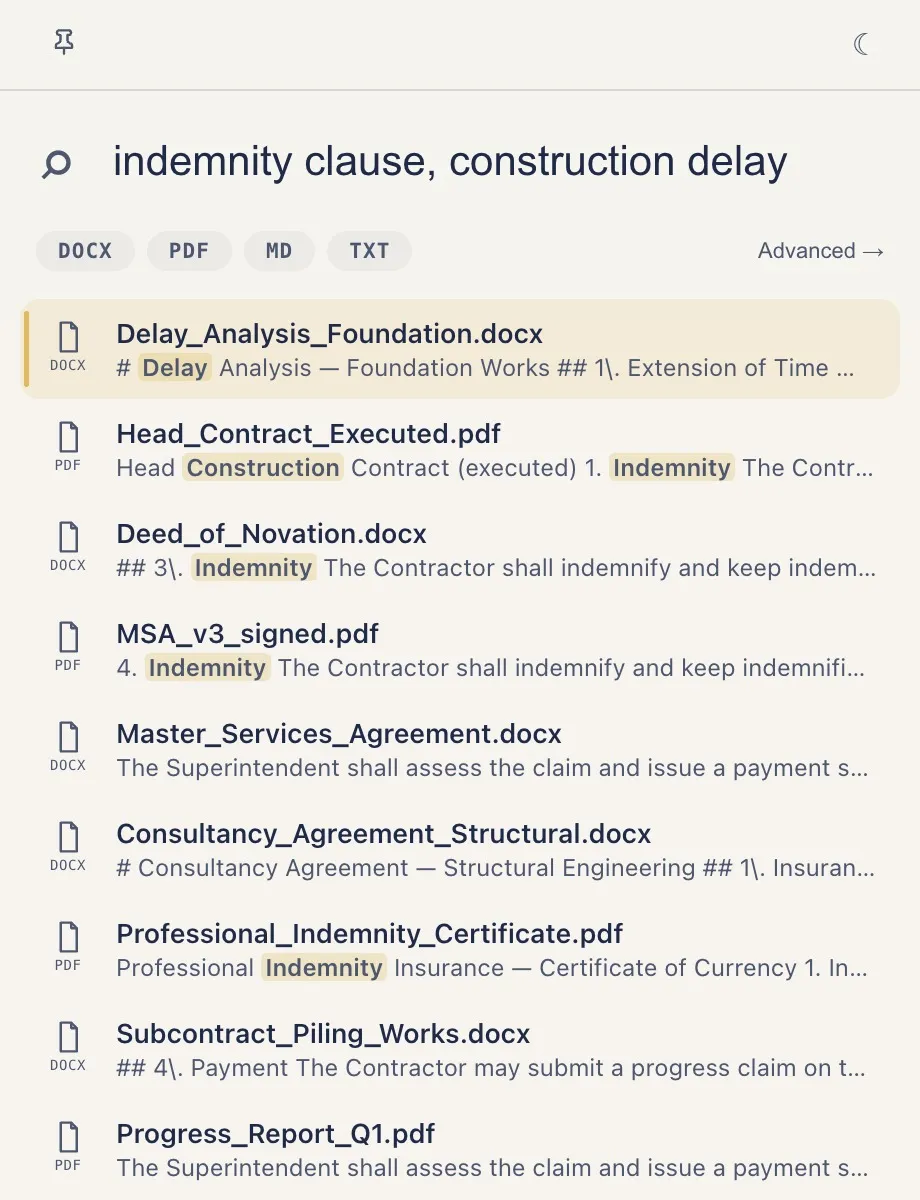
Sometimes the real problem isn't finding a word — it's that you don't remember the exact word. You recall the idea: "the memo about the delayed shipment penalty," or "the report that mentioned staff turnover."
This is where semantic search helps. Instead of matching letters, it matches meaning, so a search for staff turnover can surface a document that says employee attrition even if your exact phrase never appears. We compare the two approaches in semantic search vs keyword search.
Fossick is a desktop app that searches your local documents by meaning, entirely offline. You type what you remember; it finds the document. It's important to be clear about what it is and isn't: it's search, not chat. There's no chatbot, no generated summaries, and no answers written for you — just the actual files, ranked by relevance, so you decide what to open.
Fossick handles PDFs, Word documents, text files, and more, and runs OCR automatically on scanned PDFs and images, so photographed and scanned text becomes searchable without any extra steps.
Keeping the search private and offline
If your documents are confidential — contracts, client records, financials, research — where the search happens matters as much as how well it works.
Many cloud tools require you to upload files before they can search them. For a lawyer or accountant, that can be a non-starter. Fossick is built the opposite way: indexing, the meaning analysis (embedding), and search all run on your own device. Your documents are never uploaded. You can unplug the Wi-Fi, and search still works — that's the simplest proof that nothing is leaving your machine. Only licensing touches the internet.
It runs on Windows and Mac, and you can download it here. Fossick is a one-time purchase of US$14.99 — the full app, every file type, and all future updates, with a 14-day money-back guarantee; there's no subscription and no recurring charge. Details are on the pricing page. For confidential work, that combination of meaning-based search and staying local is the point.
Frequently asked questions
How do you search a document for a word on Windows?
Open the document and press Ctrl + F. Type the word into the search box that appears and press Enter to jump to the first match, then use the arrows or Enter to cycle through the rest. This works in Word, most PDF readers, browsers, and text editors.
What is the keyboard shortcut to find a word in a document on Mac?
Press Cmd + F inside almost any open document or app. A small Find field appears where you can type the word and step through every occurrence. It's the Mac equivalent of Ctrl + F on Windows.
Why can't I find a word in my scanned PDF?
A scanned PDF is an image of text, so there are no real characters for Find to match. You need OCR to convert the image into searchable text first. Some tools, including Fossick, run OCR automatically on scans and images so the words become searchable without extra steps.
How do I search for a word across many documents at once?
Built-in Find only works on one open file, so you need desktop search or a dedicated tool that indexes a whole folder. Windows Search and macOS Spotlight can help, and semantic tools like Fossick let you search every file at once and match by meaning, not just exact spelling — all offline on your device.
Can I find a document if I don't remember the exact word?
Yes, with semantic search. It matches the meaning of your query rather than the literal letters, so describing the idea — like "delayed shipment penalty" — can surface the right file even if it used different wording. This is what Fossick is built to do, entirely on your own machine.