How to Search a Document for a Word or Phrase (Offline, On-Device)
You know the word is in there somewhere. Maybe it's a client name, a clause, a part number, or a phrase you half-remember from a report you wrote months ago. The question is how to search a document for a word quickly — and, if the file is confidential, without sending it anywhere.
This guide covers two complementary methods: exact keyword matching (find the literal text you type) and semantic search (find the passage by what it means, even when you don't recall the exact wording). Both can run entirely on your own machine, so nothing about the process requires uploading your files or talking to a chatbot.
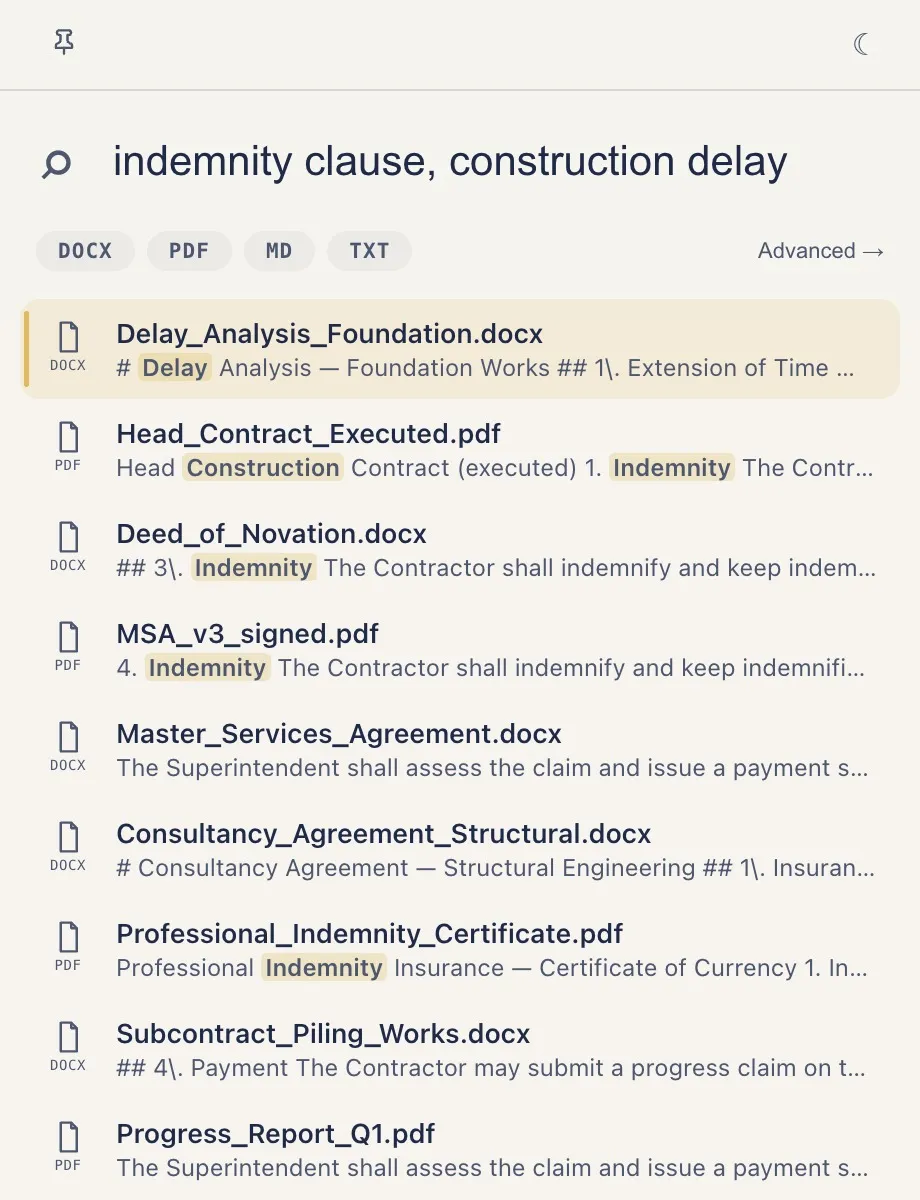
The fastest way to search a single open document
If the file is already open, the built-in Find command is the quickest path:
- Open the document in Word, Preview, Adobe Reader, a browser, or any text editor.
- Press Ctrl+F (Windows) or Cmd+F (Mac).
- Type the word or phrase and press Enter to jump to each match.
This is instant, private, and works offline in almost every application. For a phrase, type the exact words in order — most Find boxes match the literal string, so "termination for convenience" will only land on that exact sequence.
The catch: Find only searches the one file you have open. If you're not sure which document contains the word, or you have hundreds of them, you need something that searches across files. We cover that in how to search within a document as well.
When exact keyword matching breaks down
Literal search is precise, but precision cuts both ways. It only finds the exact characters you type, which fails in common situations:
- You misremember the wording. You search "cancellation clause" but the contract says "right to terminate." No match.
- Synonyms and phrasing vary. "Revenue" won't surface a page that only says "turnover" or "top-line."
- The document is scanned. A PDF that's really a photo of a page has no selectable text, so Find comes up empty.
- The word is spread across many files. You'd have to open and search each document one by one.
If you've ever known a file exists but couldn't find it because you typed the wrong keyword, this is why. Our breakdown of semantic search vs keyword search explains the trade-off in more detail.
Searching a document by meaning, not just letters
Semantic search solves the wording problem. Instead of matching exact characters, it matches meaning — so you can describe what you're looking for in plain language and still find the right passage.
Type "the part where we agreed to a 30-day exit" and a semantic tool can surface the paragraph about "either party may terminate on thirty days' written notice," even though almost none of your words appear in the text.
This is especially useful when:
- You remember the idea but not the phrasing.
- Different documents describe the same concept in different terms.
- You're searching a large folder and want the most relevant file first, not just every literal hit.
Semantic search doesn't replace exact matching — it complements it. When you know the precise term (a case number, a name), keyword search is perfect. When you only remember the gist, meaning-based search wins. Learn more about searching documents by meaning.
How to search scanned PDFs and images for a word
A large share of confidential documents are scans: signed contracts, receipts, filings, screenshots. To a computer these are pictures, not text, so no search can read them until they've been through OCR (optical character recognition), which converts the image of a word into actual, searchable text.
The key privacy question is where that OCR happens. Many online converters ask you to upload the file — a non-starter for anything sensitive. On-device OCR does the same job locally, without the file ever leaving your machine.
Once text has been extracted, both keyword and semantic search work normally across the recovered content. See how to search scanned PDFs and images locally with OCR for a step-by-step walkthrough.
Doing all of this offline with Fossick
Fossick is a desktop app for Windows and Mac that searches your local documents by meaning, entirely offline. You point it at your folders and it builds a private index on your own machine — indexing, OCR, and search all run on-device.
What that means in practice for searching a document for a word:
- Both methods in one place. Type an exact term for a literal match, or describe what you remember and let semantic search find it by meaning.
- Across every file at once. It searches thousands of PDFs, Word docs, text files, and more together, not one open file at a time.
- Scans included. OCR runs automatically on scanned PDFs and images, so text trapped in pictures becomes searchable.
- Nothing leaves your device. You can unplug the Wi-Fi and it still works — the proof that your files aren't being uploaded.
To be clear about what Fossick is not: it is search, not chat. There's no generative AI, no chatbot, and no assistant that summarises or answers questions. It finds and shows you the actual documents and passages, so you read the source yourself. If you want the reasoning behind that design, see on-device AI search, explained.
Choosing the right method for the job
A simple way to decide:
- One file already open, and you know the exact word? Use Ctrl+F / Cmd+F. Nothing beats it for speed.
- Not sure which file, or you misremember the wording? Use semantic search across your folders.
- The document is a scan or screenshot? Make sure OCR has run first, then search.
- Confidential material? Keep everything on-device — no uploads, no cloud account for your files.
Most professionals need all four at different moments. A local tool that combines exact and semantic search over your whole document set — including scans — covers every case without the privacy trade-off of web-based tools. Fossick is a one-time purchase of US$14.99 with a 14-day money-back guarantee — no subscription and no recurring charge; you can review pricing here or download it to try it on your own files.
Frequently asked questions
How do I search a document for a specific word?
If the file is open, press Ctrl+F (Windows) or Cmd+F (Mac), type the word, and press Enter to jump between matches. To search across many files at once, or when you don't remember which document contains the word, use a desktop search tool that indexes your folders.
What if I can't remember the exact word in the document?
Exact keyword search only matches the literal text you type, so misremembered wording returns nothing. Semantic search matches by meaning instead — you can describe the idea in plain language and it will surface the relevant passage even if your words don't appear in the file.
Can I search scanned PDFs or images for a word?
Yes, but only after OCR converts the picture of the text into actual searchable text. Choose a tool that runs OCR on-device so confidential scans never have to be uploaded. Fossick does this automatically when it indexes your files.
Is searching my documents online safe for confidential files?
Web-based search and conversion tools usually require uploading your file, which is a risk for privileged or sensitive material. An on-device tool keeps indexing and search on your own machine — Fossick works with the Wi-Fi unplugged, so your documents are never sent anywhere.
Does Fossick answer questions about my documents?
No. Fossick is search, not chat — there is no generative AI or chatbot. It finds and displays the actual documents and passages that match your query so you can read the original source yourself.