A Lookeen Alternative for Private Local Document Search
Short answer: A good Lookeen alternative for document-heavy work is an offline semantic search app such as Fossick, which finds local files by meaning rather than exact keywords, on Windows and Mac. Lookeen is strongest at Outlook email search. If your work lives mainly in PDFs, Word files and scans, a meaning-based document tool may fit better.
Free to try (1 folder, 200 files) · US$14.99 to keep · Mac & Windows
Lookeen has a loyal following, and for good reason: it is one of the better-known tools for searching Outlook mailboxes, attachments and files from one box on Windows. But not everyone searching for a Lookeen alternative has an email problem. Many professionals have a document problem. They have thousands of contracts, reports, specs and scanned letters, and they remember what a file said but not what it was called.
This article compares the two approaches fairly. It covers what Lookeen does well, where a meaning-based, fully offline document search tool is a better match, how the two differ on platforms and cost, and how to decide which one belongs on your machine.
What Lookeen does well
Lookeen's main strength is fast, filterable search across Outlook email and the files around it, which is exactly what inbox-heavy Windows users need.
If your day is spent in Outlook, those strengths are real:
- Email-first design. Lookeen is built to search messages, folders and attachments, and it integrates with Outlook rather than asking you to leave it.
- Filters for mail. Narrowing by sender, date or folder is often the quickest way to find a particular thread.
- Files in the same place. It also indexes documents on local and network drives, so mail and files can be searched together.
For someone whose key question is "which email had that attachment from the client in March?", an Outlook-centred tool is a reasonable fit. Being fair about this matters: if email is 80% of your search, a document-first tool will not replace it.
Why people look for a Lookeen alternative
Most people looking for a Lookeen alternative want better search across documents, work on a Mac, or prefer to avoid recurring software costs.
Common reasons include:
- Documents, not email, are the bottleneck. The hard searches are across years of PDFs, Word files and spreadsheets.
- You don't remember the exact words. Classic desktop search matches terms. As the SQLite FTS5 documentation shows, a full-text index finds documents containing the tokens you type. It doesn't know that "termination for convenience" and "either party may end the agreement" are about the same thing.
- Mixed platforms. Lookeen is built around Windows and Outlook. If you also use a Mac, you may want one tool on both.
- Scanned paperwork. Signed contracts, receipts and old letters are often images inside PDFs, which need OCR before any search can see them.
- Pricing model. Some buyers simply prefer paying once. Check Lookeen's current terms directly, as vendors change their licensing.
Fossick: offline, meaning-based search of local documents
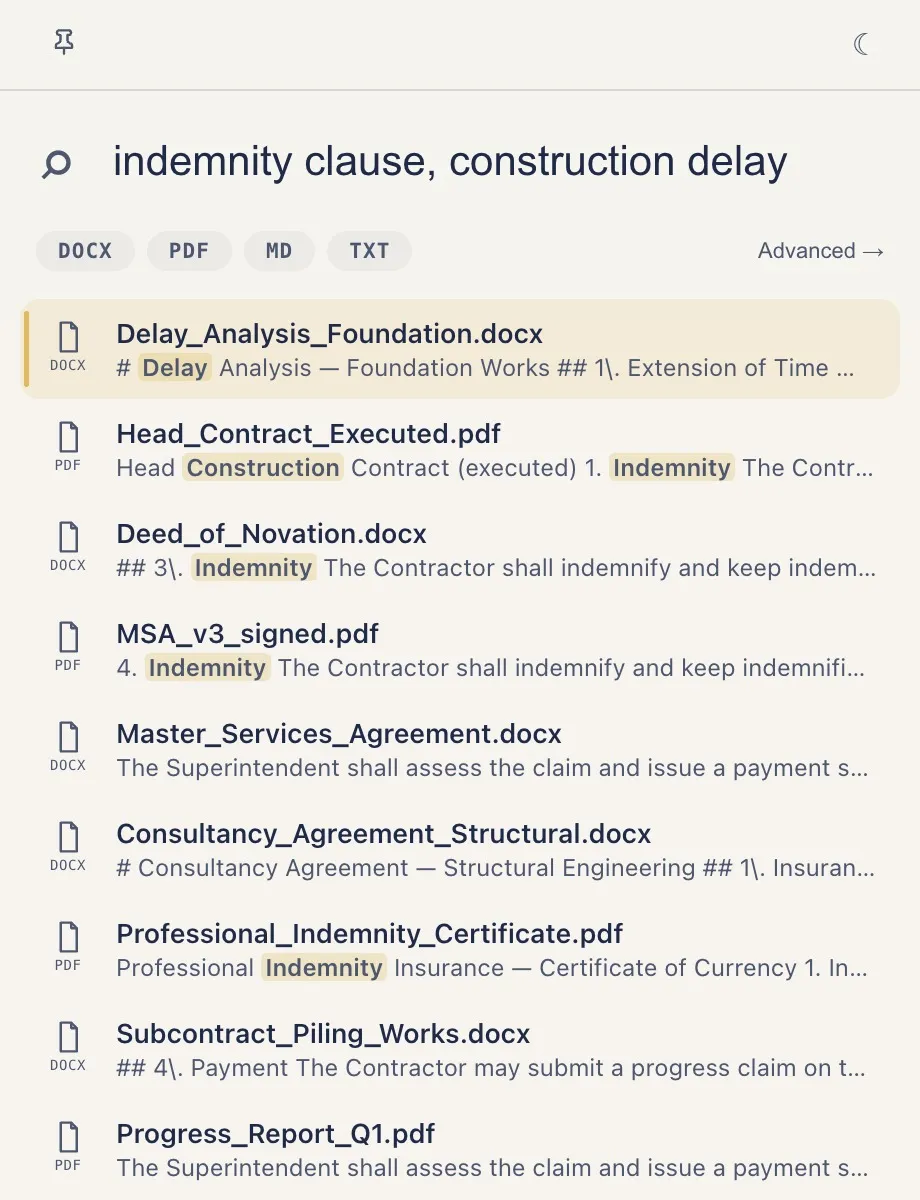
Fossick, a desktop app that searches your local documents by meaning entirely offline, is aimed at people whose problem is finding the right file rather than the right email.
You type what you remember, such as "the memo about moving the data centre to Frankfurt", and it returns the documents whose content is closest in meaning, even if they never use those words. This is semantic search: matching intent rather than exact keywords. Under the hood, Fossick uses sentence embeddings, the technique described in the Sentence-BERT paper, via the small open all-MiniLM-L6-v2 model (384 dimensions, about 22 MB quantized), running on your machine.
What it covers:
- File types: PDF, Word (.docx, .doc), Excel (.xlsx), PowerPoint (.pptx), OpenDocument text, plain text, Markdown, CSV, HTML, email files (.eml, .msg) and images (PNG, JPG).
- Scans: scanned PDFs and images are made searchable with on-device OCR, automatically.
- Incremental updates: only new or changed files are re-processed.
What it is not: it is not a chatbot. There is no generative AI, no summaries and no answers written for you. It shows you the documents, and you read them. More detail is on the Fossick homepage.
Lookeen vs Fossick at a glance
The short version: Lookeen is an Outlook-centred keyword search tool, while Fossick is a document-centred semantic search tool that runs offline on Windows and Mac.
| Lookeen | Fossick | |
|---|---|---|
| Main focus | Outlook email plus files | Local documents and scans |
| Search method | Keyword index with filters | Meaning-based (semantic) |
| Live Outlook mailbox | Yes, integrated | No; searches exported .eml/.msg files |
| Platforms | Windows | Windows and Mac |
| Scanned PDFs/images | Check vendor docs | On-device OCR, automatic |
The row that matters most depends on your work. If you need live mailbox search inside Outlook, Lookeen has the clear edge. If you need to find a contract clause you can only paraphrase, semantic search is the better tool. For a deeper look at the difference, see semantic search vs keyword search.
Privacy: where your documents are processed
With Fossick, text extraction, OCR, embedding and search all happen on your computer, and documents are never uploaded. It works with the Wi-Fi switched off.
That matters for lawyers, accountants, consultants and engineers bound by confidentiality obligations. There is no cloud account for your files and no third party processing their contents. The only thing that touches the internet is licensing. Unplugging the network and running a search is the simplest way to verify this yourself.
Lookeen's desktop product also indexes locally, so neither tool requires you to send files to a cloud AI service. The difference is less about local versus cloud and more about what kind of search you get locally: keyword matching around Outlook, or meaning-based search around documents. If you are weighing cloud AI tools too, our guide on whether it's safe to search documents with AI covers the trade-offs.
Performance and cost in practice
Fossick is light enough for an ordinary laptop, and it costs a single payment with no subscription.
Measured figures, from an Apple M1 MacBook with 8 GB RAM on a 52-document folder (Word, PDF including scanned pages, Excel, CSV, Markdown):
- First-time indexing: about 81 seconds from scratch, including model load and OCR.
- Re-checking an unchanged folder: about 7 seconds.
- Search speed: about 15-20 ms median per semantic search.
- Index size: about 1.9 MB on disk.
On cost, Fossick is a one-time purchase of US$14.99 that includes every file type and all future updates, with a 14-day money-back guarantee. There is no recurring charge. Full details are on the pricing page.
It is free to try with no sign-up or card, limited to 1 folder of up to 200 files, which is enough to test it on a real project folder. You can download it for Windows or Mac.
Which should you choose?
Choose Lookeen if your searching is mostly inside Outlook, and choose Fossick if it is mostly across documents you can describe but can't name.
A practical way to decide:
- List your last ten hard searches. Were they for emails or for files?
- Check your platforms. If you need the same tool on a Mac, that narrows things quickly.
- Test with real material. Point each tool at a folder you know well and search for something by paraphrase, not exact wording.
Some people run both: an Outlook tool for mail, and a semantic tool for the document archive. That is a perfectly sensible setup. Related comparisons include the X1 Search alternative and the Copernic Desktop Search alternative.
Frequently asked questions
Can Fossick search my Outlook email like Lookeen?
Not directly. Fossick does not connect to a live Outlook mailbox. It can search email files saved as .eml or .msg, so exported messages are searchable by meaning, but if you need integrated inbox search, an Outlook-focused tool is the better fit.
Does Fossick work on Mac?
Yes. Fossick is a desktop app for both Windows and Mac, and it runs the same offline indexing, OCR and semantic search on each.
Is Fossick an AI chatbot?
No. Fossick is search, not chat. It uses a small on-device embedding model to match your query to documents by meaning, but it doesn't generate text, summarise files or answer questions.
Will Fossick find text in scanned PDFs?
Yes. Scanned PDFs and images such as PNG and JPG are processed with on-device OCR automatically, so their text becomes searchable without anything being uploaded. See our guide to searching scanned PDFs for tips.
Does Fossick need an internet connection?
No. Indexing, OCR, embedding and search all run locally, and the app works with Wi-Fi turned off. Only licensing touches the internet.